What Is the CSS Exam and Why Does It Matter?
Every year, somewhere between 20,000 and 25,000 young Pakistanis sit down in examination halls across 21 cities and attempt one of the most demanding examinations in the country. Out of those 20,000 to 25,000 applicants, only 400 to 600 clear the written examination. Around 200 to 300 ultimately receive service allocation after the interview and medical stages. The overall CSS pass rate is approximately 2 to 3 percent annually.
That number — 2 to 3 percent — stops most people before they even start. But here is what that number actually means: out of every 100 people who sit the CSS, around 2 or 3 pass. That is a demanding filter. It is not an impossible one. The people who pass the CSS are not extraordinary geniuses with photographic memories. Most of them are ordinary graduates who made one decision that their peers did not: they started early, prepared strategically, and showed up consistently for 12 to 18 months. This guide is for everyone considering that decision — and everyone who has already made it. Here is everything you need to know about the CSS exam in 2026 before you begin.
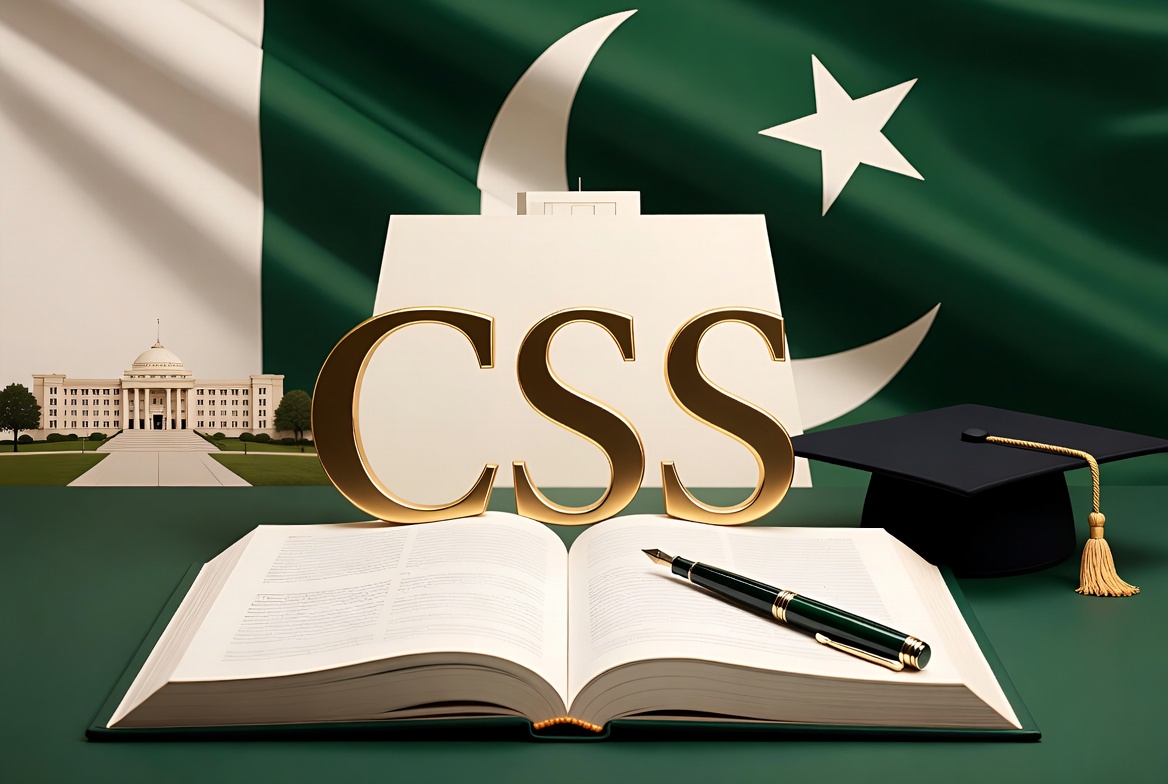
CSS stands for Central Superior Services. It is Pakistan's most prestigious government examination, conducted annually by the Federal Public Service Commission — FPSC. The CSS exam is Pakistan's most competitive recruitment examination for federal civil services. It is the only legal route to become a top-rank federal government officer at BPS-17. Once you enter, your future shifts toward administration, policy-making, law enforcement, diplomacy, or revenue control. When you pass CSS and are allocated a service, you become part of Pakistan's administrative machinery at the very top level. District Management Group officers govern districts. Foreign Service officers represent Pakistan abroad. Police Service officers command law enforcement. Income Tax and Customs groups manage revenue. The power, the respect, the career structure, and the long-term stability that come with these positions are why hundreds of thousands of Pakistanis spend years preparing for a single examination.
Who Can Apply? CSS Eligibility Requirements 2026
Before investing a single day in preparation, confirm that you actually meet the eligibility criteria. Many candidates discover a disqualifying factor only after months of preparation. The standard CSS age limit is 21 to 30 years, calculated as of 31st December of the year in which the examination is held. The CSS application fee is approximately Rs 2,000 for general candidates. Candidates must hold a Bachelor's degree issued by an HEC-registered university.
Three points on eligibility that cause the most confusion: Your degree subject does not matter. Engineers, doctors, economists, arts graduates, and commerce graduates all sit the same CSS examination and compete on the same ground. Engineers, doctors, business graduates, and arts students all compete on the same playing field. What matters is your preparation, not your undergraduate major. Age relaxation exists for specific categories. A two-year age relaxation is available for specific categories as defined by the FPSC. These include candidates from scheduled castes, minorities, tribal areas, and certain other groups. Check the FPSC website at fpsc.gov.pk for the complete list. You have exactly three attempts. There are only three chances for candidates to appear in CSS exams. No candidate can appear more than three times. This makes each attempt precious. Do not sit the exam until your preparation is genuinely ready — using an attempt before you are prepared costs you one of only three chances.
The Complete CSS Exam Structure: 1,200 Marks Explained
The CSS syllabus 2026 covers 12 papers carrying 1,200 marks in total. Six compulsory subjects — English Essay, English Precis and Composition, General Science and Ability, Current Affairs, Pakistan Affairs, and Islamic Studies — account for 600 marks. The remaining 600 marks come from optional subjects selected across seven subject groups. Beyond the written examination, there is a third critical component. In addition to the written exam, candidates must appear for the viva voce — the interview — which is worth 300 marks. The viva voce happens after the written examination for candidates who clear the written stage. It is conducted by a panel of senior civil servants and assesses your personality, communication, general awareness, and suitability for public service.
The total marks picture therefore is: Written examination: 1,200 marks. Viva voce (interview): 300 marks. Total: 1,500 marks. Any candidate who fails to score at least 40% in the compulsory subjects, 33% in the optional subjects, and 50% overall shall be considered to have failed the written examination and be ineligible for medical examinations, psychological assessments, and viva voces.
The 6 Compulsory Subjects — What They Cover
Every CSS candidate attempts these six subjects, regardless of background or optional subject choices. They form the foundation of the written examination.
English Essay (100 marks): One essay from a choice of topics. This is statistically the paper with the highest failure rate in CSS. Most candidates fail not because they lack knowledge but because they cannot write a structured, analytical, well-argued essay of 2,500 to 3,000 words under exam conditions. For English Essay: read editorials from Dawn and The Express Tribune daily and practice essay writing regularly. Analyse essays written by CSS toppers and understand how they structure arguments. There is no shortcut here — you improve by writing, not by reading about writing.
English Precis and Composition (100 marks): Précis writing — condensing a passage to one-third its length while retaining all essential points — is a skill most Pakistani graduates have never formally practised. Practice this weekly from your first month of preparation. Solve previous CSS papers and practise precis writing from the start of your preparation.
General Science and Ability (100 marks): Covers basic scientific concepts, everyday science, reasoning, and mental ability questions. Cover basic science topics, practise reasoning questions, and solve MCQs consistently throughout your preparation.
Current Affairs (100 marks): Covers national and international events of the past year. This paper rewards candidates who read seriously and consistently throughout their preparation rather than cramming at the end. A candidate who reads Dawn daily for 12 months will have a significant advantage over someone who relies on current affairs digests alone.
Pakistan Affairs (100 marks): Pakistan's history, geography, political structure, constitutional framework, economic policy, and foreign relations. Given Pakistan's extraordinary year in 2025–2026 — the India-Pakistan conflict, the US-Iran mediation role, the IMF programme, 5G launch — current affairs and Pakistan affairs overlap heavily this cycle.
Islamic Studies / Comparative Religion (100 marks): For Muslim candidates, Islamic Studies covers principles of Islam, Islamic history, and ethics. Non-Muslim candidates may opt for Comparative Religion instead.
Choosing Optional Subjects — The Most Important Strategic Decision
This is where most CSS candidates either gain a significant advantage or make a costly mistake. CSS candidates must choose 6 optional subjects — one from each of FPSC's subject groups — each worth 100 marks. Optional subject selection is one of the most important strategic decisions in CSS preparation, as the right combination can significantly boost your aggregate score.
The strategic framework for choosing optionals: Choose subjects that overlap with compulsory papers. International Relations shows overlap with Current Affairs, Pakistan Affairs, and the essay component, making it a strategic choice. The subject selection should consider scoring potential, as seen in Gender Studies which is high scoring and involves updated analytical topics.
The highest-scoring optional subjects in recent years: International Relations is the most chosen optional nationwide, with strong overlap with Current Affairs and Pakistan Affairs and excellent scoring potential. Public Administration has high average scores consistently, a clear and concise syllabus, and is a strong choice for candidates from humanities or social sciences. Gender Studies has been rising in popularity since 2021 with a well-defined syllabus, good scoring, and relatively lower competition in marking with overlaps across multiple subjects.
Match optionals to your academic background. A medical graduate should consider Psychology and related sciences. An engineering graduate should consider Applied Mathematics, Computer Science, or Physics — where their technical background gives a genuine advantage. An economics graduate should seriously consider Economics and either Public Administration or International Relations. Avoid choosing optionals purely for prestige. Law is prestigious but extremely demanding. Philosophy is intellectually rich but difficult to score well in. Choose based on your honest ability to write well on the subject, not on what sounds impressive.
The Exam Schedule: When Does CSS Happen?
The FPSC officially released the tentative schedule for the CSS Competitive Examination 2026 in August 2025. The CSS Annual Examination 2026 was scheduled to begin in February 2026, with the MPT — MCQ-Based Preliminary Test — being mandatory to qualify for the written examination. The exam is conducted in 21 cities of Pakistan — ensuring candidates from across the country can appear without travelling to Islamabad or Lahore.
For CSS 2027 — the next cycle for anyone beginning preparation now — the examination will follow the same February schedule. FPSC typically announces the schedule 5 to 6 months in advance and opens applications 2 to 3 months before the exam. The timeline this means for you today: If you begin preparation now in May 2026, you have approximately 9 months before CSS 2027 begins. A 9-month CSS preparation strategy is ideal for fresh candidates who need time to build strong concepts while balancing all subjects. You are starting at exactly the right time.
A Realistic 9-Month Preparation Strategy
Here is a structured preparation timeline specifically designed for candidates starting in May 2026 for CSS 2027.
Months 1–2 (May–June): Foundation Building. This phase is about understanding what you are dealing with. Read the complete FPSC CSS syllabus document — available free at fpsc.gov.pk. Download 5 years of past papers for every compulsory subject and read them carefully. Not to solve them yet — to understand the standard expected. Begin daily newspaper reading. Dawn or Express Tribune every single day, with no exceptions. This is not optional — it is the most important habit in CSS preparation. Start writing one short essay per week, even badly at first. Finalise your optional subject selection this month based on the criteria above. Do not change your optionals repeatedly — pick them and commit.
Months 3–5 (July–September): Core Content Study. Dedicate at least 6 to 7 hours daily to compulsory and optional subjects, practice Essay and Précis weekly, and build topic-wise notes. Cover the syllabus for each subject systematically. Do not try to memorise everything — focus on understanding concepts deeply enough to write analytically about them under pressure. The recommended book for CSS beginners on Current Affairs is PIPS (Pakistan Institute for Parliamentary Services) reports alongside daily newspaper analysis. For Pakistan Affairs, the standard reference remains Ahmad Saeed Minhas combined with Dawn editorials on Pakistan's constitutional and political history.
Months 6–7 (October–November): Past Paper Practice. Begin weekly mock exams to practise under real exam conditions. Review your mistakes in Essay, Précis, and optional subjects. Past papers reveal patterns — certain topics, question formats, and themes recur across years. Prioritise high-recurrence topics in past papers — for example, Fundamental Rights in Law, CPEC in Current Affairs, Feminism in Gender Studies, Climate Policy in Environmental Science.
Months 8–9 (December–January): Intensive Revision. Full-length timed practice papers for every subject under real exam conditions — three hours, no notes, strict timing. Revisit every weak area identified during past paper practice. Tighten your essay structure. Perfect your précis technique. Update current affairs for the most recent three months. For more effective study strategies, check our guide on Effective Study Techniques That Actually Work.
The Viva Voce — What Most Candidates Ignore
Here is a critical fact that many CSS aspirants do not take seriously enough until it is too late: 300 marks — 20% of your total CSS score — comes from the interview. This is not an afterthought. Candidates have failed to receive service allocation after clearing the written examination because their viva voce performance was poor. The FPSC interview panel does not want you to recite facts at them. They want to see a person they would want to post as a district officer or send to represent Pakistan abroad. They are evaluating your communication, your composure under pressure, your general awareness, your logical thinking, and your personality. Prepare for the viva as seriously as the written paper. Practice answering difficult questions about your background, your education, Pakistan's current situation, and your reasons for wanting to join civil service. Do mock interviews with friends or mentors who will challenge you honestly.
What CSS Officers Earn and the Career Structure
CSS is not about instant wealth, but it offers long-term stability, authority, and national-level impact. CSS officers live comfortable but controlled lives — their lifestyle depends on service allocation and posting. CSS offers respect and stability, not unlimited luxury. Anyone entering for glamour will be disappointed. The honest financial picture: A newly allocated BPS-17 federal officer earns a basic salary of approximately Rs 60,000–70,000 per month — below what a mid-level software engineer in Pakistan earns. However, the complete compensation package includes government housing or house rent allowance, a vehicle or vehicle allowance, medical benefits for the entire family, pension security, and the kind of career progression that is almost impossible in the private sector. By BPS-20 — which takes 15 to 20 years for talented officers — salary and perquisites are significantly higher. At BPS-22 — Federal Secretary level — you are among the most powerful administrators in the country. More importantly, CSS gives you influence and the opportunity to shape policy at national level. That is something money alone cannot buy.
Common CSS Myths That Waste Candidates' Years
Many students delay or completely abandon CSS preparation because of myths that have been repeated for years. These false beliefs create fear, confusion, and unrealistic expectations. Myth 1: You need to go to a coaching academy. Many successful CSS candidates prepared entirely through self-study. Many academy students fail. Many successful candidates prepared without academies. The deciding factor is self-effort, not fees. Myth 2: CSS is only for Arts graduates. Engineering and science graduates do very well in CSS when they choose appropriate optional subjects and prepare their English writing seriously. Myth 3: Failing once means you cannot pass. Failure in CSS is common and does not mean the end of your career. Many candidates pass on their second or third attempt. What matters is learning from mistakes and improving strategy. Myth 4: You need a special background or family connections to get allocated. FPSC conducts merit-based examinations. Service allocation follows a transparent merit and preference system. First-generation graduates from small cities regularly pass CSS.
Frequently Asked Questions
Q: What is the best optional subject combination for CSS?
A: International Relations, Public Administration, and Gender Studies are consistently among the highest-scoring optionals. Match your remaining choices to your academic background for best results.
Q: How many hours should I study per day for CSS?
A: Dedicate at least 6 to 7 hours daily during your core preparation phase. Quality matters more than quantity — 6 focused hours with consistent writing practice beats 10 hours of passive reading.
Q: Is coaching centre necessary for CSS?
A: No. The FPSC official syllabus, past papers, standard reference books, and daily newspaper reading have produced CSS toppers without coaching centres. If a coaching environment helps your discipline, use it — but it is not a prerequisite for passing.
Q: How long does CSS preparation take?
A: A 9-month CSS preparation strategy is ideal for fresh candidates. Six months is possible for candidates with prior preparation or strong academic backgrounds, with 6 to 7 hours of daily dedicated study.
Q: Where do I apply for CSS 2027?
A: Applications are submitted online through the FPSC official portal at fpsc.gov.pk. Applications typically open 2 to 3 months before the February examination date. Create your FPSC account now and set a reminder for when applications open.
The One Thing That Separates Candidates Who Pass
The failure rate in CSS is not primarily about intelligence. It is about consistency. The candidates who clear CSS are not necessarily the smartest people in the room. They are the ones who read their newspaper every single morning for 12 months without skipping. Who wrote an essay every week even when it felt pointless. Who showed up to their desk on the days they did not feel like it — which is most days. CSS requires consistent preparation, clear concepts, and disciplined writing practice. It does not require extraordinary intelligence. Pakistan needs better administrators, better diplomats, better district officers, and better public servants. CSS is the mechanism that finds them. If you have the discipline to prepare seriously for 9 months and the resilience to keep going when it gets difficult — and it will get difficult — you belong in that room. Start today.