What Is IELTS and Why Does Pakistan Need It So Much?
Somewhere in Pakistan right now, there are ten thousand people sitting with the same weight on their shoulders. A nurse who wants to work in the UK. A software engineer chasing a Canadian PR. A student who got conditional admission to a university in Australia — conditional on an IELTS score of 6.5. A mother who wants to join her husband who has been working abroad for three years. Every one of them is trying to answer the same question. How do I actually pass this exam?
The IELTS test in Pakistan is not just an English proficiency test. For millions of Pakistanis, it is the single document standing between where they are and where they want to be. A good band score unlocks university admissions in 140 countries, work visas across the Gulf and Europe, immigration to Canada and Australia, and professional registration for doctors, nurses, engineers, and accountants working abroad. This guide covers everything — what the exam actually tests, what scores you need for what purpose, how to register, how much it costs in 2026, where to take it across Pakistan, and — most importantly — how to prepare for it effectively without spending a fortune on coaching centres you might not need.
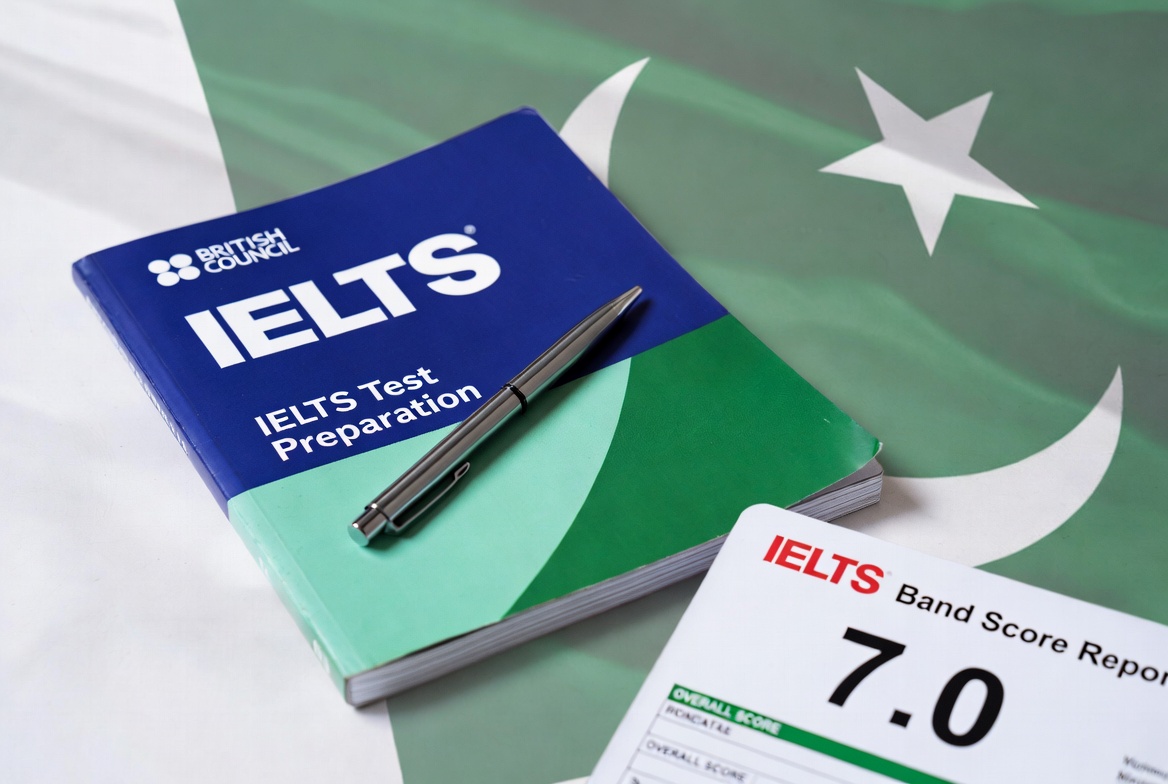
IELTS — the International English Language Testing System — is the world's most popular English language proficiency test for studying, working, and migrating abroad. It is jointly owned by IDP Education, the British Council, and Cambridge Assessment English. IELTS is accepted by over 12,000 organisations in more than 140 countries, including universities, immigration authorities, employers, and professional bodies. More than 4 million tests are taken each year worldwide. Pakistan's demand for IELTS has surged in recent years — and the reasons are not difficult to understand. The country's skilled professionals are in high global demand. Pakistani doctors and nurses are recruited actively by NHS hospitals in the UK. Pakistani engineers and IT professionals are sought by Canadian employers under express entry programmes. Pakistani students are winning scholarships to UK, Australian, and European universities in increasing numbers. All of them need one document. IELTS.
The demand for IELTS in Pakistan has surged due to increasing academic mobility and skilled migration. Many top destinations such as the United Kingdom, Canada, Australia, New Zealand, and the United States require IELTS scores as part of their admission or visa process. IELTS is jointly managed by the British Council, IDP Australia, and Cambridge Assessment English, ensuring high quality standards and fairness in testing. For more on scholarships that may require IELTS, see our guide on Best Fully Funded Scholarships for Pakistani Students 2026.
Academic vs General Training: Which IELTS Do You Need?
This is the first decision every candidate must get right — because taking the wrong version wastes your time, money, and potentially your application deadline. IELTS Academic is for candidates applying to undergraduate or postgraduate degree programmes at universities, or seeking professional registration with bodies in countries like the UK, Canada, and Australia (doctors, nurses, and accountants typically need Academic). IELTS General Training is for candidates seeking skilled worker visas, permanent residency through immigration programmes like Canada's Express Entry or Australia's points-based system, or admission to secondary school or vocational training programmes.
IELTS Academic and General Training are both available in major Pakistani cities. Students applying to universities need Academic. Professionals seeking work visas or immigration applicants should check whether they need General Training or UKVI. IELTS for UKVI is a separate variant specifically required for UK visa applications. The IELTS Test Partners no longer offer IELTS for UKVI on Paper in Pakistan from October 1, 2024. Test takers can still take IELTS for UKVI on Computer in Pakistan, which offers results within 1 to 5 days and is available throughout the week. If you are going to the UK for any purpose — study, work, or residency — confirm whether you specifically need IELTS for UKVI rather than standard IELTS. Many UK visa refusals happen because the applicant submitted the wrong test variant.
Understanding the IELTS Exam Format
The exam tests four skills. Every candidate appears for all four, regardless of which variant they take.
Listening (30 minutes + 10 minutes transfer time): Four recordings — conversations, monologues, and academic discussions — followed by questions. Pakistani students are advised to practise various accents — British, Australian, Canadian — because the recordings use all of them. Most Pakistani students underperform here not because their English is poor but because they have never trained their ear to non-Pakistani English accents systematically.
Reading (60 minutes): Academic: three long texts from academic sources covering topics from science to social sciences. General Training: shorter texts from everyday sources plus at least one longer text. In 2026, expect longer, denser texts with more technical vocabulary. The passages come from academic journals, research papers, and specialist publications. Current tests already include passages around 900 words. Time management is critical here — most candidates who score below their target do so because they spend too long on difficult questions at the expense of easier ones later.
Writing (60 minutes): Two tasks. Task 1: a data description (Academic — graph, chart, or diagram) or an information/problem letter (General). Task 2: an essay on a given topic. In Pakistan, writing is the most difficult section for candidates. This is true across every teaching centre and every test data analysis. Pakistani students read and listen reasonably well. They struggle to produce structured, analytical, well-argued written responses under time pressure. Improving your Writing score requires one thing above all others: regular, consistent writing practice with feedback. Not reading about writing. Actually writing — essays, letters, and data descriptions — and comparing them critically to band 7 and band 8 sample responses. Task 2 essays now require deeper analysis. Simple opinions are not enough. You need to examine issues from multiple angles and provide nuanced arguments. Topics now ask "to what extent" and "discuss both views" more often. You must show complex thinking, not just basic agreement or disagreement.
Speaking (11 to 14 minutes): Face-to-face interview with a trained examiner. Three parts — a personal interview, a short monologue on a given cue card topic, and a deeper discussion based on that topic. The speaking section now focuses more on natural conversation. Memorised answers will get lower scores. Examiners ask follow-up questions that test real understanding and interrupt prepared speeches. They want spontaneous responses. You do not need to sound British. Clarity wins every time. Pakistani English is perfectly acceptable. Focus on clear vowel sounds, proper word stress, and natural intonation. This is the change that most Pakistani coaching centres have not yet fully adapted to. Students who memorise 200 cue card answers and practise scripted responses are specifically disadvantaged by the 2026 speaking assessment approach. Real conversation practice — with native or fluent speakers, in real unscripted discussions — is what the test now rewards and what most candidates are not doing. For general study techniques that apply to IELTS preparation, see our guide on Effective Study Techniques That Actually Work for Students.
IELTS Band Scores: What Do You Actually Need?
The IELTS scoring system runs from Band 1 (non-user) to Band 9 (expert user). Your overall band score is the average of your four section scores, rounded to the nearest whole or half band. Here are the band requirements for the most common purposes Pakistani candidates take IELTS for: UK Student Visa (typical university requirements): Most UK universities require overall Band 6.0 to 6.5 with no section below 5.5 to 6.0. Top universities like Oxford, Cambridge, and Imperial College London require Band 7.0 or higher with no section below 6.5. Canada Immigration (Express Entry): To qualify for the Federal Skilled Worker programme, you generally need CLB 7 in all skills, which corresponds to approximately IELTS Band 6.0 in each section. Higher scores contribute more points to your Comprehensive Ranking System total. Australia Immigration (Skilled Migration): Most skilled migration visas require Band 6.0 minimum overall with no section below 5.0 or 6.0 depending on the specific visa subclass. UK NHS Nurses (NMC Registration): IELTS Academic Band 7.0 overall with a minimum of 7.0 in each individual section. This is one of the most demanding requirements — a single section below 7.0 means failing registration regardless of your overall score. HEC Scholarships for Overseas Study: Most HEC-funded overseas scholarships require IELTS Band 6.0 to 6.5 minimum. The Chevening Scholarship typically requires Band 6.5 overall.
How to Register for IELTS in Pakistan
You can register for IELTS in Pakistan through two official providers: IDP Education and the British Council. Both offer the same test with the same scoring. The registration process involves selecting between the British Council and IDP, choosing Academic or General Training, picking paper-based or computer-based, selecting your date and location, uploading a passport copy, and making payment of the test. Critically: use a passport for IELTS registration, not a CNIC, if the result is being sent abroad. Most international universities and immigration authorities require that the document used to register for IELTS matches the passport used for the visa or admissions application. A mismatch in name spelling between your CNIC and passport has caused IELTS results to be rejected by institutions — an expensive and completely avoidable problem.
IELTS Fee in Pakistan 2026: What It Costs
As of early 2026, IELTS fees in Pakistan range between PKR 71,320 and PKR 71,920 for British Council and approximately PKR 72,000 for IDP. Fees are subject to change based on currency fluctuations, so always double-check the final amount at the moment of booking. The British Council additionally offers preparation materials free of charge to all registered test takers through its Test Taker Portal — an underused resource that is genuinely valuable for self-study. Always choose IELTS test dates in Pakistan 2026 that are at least two months before your university or visa deadline. This gives you enough time for result processing — 13 days for paper, 3 to 5 days for computer-delivered — and a potential retake if needed.
Where to Take IELTS in Pakistan: All Cities
You can find official venues for IELTS test dates in Pakistan 2026 in almost every major urban hub: Islamabad, Peshawar, Abbottabad, Mirpur; Lahore, Faisalabad, Multan, Gujranwala, Sialkot, Sargodha; Karachi, Hyderabad, Sukkur; and Quetta. Computer-delivered IELTS is available almost daily in Islamabad, Lahore, and Karachi — making it significantly more flexible than the once-monthly paper tests of previous years. For smaller cities, paper-based tests are typically available four times per month. Book early. Test slots fill up quickly in big cities like Lahore and Karachi, so book early. For computer-based IELTS, registration deadlines are more flexible since tests are held frequently. Generally, IELTS registration closes about 10 to 14 days before the test date. However, popular dates may sell out much earlier. During peak intake seasons — March-April for September university entry, and August-September for January entry — slots in major cities fill within days of becoming available. If your application deadline is June, do not wait until April to register for your test.
The One Skill Retake: A 2026 Game Changer
IELTS One Skill Retake is a feature designed to help you get your desired test score without retaking the full IELTS test. This is genuinely significant for Pakistani candidates. Previously, if you scored Band 7.0 in Listening, Reading, and Speaking but Band 6.5 in Writing — failing your university's requirement of 7.0 in every section — you had to retake the entire four-section exam. Now, you can retake Writing alone. Same cost as before for the single section. Your scores in the other three sections carry forward. In 2026, many test centres in Pakistan have upgraded their facilities to support the One Skill Retake feature, mostly applicable to those who choose computer-delivered IELTS test dates. If Writing is your weakest skill — and for most Pakistani candidates, it is — this feature changes your preparation strategy. You can take the full test, see your breakdown, and focus exclusively on Writing for your retake if needed rather than re-preparing every section.
How to Prepare for IELTS in Pakistan Without Spending a Fortune
The honest truth about IELTS coaching in Pakistan: you do not necessarily need an expensive coaching centre to score Band 7 or above. Many candidates have self-studied their way to Band 8. What you do need is structured, consistent, timed practice — and ruthless honesty about which skills are actually weak.
Step 1 — Take a full diagnostic test first. Take a full-length practice test before you get serious about preparing. Getting Band 7 in your first attempt requires knowing where you start. If you are at Band 5 now, plan for improvement from Band 5 to 7 over several months, not weeks. Cambridge Official IELTS Practice Tests books 1 through 19 are the gold standard preparation material. They are available at book shops across Pakistan and online. Use them under strict exam conditions — timed, no dictionary, no interruptions.
Step 2 — Build the habit of daily English input. The single most effective preparation for Listening and Reading is sustained daily exposure to authentic English. The BBC, The Guardian, and English-language academic papers online are all free. Listen to TED talks — the automatic transcripts let you verify what you heard. Read one full article from a serious English publication every day for six weeks. This is not glamorous advice. It works.
Step 3 — Write every day, with feedback. In Pakistan, writing is the most difficult section for candidates. Allocate 3 to 6 weeks of focused study time on writing alone if this is your weakest section. Write one IELTS Task 2 essay every two days. Compare your essay to Band 7 and Band 8 sample essays for the same topic — these are freely available on the British Council website and IELTS.org. Identify what the difference is between your response and the model answer — not just vocabulary, but structure, argument development, and coherence. If you can find a teacher, native speaker, or fluent friend to give you feedback on your writing — even informally — that feedback loop is worth more than ten coaching classes.
Step 4 — Speak English every day. IELTS performance is 50% preparation and 50% psychology. Mental calmness ensures top performance. The way to feel calm in the Speaking test is to have spoken English regularly enough that it is not an unusual experience. Speak English with your study partner, your sibling, your colleague — anyone willing. Record yourself answering cue card questions and listen back critically. Notice where you hesitate, where your sentences are incomplete, and where you reach for vocabulary that is not there. Practice reduces fear. You don't need to sound British. Focus on clear vowel sounds, proper word stress, and natural intonation. Pakistani English is perfectly acceptable.
Step 5 — Simulate exam conditions from week three. Students who manage time during the IELTS test score significantly higher. In 2026, you will have less time per question with harder material. Practise under timed conditions starting now. Every practice session in the final four weeks should be timed exactly to the real exam duration. Practise Listening, Reading, and Writing on the same day in sequence — because that is the real exam experience, and stamina matters. The fourth hour of concentration is genuinely different from the first.
Step 6 — How long do you actually need to prepare? As a general rule of thumb, 6 to 10 weeks is the average preparation time required for most Pakistani students. The secret is daily training — even 1 to 2 hours every day will be much more effective than doing 8 hours one weekend. The honest breakdown: If you are already at Band 5.5 and need Band 6.5 — 8 to 10 weeks of consistent daily study. If you are already at Band 6.0 and need Band 7.0 — 6 to 8 weeks with focused work on your two weakest sections. If you are at Band 4.5 or below and need Band 6.5 — 4 to 6 months of serious structured preparation. Do not book your test until your practice test scores are consistently one half-band above your target. A practice Band 7.0 does not guarantee a test Band 7.0 — exam nerves, unfamiliar topics, and time pressure can each cost you half a band. Give yourself a buffer.
Official Free Resources Every Pakistani IELTS Candidate Should Use
Before spending a single rupee on materials or coaching, use these free official resources: British Council Test Taker Portal: Free preparation materials included with every registered test. If you are registered for your test, log in and use every resource available. These are developed by the same organisation that writes the exam. IELTS.org official website: Free sample questions, band descriptors (the official scoring criteria for Writing and Speaking), and video tutorials for each section. British Council YouTube channel: Free IELTS preparation videos covering all four sections with expert guidance. Cambridge Official IELTS Practice Tests: Available for purchase at Rs 1,500 to Rs 2,500 per book. These are the closest available simulation of the real exam because they use actual past exam questions. Buy two or three books and work through them systematically under timed conditions.
Common Mistakes Pakistani IELTS Candidates Make
These are the errors that show up consistently across the thousands of Pakistanis who take IELTS every month. Starting preparation too late. The biggest mistake is starting preparation too close to your test date. With 2026 changes, last-minute preparation will not work. Give yourself at least three months of serious preparation. Four to six months is better if you are starting from Band 5 or below. Booking without knowing your current level. Take a full practice test before booking. If you are at Band 5.0 and you need Band 7.0, booking a test in four weeks is throwing Rs 72,000 at a wall. Memorising Speaking answers. Examiners interrupt prepared speeches. They want spontaneous responses. This trend is getting stronger in 2026. Candidates who memorise 200 cue card responses often score lower than candidates with less vocabulary who speak naturally. Ignoring task requirements in Writing. In Task 2, "discuss both views and give your opinion" requires discussing both views AND giving your opinion. Missing part of the instruction — which is extremely common under time pressure — automatically reduces your task achievement score regardless of how well you write. Not reading questions carefully in Reading. "No more than two words" means two words maximum. "Write a letter, not a word" means if the answer is two words and you write three, you score zero. These instructions are explicit and unforgiving.
After Your Test: Results, Retakes, and Next Steps
You can preview your IELTS test result online in Pakistan 13 calendar days after the IELTS test on paper and 3 to 5 calendar days for the IELTS test on computer. IELTS results are valid for 2 years from the test date. After 2 years, you may need to retake the test. There is no limit on retakes and no mandatory waiting period. You can take the test as many times as needed. If your score is not what you needed, do not despair — and do not rush to rebook immediately. Spend time genuinely understanding what went wrong in the specific section that cost you. Use the One Skill Retake option if applicable. And if you need to do the full test again, use the one-month window to work exclusively on your weakest area before rebooking.
The IELTS test does not care about your background, your university, or your career history. It cares about one thing: your ability to use English effectively across four specific skills in controlled conditions. That ability is buildable. With the right preparation and honest self-assessment, the band score that is standing between you and your goal is achievable. The question is whether you are willing to do the work — consistently, daily, for long enough to close the gap. Most people who fail IELTS do not lack English ability. They underestimate preparation time, start too late, and practise under conditions that are too comfortable to build real exam performance. Do not make those mistakes. Start today. For more on career paths after your education, see our guides on How to Get Your First Job in Pakistan After Graduation, CSS Exam Pakistan 2026 Guide, and How to Get Admission in Pakistani Universities 2026. For options after matric, see What to Do After Matric in Pakistan 2026.
Quick Reference: IELTS Fee Pakistan 2026: Rs 71,320 – Rs 72,000 | Results: 3–5 days (computer) / 13 days (paper) | Providers: British Council, IDP, AEO | Registration: britishcouncil.pk / ielts.idp.com | Validity: 2 years from test date | Retakes: Unlimited, no waiting period