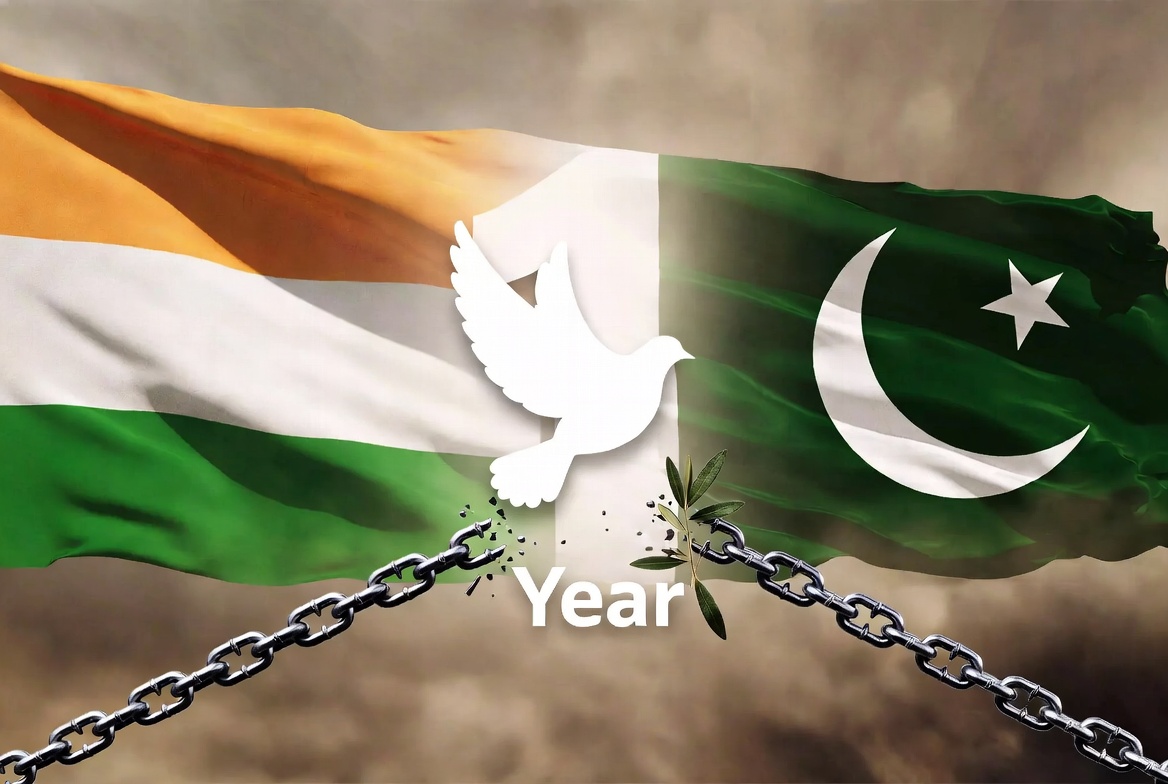
The Ceasefire That Almost Did Not Hold
Today is May 10, 2026. Exactly one year ago today, at 5 PM local time, the guns went quiet. Four days of missile strikes, drone attacks, downed fighter jets, and burning airbases — the most intense military exchange between India and Pakistan since 1971 — came to an end with a phone call between two generals. Pakistan's DGMO called India's DGMO at 3:35 PM. By 5 PM, the ceasefire was in effect. By evening, people in Lahore, Islamabad, and Peshawar were firing celebratory rounds into the sky.
Twelve months later, the question worth asking is not who won or who lost — both governments have their own answers to that, shaped more by politics than truth. The more important question is simpler and more honest. What actually changed? For the governments, the military, the diplomats — plenty. For ordinary Pakistanis and Indians living their daily lives — the answer is more complicated, and more human.
The ceasefire announced on May 10, 2025 was not the clean, ceremonial ending that anniversary celebrations suggest. India and Pakistan have decided to extend their ceasefire until May 18, with the directors general of military operations in New Delhi and Islamabad set to speak again to review the situation along the border. That extension was necessary because the original ceasefire almost collapsed within hours of being announced.
Reports from the night of May 10–11, 2025 described explosions in Srinagar, drone sightings along the Rajasthan border, and continued exchanges of fire in Kashmir. Both sides accused the other of violations. The ceasefire held — barely — because neither side wanted to be seen as the one that broke it, and because American pressure from Washington was real and immediate.
Several countries including the US, Turkey, and Saudi Arabia were in contact with Pakistan in the hours before the ceasefire agreement was reached. Pakistan's Deputy Prime Minister and Foreign Minister Ishaq Dar said Pakistan had always strived for peace and security in the region without compromising its sovereignty and territorial integrity. The ceasefire that Pakistanis celebrated on the night of May 10, 2025 was real — but it was also fragile, contested, and held together by international pressure as much as by the two countries' own desire for peace. Understanding that is important for understanding where things stand today.
What Pakistan Gained — Honestly Assessed
A year on, Pakistan's government and military have been clear and consistent about what they believe was achieved. The anniversary ceremonies, the Air Force event at Nur Khan Auditorium in Rawalpindi, the government concert at Liberty Chowk in Lahore — all carry the same message. In Pakistan, May began with streets in major cities dotted with banners and posters honouring the military leadership that, in the official telling, guided the country's defences and led the nation to victory in the four-day aerial war with India.
The military achievements are real and documented. Fighter jets were shot down. S-400 and Brahmos infrastructure was hit. The claim that Pakistan faced an adversary five times its size and forced a ceasefire within four days is one that international military analysts have broadly accepted as factually grounded, whatever disagreements exist about the precise numbers.
Beyond the military dimension, Pakistan gained something harder to quantify but arguably more valuable: diplomatic credibility. The same country that spent two years mediating the US-Iran crisis was simultaneously defending its airspace against a regional power. Holding both of those roles simultaneously — peace mediator and capable military actor — shifted how Pakistan is perceived in international capitals in ways that press releases and diplomatic visits never could.
For ordinary Pakistanis, the gain was something more personal — a sense of national pride that cut across political lines. In a country where political divisions run so deep that agreeing on almost anything is difficult, Marka-e-Haq was one of the rare moments where people from different provinces, different parties, and different income brackets felt the same thing at the same time.
What India Gained — and What It Is Not Saying
Al Jazeera's analysis published today, on the one-year anniversary, frames the conflict through the lens of two wins and two losses — one set for each country — noting that the honest accounting of what was achieved is more complicated than either government's official position suggests.
India launched Operation Sindoor with stated objectives: to strike terror infrastructure, send a message of deterrence, and demonstrate that Indian military action would have consequences for Pakistan. It achieved the first objective — strikes on identified locations happened and were confirmed. The second and third objectives are more contested.
The loss of multiple Rafale jets — among the most expensive and advanced aircraft India has purchased — was a significant military and reputational blow. India has not officially confirmed the exact number of aircraft lost. Independent analysts and international reporting suggest the losses were real and meaningful. France, which sold India the Rafales, was reportedly watching the conflict closely for exactly this kind of real-world performance data.
For ordinary Indians, the anniversary is quieter. The Washington Post's opinion piece published this week notes that the world scene is chaotic enough that very few Americans — or apparently, many Indians — remember that a shooting war between two nuclear powers happened just twelve months ago. The Pahalgam families who lost loved ones on April 22, 2025 remember. Border communities in Kashmir, Jammu, Rajasthan, and Punjab who lived through the four days remember. For much of the rest of India, it has faded into the background noise of a turbulent year.
Where the Ceasefire Stands Today
The most important question a year on is whether the ceasefire is holding — and what comes next. A year later, India and Pakistan are technically at peace — in the way that two people who once threw furniture at each other are technically peaceful roommates. You never know when the conflict could flare up, suddenly and intensely, again.
That description, from Washington Post analysis published this week, is blunt — and accurate. The ceasefire is holding. Relations have not normalised. Trade between India and Pakistan remains suspended. People-to-people contacts — cultural exchanges, sporting events, family visits across the border — remain essentially frozen. The Line of Control remains tense, monitored by soldiers on both sides who lived through the four-day conflict and have not forgotten it.
Both countries have continued military procurement since the ceasefire. India approved major purchases of drones, missiles, and guided bombs in the months following the conflict. Pakistan has reportedly been in discussions with Turkey and China for new drone and air defence systems. The lesson both sides drew from May 2025 was not that war is impossible — it is that the next round needs better preparation. Meanwhile, the underlying cause of the conflict — Kashmir — remains exactly as unresolved as it was before the first missile was fired.
The Human Cost That Gets Forgotten in Anniversary Coverage
Something important gets lost in the ceremonial celebrations and the military press conferences. People were killed in May 2025. On both sides of the border. Civilians living nowhere near military installations. Soldiers following orders they did not write. Families who had no say in the decisions that were made in government offices and military command rooms.
India reported civilian casualties from Pakistani strikes. Pakistan reported civilian casualties from Indian strikes. The exact numbers remain disputed — official figures on both sides are lower than estimates from independent sources and human rights organisations. The truth, as it usually is in armed conflicts between states with strong censorship instincts, sits somewhere between the two official accounts.
A fair and honest anniversary coverage acknowledges this. The military achievements were real. The diplomatic gains were real. And the human cost was also real — paid by people who will not attend any ceremony today, whose names will not appear in any banner or poster, and whose families are marking this anniversary in a completely different way from the celebrations happening in Lahore and Rawalpindi.
What This Means for South Asia Going Forward
Dawn's anniversary analysis, published four days ago, describes the conflict period from the night of May 6 to May 10 as one where the drums of war were echoing loudly across South Asia as the nuclear-armed arch-rivals exchanged missiles, raising global alarm over the risk of unpredictable escalation.
That phrase — "unpredictable escalation" — is the one that should concentrate minds as we mark one year since the ceasefire. The conflict happened faster than anyone expected. It escalated more rapidly than most crisis models predicted. And it came closer to a threshold that nobody wants to contemplate — Pakistan's National Command Authority convening during active hostilities — than the anniversary celebrations tend to acknowledge.
The lesson for South Asia is not that deterrence works perfectly. It is that deterrence worked this time — and that "this time" is not the same as "every time." The structural conditions that produced the May 2025 conflict — an unresolved territorial dispute, domestic political pressures on both sides, deep institutional mistrust, and zero formal communication channels below the very highest levels — remain exactly in place. None of them have been addressed in the twelve months since the ceasefire.
A peace that rests entirely on military deterrence and international pressure, without any diplomatic framework, any confidence-building measures, or any contact between the societies themselves, is a peace that depends on nothing going wrong. That is a fragile foundation for the security of 1.7 billion people.
For Ordinary Pakistanis: What Today Means
On this specific anniversary — May 10, 2026 — the mood in Pakistan is genuinely celebratory. The concerts, the ceremonies, the social media tributes to the armed forces are real expressions of real national feeling. That pride is legitimate and earned. Pakistan's armed forces performed well under extraordinary pressure. The political leadership showed nuclear restraint when it mattered most. The diplomatic team played a role in de-escalation that the country will benefit from for years.
But the most meaningful tribute to what was achieved on May 10, 2025 is not a concert or a press conference. It is working — seriously, patiently, and without giving up — toward the kind of durable peace that makes another May 2025 impossible rather than merely unlikely. The ceasefire was the end of a conflict. It was also the beginning of a choice. Pakistan can use the credibility it earned — as a military actor, as a regional mediator, as a country that showed restraint when restraint was hardest — to build toward something more permanent than the current armed standoff. That work is slower, harder, and less photogenic than a military ceremony. It is also more important.
Note: This article presents a balanced assessment drawing on Pakistani, Indian, and international sources. Both countries have competing accounts of the conflict. Readers are encouraged to review multiple sources for a complete picture.