How It Started: The Pahalgam Attack
This week, exactly one year ago, Pakistan was at war. Not a skirmish along the Line of Control. Not a diplomatic standoff or an exchange of angry statements at the United Nations. An actual war — missiles flying, fighter jets in the sky, airbases burning, and two nuclear-armed nations standing at the most dangerous edge either had approached in nearly three decades.
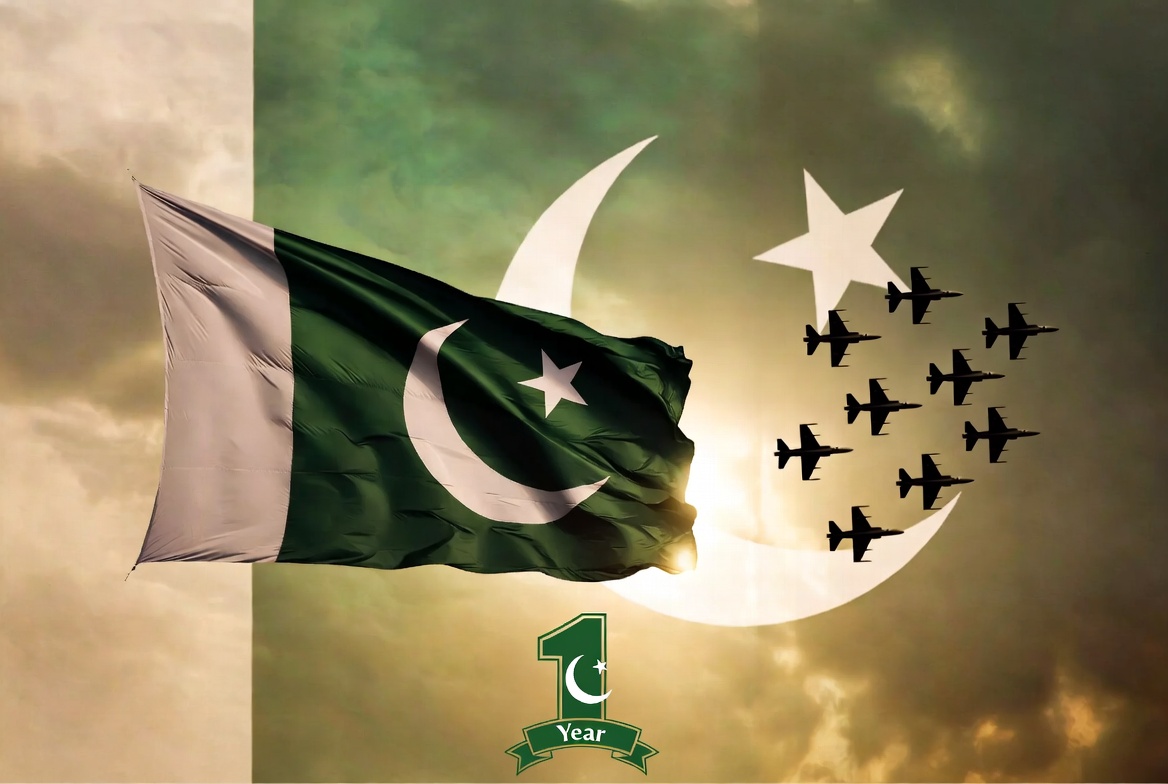
That four-day conflict — which Pakistan has named Marka-e-Haq, meaning the Battle of Truth — ended on May 10, 2025, with a ceasefire brokered by the United States. One year later, Pakistan is marking the anniversary with military press conferences, national celebrations, and a deeply felt sense of pride that cuts across political divides. Here is the complete, honest account of what happened, what was achieved, and what the next year holds for Pakistan and the region.
Every conflict has a starting point. For Marka-e-Haq, it was April 22, 2025. On April 22, 2025, gunmen opened fire on tourists in Pahalgam, India-administered Kashmir, in the worst assault on civilians in the region since 2002. Twenty-six civilians were killed. Eyewitnesses indicated that the attackers specifically targeted Hindu men, leading to a surge of outrage across India. India accused Pakistan of harbouring and supporting the militants responsible. Pakistan denied any involvement and called for an independent investigation. India rejected the call and began making military preparations that were visible and unmistakable.
The tension on the Line of Control escalated through the last days of April. With exchange of fire on the Line of Control beginning on April 26, bringing tensions between India and Pakistan to an alarming level, the armed forces were prepared with their full might for what was to come. On the night of May 6–7, 2025, the brinkmanship ended and the war began.
Operation Sindoor and Pakistan's Response
A brief armed conflict between India and Pakistan began on 7 May 2025, after India launched missile strikes on Pakistan in a military campaign codenamed Operation Sindoor. India said the operation was in response to the Pahalgam attack and targeted terrorism-related infrastructure facilities of Pakistan-based militant groups in Pakistan and Pakistan-administered Azad Kashmir, saying no Pakistani military or civilian facilities were targeted. According to Pakistan, the Indian strikes hit civilian areas including mosques and resulted in civilian casualties.
What happened next was the moment that defined the entire conflict. What followed was a thundering response from Pakistan, dubbed Operation Bunyanum Marsoos — meaning "concrete structure" or "unbreakable wall" in Arabic. Over a span of about 12 hours, the armed forces targeted multiple strategic and military sites in India and occupied Kashmir, destroying the S-400 missile system in Adampur and a storage site of the Brahmos missiles in Beas, among other targets. The retaliatory attacks targeted at least 26 locations; India acknowledged that at least five airbases suffered damage to "equipment and personnel."
In the air, Air Vice Marshal Tariq Ghazi stated that eight Indian aircraft were shot down during Operation Bunyan-um-Marsoos — four Rafale jets, one Su-30, one MiG-29, one Mirage 2000, and one expensive multi-role unmanned aerial system. These were not outdated, second-tier aircraft. Rafale jets are among the most advanced fighter aircraft in the world, purchased by India from France at enormous cost and considered the crown jewel of the Indian Air Force's modern fleet. Losing four of them in a single conflict sent a shock through defence circles globally.
The Nuclear Moment Nobody Likes to Remember
Here is a detail that was reported at the time but has largely faded from the anniversary coverage — and it is the most important context for understanding how serious those four days actually were. In the morning of May 10, state media reported that PM Shehbaz had called a meeting of the National Command Authority, which is responsible for making operational decisions on Pakistan's nuclear weapons. However, hours later, the defence minister said the nuclear option was "not on the cards" at the moment.
The National Command Authority meeting was not a routine government briefing. It is the body that holds authority over Pakistan's nuclear arsenal. Its convening during an active military conflict tells you everything about how close the situation came to a threshold that no one in the world wanted to cross. The fact that it was convened and that the nuclear option was subsequently and explicitly ruled out by the Defence Minister is, in hindsight, one of the most important decisions made by Pakistani leadership during that entire crisis. It was a demonstration of exactly the kind of nuclear restraint that international observers had long wondered whether South Asian leaders would show under genuine pressure. They did.
The Ceasefire: How the War Ended
In between developments, US Secretary of State Rubio spoke separately with Chief of the Army Staff Gen Asim Munir and Deputy PM Ishaq Dar, offering US assistance in talks for de-escalation. The American intervention was decisive. After the four-day military conflict, both India and Pakistan announced that a ceasefire had been agreed after a hotline communication between their Directors General of Military Operations on May 10, 2025. US President Donald Trump announced the ceasefire publicly — an announcement Pakistan welcomed and India characterised as a direct bilateral communication without third-party involvement.
PM Sharif said the Army Chief had called him at 2:30 AM to inform him about the Indian airstrikes and sought permission to strike back. The Army Chief called back later in the night informing him about a "befitting response" and adding, "we are being requested for a ceasefire." PM Sharif said he told him to go ahead and accept the offer. A war that brought two nuclear states to the brink ended with a phone call at two in the morning.
One Year Later: What Pakistan Is Saying
This week, Pakistan's military held a major press conference to mark the anniversary — and the tone was one of clear, confident pride. DG ISPR Lt Gen Ahmed Sharif Chaudhry, addressing a joint press conference alongside senior officials from the Pakistan Navy and Pakistan Air Force, said Pakistan had inflicted a "crushing and humiliating defeat" on an adversary five times larger, during the conflict that concluded with a ceasefire on May 10 following Operation Bunyanum Marsoos. "We were ready then, and we are ready now," the DG ISPR said, adding that Pakistan had demonstrated its capabilities across air, land, sea, cyber, and multi-domain warfare.
Operation Bunyan-ul-Marsoos stands today, one year on, as a defining chapter in Pakistan's contemporary history — an episode that reshaped perceptions, reinforced national confidence, and elevated the country's standing across military, diplomatic, political, and economic spheres. The DG ISPR outlined what he described as ten strategic consequences of the conflict. The first strategic consequence, he said, is that the Indian narrative of painting Pakistan as a source of terrorism stood buried forever. He said Pakistan had defeated an enemy five times larger and described India as a "terrorist state."
Across Pakistan, the anniversary has been marked with ceremonies, tributes to martyrs, and national celebrations. A special ceremony took place at Peshawar Cricket Stadium on May 7, 2026, featuring live concerts, fireworks, performances, and a tribute session to honour martyrs and war veterans.
What Changed After the War
Beyond the military dimension, the conflict produced changes that are visible in Pakistan's standing and posture today. Diplomatically, Pakistan's image experienced a notable transformation. The country began to be viewed not simply as a participant in regional tensions, but as a state capable of measured and responsible decision-making under pressure. This perception strengthened Pakistan's image in international forums and contributed to renewed engagement with global partners.
Field Marshal Asim Munir — elevated to his five-star rank in recognition of his leadership during the conflict and subsequently appointed as Pakistan's first ever Chief of Defence Forces — has become a central figure in Pakistan's post-conflict national narrative. Trump has repeatedly referred to the May conflict and appeared to endorse Pakistani claims of shooting down several Indian fighter jets. The US president also imposed tariffs of nearly 50% on India while Pakistan received a lower rate of 19%. Whether that preferential tariff treatment is directly connected to Pakistan's role in regional diplomacy — including the US-Iran peace talks — is a question analysts continue to debate. What is clear is that Pakistan's relationship with Washington is at one of its most functional points in recent memory.
On June 21, Pakistan announced it would nominate Donald Trump for the Nobel Peace Prize, citing his role in brokering the ceasefire — a gesture that underscored Islamabad's desire to credit Washington's intervention and maintain the goodwill that followed it.
Where India-Pakistan Relations Stand Today
The honest picture is one of fragile, uneasy stability. Since the conflict, ties have remained tense, with fears of renewed conflict never far from the surface. Leaders on both sides have exchanged sharp rhetoric. Both countries have also tested ballistic missiles and conducted military exercises. Pakistan's military warned on the anniversary that it would respond strongly against any attack, as the country marked one year since the four-day conflict that brought the nuclear-armed rivals to the brink of war before a US-brokered ceasefire halted the fighting.
The Council on Foreign Relations has warned of a moderate likelihood of armed conflict between India and Pakistan in 2026, noting that despite a ceasefire, both nations continue to strengthen their military capabilities with Pakistan reportedly in talks with Turkey and China for new drones and air defence systems, while India has cleared purchases worth ₹79,000 crore for drones, missiles, and guided bombs. The ceasefire is holding — for now. But both sides are clearly preparing for the possibility that it does not hold forever.
What Marka-e-Haq Means for Pakistan
Step back from the military details and look at what this moment means at a national level. Pakistan has spent years in a difficult position globally — managing external perceptions of instability, terrorism, and economic fragility while trying to build legitimate standing in international forums. In four days in May 2025, something shifted. The country that the world had, in certain circles, written off as perpetually chaotic demonstrated coordinated military precision, nuclear restraint, diplomatic engagement, and enough strategic deterrence to bring a much larger adversary to a ceasefire.
That does not resolve the deep and unresolved tensions with India. It does not solve Kashmir. It does not eliminate the risk of future conflict. The analysts warning of continued instability are not wrong to warn. But it changed the terms of the conversation. And one year on, the operation symbolised Pakistan's unwavering commitment to defending its sovereignty and demonstrated a highly coordinated effort by the Pakistan Armed Forces that contributed to enhancing Pakistan's image as a capable and responsible state. That legacy — whatever comes next — is real and earned.
Note: This article covers a developing story. India and Pakistan have competing accounts of several aspects of the May 2025 conflict. This article presents Pakistan's official account and verified international reporting. Readers are encouraged to review multiple sources for a complete picture.