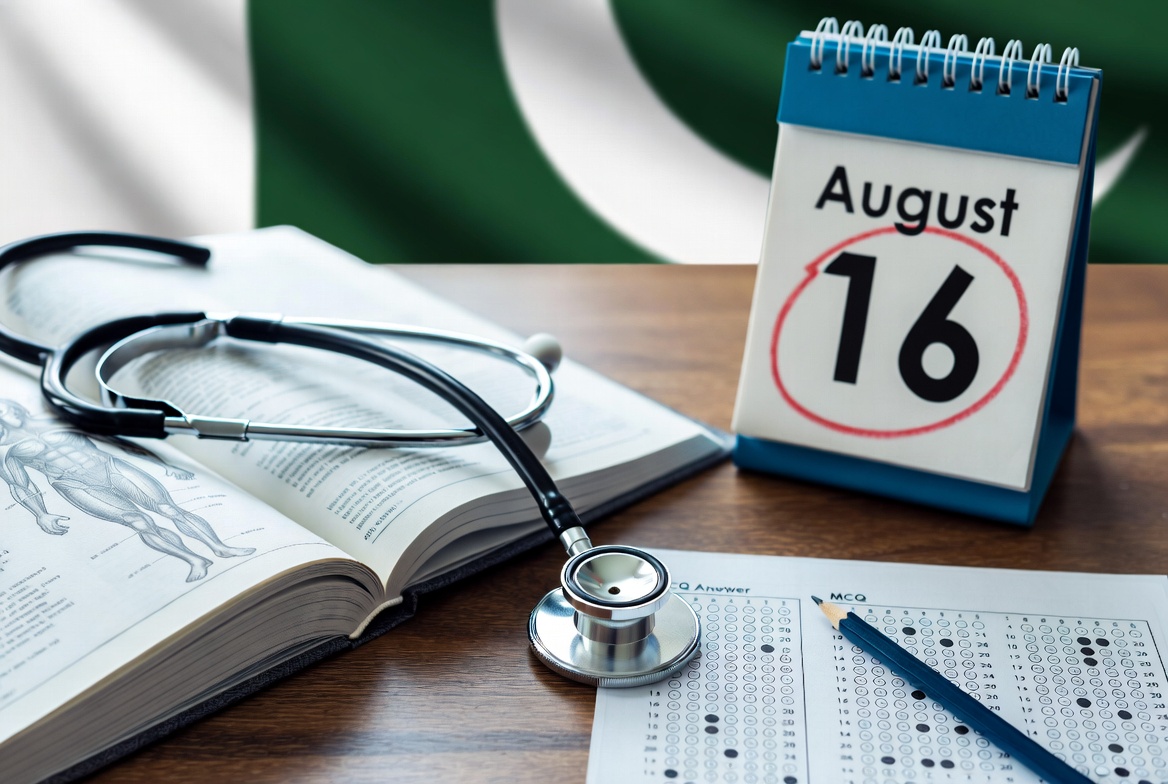
What Is MDCAT and Why Nothing Else Matters Right Now
The date is set. Yesterday — May 18, 2026 — the Pakistan Medical and Dental Council officially announced that MDCAT 2026 will be held on Sunday, August 16, 2026. If you are reading this today, you have exactly 89 days. That number — 89 days — is either enough or it is not enough, depending entirely on what you do with it. Students who have been preparing since January are quietly confident right now. Students who have been waiting for the official date before starting are facing a shorter window than they probably hoped for. Whichever category you fall into, this is your complete guide. The date, the registration process, the full syllabus, the scoring system, a realistic preparation strategy, and the resources that actually work for Pakistani MDCAT students in 2026. No fluff. No false reassurance. Just the complete honest picture of what you are up against and exactly how to approach it.
If you are in FSc Pre-Medical and you want to become a doctor or dentist in Pakistan, MDCAT is the examination that determines whether that happens. Not your FSc marks alone. Not your matric result. Not which coaching centre you attended. The MDCAT is conducted by PMDC every year to evaluate students' knowledge in the medical field. Students who want to pursue a degree in medicine can enrol. To be eligible, students need a minimum of 65% marks in FSc Pre-Medical. The test is multiple choice questions only. Your score on this single examination — combined with your FSc marks — determines your aggregate. Your aggregate determines your merit position. Your merit position determines whether you get into a government medical college, a private medical college, or neither. The competition is intense. Pakistan has approximately 17,000 MBBS seats annually across all government and private colleges — and tens of thousands of students compete for them. Government college seats — where fees are a fraction of private — are far fewer and require the highest aggregates. The students who get those seats are not necessarily more intelligent than those who do not. They are the ones who prepared more strategically. For more on career paths after FSc, see our guide on What to Do After Matric in Pakistan 2026.
MDCAT 2026 Official Date and Key Dates to Mark
The Pakistan Medical and Dental Council has officially announced that MDCAT 2026 will be held on Sunday, August 16, 2026. Here is the complete timeline of key events leading up to exam day:
| Event | Expected Date |
|---|---|
| PMDC Syllabus 2026 Released | June 2026 |
| MDCAT Registration Opens | July 2026 |
| MDCAT Registration Closes | Late July 2026 |
| Roll Number Slips Available | August 2026 |
| MDCAT Exam Date | August 16, 2026 |
| MDCAT Results | September 2026 |
| Medical College Admissions Begin | October 2026 |
| First Merit Lists | October–November 2026 |
Three urgent warnings about these dates that most students learn the hard way: PMDC's official website crashes on registration day. Every single year without exception. The entire country's pre-medical students try to register simultaneously and the server goes down. Register on the first day registration opens — not the last day. Keep multiple browser tabs open and use a VPN if needed to reduce load time. Missing the registration deadline is final. There is no appeal, no late registration window, no exceptions for technical difficulties. If you miss the registration deadline, you do not sit MDCAT 2026. Set a phone alarm for registration opening day today. FSc result awaiting students can register. PMDC has introduced a flexible approach to MDCAT eligibility criteria. Students are permitted to participate in MDCAT even after successfully completing their HSSC intermediate exams, including those whose results are still pending. This means FSc 2026 students — whose results come in September — can register for MDCAT in July even before their result arrives. Register. For FSc exam details, see our FSc Exams 2026 Pakistan Guide.
The Complete MDCAT 2026 Syllabus Breakdown
The MDCAT 2026 syllabus comprises five subjects: Biology, Chemistry, Physics, English, and Logical Reasoning. The examination has 200 questions, each worth 1 mark for a correct answer. Negative marking applies — each wrong answer deducts 0.25 marks. The total score therefore ranges from 0 to 200, though practical high scores are typically in the 155 to 195 range for competitive candidates.
Biology — The Highest Weightage Subject
Biology typically carries the highest proportion of questions in MDCAT — approximately 68 to 80 questions depending on the year. This makes Biology the subject where MDCAT scores are most won or lost. The MDCAT 2026 Uniform Curriculum defines three cognitive levels at which each topic is tested: knowledge, comprehension, and application. The shift in MDCAT questioning style in recent years has moved away from simple recall toward application and comprehension questions that require understanding concepts deeply enough to apply them in clinical or experimental scenarios. Key Biology topics with the highest question frequency in recent MDCAT examinations: Cell biology and cell division (Mitosis and Meiosis), Biological molecules (proteins, enzymes, nucleic acids), Human physiology (circulatory, respiratory, digestive, nervous, excretory, and endocrine systems), Genetics and inheritance, Evolutionary biology and biodiversity, Plant physiology and reproduction, Biotechnology. The common mistake FSc students make in Biology: memorising definitions without understanding mechanisms. MDCAT questions ask you why something happens, not just what it is called. Understand the mechanism of enzyme action, not just the definition of an enzyme. Understand how DNA replication works, not just that it occurs. This shift from memorisation to understanding is the most important strategic insight for MDCAT Biology preparation.
Chemistry — The Calculation and Conceptual Balance
Chemistry carries approximately 54 to 60 questions. It has two equally important components that require completely different preparation approaches. Organic Chemistry is the component most MDCAT students underperform on. Reaction mechanisms, functional group identification, and organic synthesis pathways appear repeatedly and require genuinely deep conceptual understanding. Many students skip organic chemistry during FSc because it is difficult and time-consuming. In MDCAT, that decision costs significant marks. Physical Chemistry tests calculations — stoichiometry, mole concepts, chemical equilibrium, thermodynamics, and electrochemistry. These topics reward systematic practice of numerical problems. Do fifty problems on chemical equilibrium and you will not panic when it appears in the actual exam. Inorganic Chemistry is more manageable and largely testing factual recall — periodic table trends, properties of elements, industrial processes. Do not neglect it but allocate preparation time proportionally.
Physics — The Feared Subject That Rewards Strategy
Physics carries approximately 54 questions. It is the subject with the highest dropout rate in MDCAT preparation — students panic, skip it, and pay the price. The honest insight about MDCAT Physics: it is significantly more predictable than students realise. The same topics appear with remarkable regularity across every year's paper. Topics that consistently generate the most MDCAT Physics questions: Kinematics and dynamics (Newton's laws, projectile motion), Work, energy, and power, Circular motion and gravitation, Fluid mechanics (pressure, Bernoulli's equation), Oscillations and simple harmonic motion, Waves and sound, Optics (reflection, refraction, lenses), Electrostatics and current electricity, Magnetic effects of current. Do not try to master all of FSc Physics equally. Focus your preparation heavily on these specific topics, practise numerical problems until you can solve them mechanically, and use the marks you save for Biology and Chemistry.
English — 18 Questions, Not an Afterthought
Most MDCAT students seriously underestimate the English section. It carries approximately 18 questions covering vocabulary, reading comprehension, grammar, and sentence correction. For a student who scores 175 in Biology, Chemistry, and Physics combined but loses 12 marks in English through carelessness, the damage to their aggregate is real and avoidable. The English vocabulary tested in MDCAT draws heavily from medical and scientific terminology. Reviewing medical word roots, prefixes, and suffixes — alongside standard vocabulary lists — is more targeted preparation than generic English study.
Logical Reasoning — The 10 Questions That Trip Everyone Up
Logical reasoning carries approximately 10 questions and is the section where the least preparation time produces the most improvement. Most Pakistani students have minimal formal exposure to logical reasoning questions in their FSc curriculum, which means almost everyone struggles with it — making improvement a genuine competitive advantage. Practise critical thinking puzzles, sequence problems, syllogism questions, and pattern recognition exercises for 20 minutes per day in the final four weeks of your preparation. A student who goes from scoring 4 out of 10 in logical reasoning to 9 out of 10 gains 5 marks — equivalent to significant improvement in multiple harder subjects.
Understanding the MDCAT Scoring and Aggregate System
This section is critical for understanding what score you actually need — not just on MDCAT but in your combined aggregate. The aggregate for medical college admission combines your MDCAT score, your FSc marks, and your Matric marks in a weighted formula. The exact weights vary by province: Punjab Medical Colleges: MDCAT: 50%, FSc (Pre-Medical, Part I and II): 40%, Matric: 10%. Sindh Medical Colleges: MDCAT: 50%, FSc: 40%, Matric: 10%. KPK Medical Colleges (ETEA pathway): KPK runs its own separate medical entry test (ETEA) for KPK-domicile students for most government medical colleges. NUMS conducts its own separate exam for NUMS-affiliated colleges. Confirm your target college's specific requirement. What this weighting means practically: on a 200-mark MDCAT, each additional mark you score contributes 0.25 percentage points to your aggregate (since MDCAT is 50% of total). Five additional MDCAT marks is 1.25 percentage points in aggregate. In a competitive merit list where seats are allocated by tenths of a percentage point, five marks is the difference between getting in and not getting in. For university admissions guidance, see our How to Get Admission in Pakistani Universities 2026 guide. For effective study techniques, see Effective Study Techniques That Actually Work.
The Honest Preparation Strategy for 89 Days
With exactly 89 days until August 16, here is a realistic, evidence-based preparation approach for students at different starting points. If You Have Been Preparing Since February or Earlier: You are in a strong position. The next 89 days are about consolidation, gap-filling, and intensive mock exam practice — not learning new content. Effective MDCAT preparation requires complete coverage of the syllabus, consistent mock test practice, time management under exam conditions, and thorough revision of weak areas. Your focus now: do a full mock test every three days. Mark every wrong answer. Spend the following day exclusively on the concepts behind those wrong answers. Repeat. By August, you should have done at least 25 to 30 full mock tests under timed conditions.
If You Are Starting Now in May: You have 89 days. That is enough — but only if you work with serious intensity and zero days off. Week 1 to 3: Biology intensive — cover all major systems thoroughly. Human physiology first because it generates the most marks. Use past MDCAT papers to identify the specific topics that appear most frequently. Week 4 to 6: Chemistry — Organic Chemistry first because it requires the most time to properly understand. Then Physical Chemistry calculations. Then Inorganic. Week 7 to 8: Physics — focus only on the high-frequency topics listed above. Do not try to cover all of FSc Physics. Week 9 to 10: English vocabulary, logical reasoning practice, and begin full mock tests three times per week. Week 11 to 12: Pure revision. Nothing new. Only mock tests, identifying weaknesses, and targeted revision of weak areas. Study time required: minimum 8 to 10 hours per day. This is not optional if you are starting in May — the exam is in August and the competition is severe. If Your FSc Result Is Still Pending: You can and should register for MDCAT when registration opens in July regardless of your result status. Do not let pending FSc results slow your preparation. Use your FSc study materials now — your textbooks are the primary source for MDCAT content. Do not wait for your result to start. Every day of preparation you delay is a day you cannot recover. For focus and productivity tips, see our Improving Focus and Productivity During Study Sessions article.
The Resources That Actually Work
This is the practical list that experienced MDCAT students and teachers recommend for 2026. The PMDC Official Syllabus PDF (Free): Every topic you study, every MCQ you practise, and every mock test you take must be anchored to the official MDCAT Uniform Curriculum document. This is the only document that should define your entire preparation — not coaching academy notes, not YouTube summaries, not third-party guides. Download it from pmdc.gov.pk the moment it is released in June. Past MDCAT Papers (Free): PMDC releases official past papers on its website. Five years of past papers is your most valuable preparation resource. Work through every paper under timed conditions. The question patterns, difficulty levels, and topic emphasis tell you more about what to expect than any course material. TopGrade.pk: The TopGrade app is widely recommended for MDCAT preparation with interactive content and mock tests. Students report it helps significantly for concept clarification and targeted MCQ practice. The platform maps its content directly to the PMDC syllabus. Kips and PGC STEP Notes: These remain the most widely used printed preparation materials in Pakistan for MDCAT. They are topic-specific, MCQ-rich, and aligned with the PMDC syllabus. Available at major bookshops in all cities. MDCAT-specific YouTube channels: For Biology particularly, several Pakistani MDCAT educators have free YouTube channels that cover difficult concepts with genuine depth. Search specifically for MDCAT 2026 Biology and Chemistry content — the quality has improved significantly in recent years and free content is now genuinely competitive with paid coaching. The honest coaching academy question: Becoming a doctor and getting admission to a public or private medical college is very competitive. Many students benefit from structured coaching environments that provide discipline and peer accountability. However, coaching centres do not replace personal study — they supplement it. Students who attend coaching but do minimal personal study fail MDCAT. Students who study intensively at home and skip coaching often pass. The preparation is the variable, not the venue. For scholarship opportunities after MDCAT, see our Best Fully Funded Scholarships for Pakistani Students 2026. For IELTS preparation if considering abroad, see our IELTS in Pakistan 2026 Guide. For Pakistan's education system overview, see Pakistan Education Crisis and Comeback 2026.
Negative Marking: The Rule That Separates Scores
This section deserves separate emphasis because it changes exam strategy fundamentally. MDCAT 2026 applies negative marking of 0.25 marks per wrong answer. This means: A correct answer: +1.00 mark. Skipped question: 0.00 marks. Wrong answer: -0.25 marks. A student who attempts 190 questions and gets 160 correct and 30 wrong scores: 160 - (30 × 0.25) = 152.5. A student who attempts 165 questions and gets 155 correct and 10 wrong scores: 155 - (10 × 0.25) = 152.5. Identical scores — but the second student left 35 questions unattempted rather than guessing. The practical strategy: never guess randomly. If you can eliminate two options from a four-choice question, guess between the remaining two — the probability tilts in your favour. If you cannot eliminate any option, skip the question rather than guessing blindly. Practice this strategy in every mock test. Students who do not practise it under timed conditions tend to abandon it under exam pressure and guess randomly — costing themselves marks they thought they were gaining.
What Score Do You Actually Need?
This is the question every MDCAT student asks and almost no article answers honestly. There is no universal "passing" MDCAT score — because admission depends on aggregate and aggregate depends on your FSc marks. But here are the realistic benchmarks based on recent merit lists: Government medical college seat (any specialty): Aim for 175+ out of 200 in MDCAT with 85%+ FSc marks. This is genuinely competitive preparation. Strong government college contention: 185 to 195 out of 200 in MDCAT with 90%+ FSc marks. This range is where the top government seats are typically filled. Private medical college eligibility: Scores above 150 in MDCAT with 65%+ FSc marks open private medical college options. Higher scores and FSc marks reduce the fee-based seats available and improve access to merit-based private college seats. Minimum eligibility: Students need a minimum of 65% marks in FSc Pre-Medical to be eligible for MDCAT registration. There is no official minimum MDCAT score for registration, but medical colleges set their own minimum aggregate thresholds for consideration.
The Bigger Picture: What If MDCAT Does Not Go as Planned?
This section is for the student who is reading this and quietly carrying the weight of family expectations alongside exam stress. Pakistan's medical education system is highly competitive and the seats are genuinely limited. Every year, students with excellent preparation miss government college seats by fractions of a percentage point. It happens to capable, hardworking people. It is not a reflection of their potential. If MDCAT 2026 does not produce the aggregate you need, your options are real and legitimate: MDCAT can be retaken in 2027. There is no limit on retakes. Many of Pakistan's practising doctors passed on their second or third attempt. Private medical colleges — while expensive — produce fully qualified doctors. The degree is identical. The career pathway is identical. Allied health sciences — pharmacy, physical therapy, medical laboratory technology, dental surgery — are genuinely excellent careers that are growing in demand, shorter in duration than MBBS, and increasingly well-paid both in Pakistan and internationally. The doctor you want to become is not exclusively accessible through a single August examination. But the only path that is closed is the one you stop preparing for. Prepare as if August 16 is your one chance. Know that if it does not go perfectly, the story is not over.