1. Why Online Education in Pakistan Is Different in 2026
Picture this: a 19-year-old girl in Larkana, Sindh — far from any decent university, unable to afford private tuition — opens her smartphone, enrolls in a free course, and six months later lands a remote job paying more than her father earned in a year. This is not a motivational story someone made up. It is happening across Pakistan right now.
Online education in Pakistan has crossed a turning point in 2026. The combination of better internet access, government-backed programs, and world-class free platforms has made it possible for any Pakistani — regardless of city, gender, or income — to access quality learning. The question is no longer can you learn online. The question is: where do you start? This guide answers that — completely and honestly.
Something shifted in the last two years. Before, online learning in Pakistan was mostly a side activity — something people dabbled in between college exams or during summer breaks. It was not taken seriously by employers, families, or the students themselves. That has changed. Dramatically.
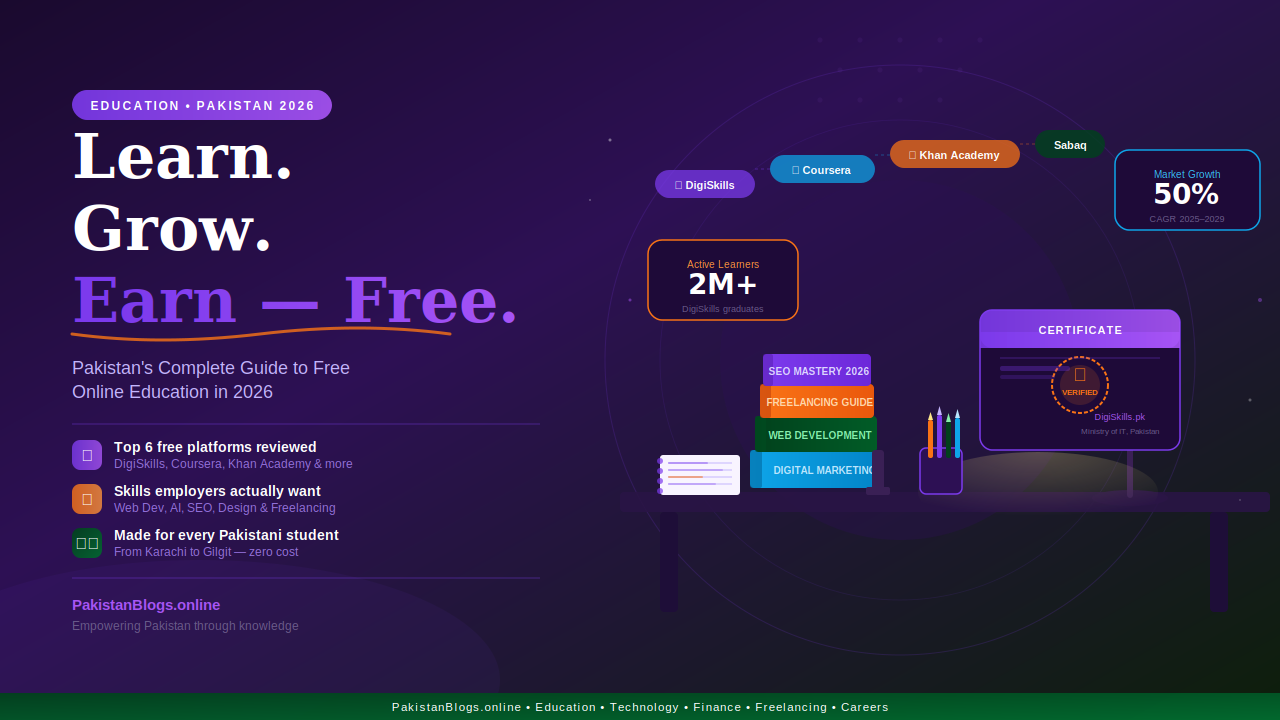
Today, the online education market in Pakistan is growing at a projected annual rate of over 50%, with revenue expected to reach $428 million by 2029. Employers in the IT sector now actively look for candidates who completed courses on Coursera or DigiSkills. Families who once insisted on a degree from a physical university are watching their children earn dollars online after completing a six-week free course. The mindset has shifted. And the tools have improved to match it.
Globally, the e-learning market is on track to reach $400 billion by 2026, fueled by accessibility, affordability, and digital innovation. Pakistan is right in the middle of this wave — and for once, young Pakistanis are positioned to benefit if they move quickly.
2. The Crisis Behind the Opportunity
Here is something uncomfortable but important to understand. Pakistan's traditional education system is struggling. An estimated 25.1 million children aged 5–16 are out of school — giving Pakistan the world's second-highest number of out-of-school children.
Pakistan has historically allocated around 1.5% of GDP to education — well below the UNESCO benchmark of 4–6% — and the situation worsened further, with the Pakistan Economic Survey 2024–25 reporting education spending at approximately 0.8% of GDP, a record low.
Of 20.8 million students enrolled at the primary level, only 9.2 million reach middle school — a loss of more than half in a single transition. Those are sobering numbers. However, they tell only part of the story. Because the students who do stay in the system — and millions who dropped out — now have an alternative route. Online education is not just supplementing Pakistan's broken system. For many young Pakistanis, it is replacing it entirely, and delivering better outcomes.
What began as an emergency workaround during school closures is fast becoming a recurring and permanent feature of how Pakistanis learn. The crisis created a need. Digital platforms answered it.
3. Best Free Online Education Platforms for Pakistani Students
Let's get practical. Here are the platforms worth your time — and more importantly, your trust.
DigiSkills.pk — Pakistan's Best Free Learning Platform
If you only use one platform from this list, make it DigiSkills. DigiSkills is Pakistan's largest free online training program. In 2026, enrollments for Batch 3 opened with 300,000 seats available on a first-come, first-served basis.
The DigiSkills.pk platform, a joint venture by the Ministry of IT and Ignite, has trained over 2 million Pakistanis in freelancing and tech-based skills. It offers courses in: Freelancing, Digital Marketing and SEO, WordPress Development, Graphic Design and Video Editing, E-Commerce Management, QuickBooks and AutoCAD, and Creative Writing. Every course is free. Every certificate is real. And the instructors are Pakistani experts — people who understand the local market and the specific challenges Pakistani learners face.
Coursera — World-Class Learning at Zero Cost
Coursera is the global giant of online education. Pakistani students can audit courses from top universities like Stanford, Princeton, and the University of London at zero cost. The trick most people miss: you only pay on Coursera if you want a verified certificate. The actual course content — all the video lectures, readings, and quizzes — is completely free when you choose to "audit" the course.
Platforms like Coursera, edX, and Google Digital Garage provide globally recognized certificates that employers in Pakistan and internationally take seriously. A Coursera certificate from Google or IBM on your CV is worth more than many local diplomas.
Khan Academy — The Best Place for Students and Beginners
Khan Academy is not just for school students. It is for anyone who wants to build a genuinely strong foundation in a subject. Khan Academy, now available in Urdu, provides world-class instruction in math, science, computing, and more. Its structured, bite-sized lessons are ideal for self-paced learning and concept mastery. If you struggled with maths in school, or want to understand computer science from scratch, Khan Academy is the most patient and thorough teacher you will find — and it costs absolutely nothing.
Udemy — Thousands of Courses, Regular Free Sales
Udemy hosts over 100,000 courses on practically every skill imaginable. While many courses are paid, Udemy runs frequent sales where courses drop to Rs 300–500. Additionally, many instructors offer their courses free during launch periods. The important caveat: Udemy certificates are not recognized by employers as accredited qualifications, but the quality of courses genuinely helps you develop practical skills. Think of Udemy as a learning tool, not a credentialing one.
Sabaq Foundation — Pakistan's Curriculum Done Right
For school students specifically, Sabaq Foundation is exceptional. It provides free video lessons aligned with the Pakistani board curriculum — Matric and FSc — in both English and Urdu. Apps like Sabaq Foundation not only provide free access to academic content but also offer structured, engaging formats that encourage independent learning. If your child is preparing for board exams and cannot afford a tuition center, Sabaq is the solution.
4. Government Programs You Should Know About
Beyond DigiSkills, the Pakistani government has launched several education initiatives that most people simply do not know about.
Saylani Mass IT Training (SMIT)
The Saylani Welfare International Trust's contribution to the democratization of IT education in Pakistan is unparalleled by any other nonprofit. Their Mass IT Training Program has become an institution in transforming novices into professional developers. SMIT offers free in-person and online training in web development, mobile apps, and graphic design. Courses run in batches and are open to everyone — including people with no prior technical background. Many SMIT graduates are now earning well above Rs 100,000 per month.
MOFEPT + Cisco Networking Academy
In early 2026, the Ministry of Federal Education and Professional Training began offering self-paced, fully online technology courses developed in partnership with Cisco Networking Academy at no cost. These include: Cybersecurity and Networking, Internet of Things (IoT), and Digital Badges via Credly — recognized by global tech companies. This is particularly powerful for anyone interested in IT infrastructure and security careers.
TeleSchool
The government launched the TeleSchool initiative in collaboration with EdTech providers like Knowledge Platform, Sabaq.pk, and Taleemabad to broadcast free learning content to students in grades 1–12. For families in areas with poor internet, TeleSchool content accessible via television remains a lifeline.
5. Which Skills Are Worth Learning Online in Pakistan in 2026?
Not all skills deliver equal returns. Here is an honest breakdown of what is worth your time in 2026, based on actual market demand:
Highest earning potential: Web and App Development (Python, Flutter, React), Cybersecurity and Ethical Hacking, Data Science and Analytics, UI/UX Design.
Strong demand, faster to learn: SEO and Digital Marketing, Graphic Design (Canva, Photoshop, Illustrator), Video Editing and Content Creation, Copywriting and Content Writing in English.
Growing fast, underserved in Pakistan: E-Commerce Management (Shopify, Amazon, Etsy), Social Media Management, Virtual Assistance.
If you do not know where to begin, Python is considered the easiest programming language to learn for beginners in 2026, thanks to its readability, and it is also excellent for AI and automation. A free Python course on DigiSkills or Coursera can genuinely open doors that a university degree cannot.
6. How to Actually Succeed at Online Learning
Here is the part most guides skip — and it is the most important part of all. The majority of people who enroll in online courses never finish them. The flexibility that makes online learning attractive is also what makes it easy to quit. So how do you beat those odds?
Treat it like a job, not a hobby. Set a fixed time every day — even if it is just 45 minutes. Morning tends to work best before distractions build up. Put it in your calendar. Tell your family. Create accountability.
Choose one course at a time. The biggest mistake new learners make is enrolling in five courses simultaneously and completing none. Pick one. Finish it. Then move to the next.
Apply as you learn. Knowledge without application evaporates fast. If you are learning graphic design, create a logo for a local shop — even for free. If you are learning SEO, start a small blog. Practical experience cements what you learned in a way that watching videos alone never will.
Build a portfolio from day one. Your certificate matters less than your proof of work. Start collecting samples, projects, and results from the very beginning. When you apply for jobs or freelance projects, your portfolio does the talking.
Research shows that learners retain 25–60% of material studied online, compared to just 8–10% in traditional classroom settings — but only when they are actively engaged. Passive watching delivers the same retention as a traditional classroom. Take notes. Do exercises. Ask questions.
7. Online Education for Girls in Pakistan — Why It Matters Most
If there is one group online education has the power to truly transform, it is girls and women in Pakistan. Gender disparities are especially acute in Sindh and Khyber Pakhtunkhwa, where the number of out-of-school girls exceeds that of boys, driven by structural and socio-cultural barriers.
For a girl in a conservative household who cannot travel to a university or a tuition center, an online course on her smartphone changes everything. She can learn at home. She can earn from home. She can build a career without ever leaving her neighborhood — and in doing so, begin to challenge every assumption her family had about what she could achieve.
Lockdowns and school closures hit girls' education particularly hard, threatening to roll back years of hard-won progress. Online education is one of the most powerful tools to reverse that damage. If you are a parent reading this, giving your daughter access to a free DigiSkills course could be the most impactful educational investment your family makes.
Frequently Asked Questions
Q: Is online education recognized by employers in Pakistan?
A: Increasingly, yes — especially in the IT and digital sectors. Certificates from DigiSkills, Coursera, and Google are well recognized. Courses in digital skills, programming, and business are highly valued by employers worldwide. However, for traditional fields like medicine or law, online certificates do not replace formal degrees.
Q: Do I need a laptop to take online courses in Pakistan?
A: No. Many platforms, including DigiSkills and Khan Academy, work perfectly on Android smartphones. A basic 4G connection is sufficient for most courses. A laptop helps for development and design courses, but it is not a barrier to getting started.
Q: Which free online course is best for a fresh matric or FSc graduate in Pakistan?
A: DigiSkills' Freelancing or Digital Marketing course is the best starting point. It is free, taught by Pakistani instructors, gives you a real certificate, and covers skills with immediate earning potential. After that, move to Coursera's Google Digital Marketing certificate for international credibility.
Q: How long does it take to earn money after completing an online course in Pakistan?
A: Realistically, 3–6 months of consistent learning and practice before your first freelance income. Some students land their first client within 8 weeks. Others take a year. The key variable is not the course — it is how consistently you practice and build your portfolio after the course ends.
Q: Are online certificates enough to get a job in Pakistan?
A: For tech and digital jobs, a strong portfolio backed by a recognized certificate (Google, Coursera, DigiSkills) is often more than enough. Many Pakistani IT companies care far more about what you can do than what paper you hold. For corporate, banking, or government sectors, a formal degree remains important alongside online skills.
Conclusion: Your Education Does Not Have to Wait
Pakistan's traditional education system has real, deep problems. Funding is critically low. Millions of children are out of school. Quality varies wildly by province and by income. But here is the truth that matters in 2026: you do not have to wait for the system to fix itself.
DigiSkills, Coursera, Khan Academy, Sabaq, SMIT — these platforms exist right now. They are free right now. And the skills they teach are in demand right now, both inside Pakistan and internationally. The 19-year-old girl from Larkana is not a fairy tale. She is a product of a decision — a decision to open a browser, enroll in a free course, and show up every single day. That decision is available to anyone reading this article. Your future does not begin when circumstances improve. It begins the moment you decide it does.