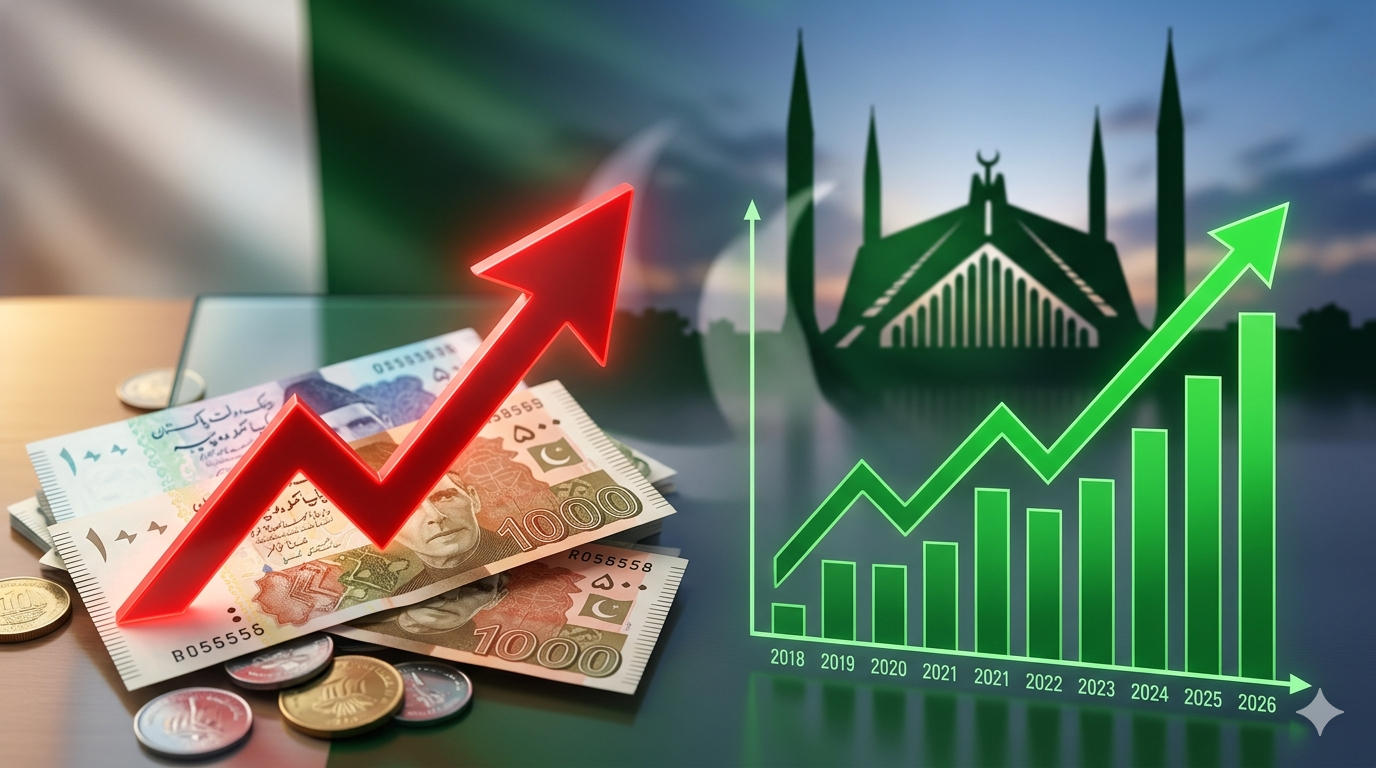
Inflation Just Jumped Back Up — Here Is Why
If your grocery bill feels heavier than it did six months ago, you are not imagining it. If your electricity bill made you do a double-take last month, that was real too. And if you have been watching the news and wondering what terms like "IMF targets," "fiscal deficit," and "monetary tightening" actually mean for your family's finances — you are asking exactly the right question.
Pakistan's economy in 2026 is a story of two realities existing simultaneously. On one hand, genuine recovery — GDP is growing, foreign exchange reserves have stabilised, the IMF programme is on track, and international institutions are cautiously optimistic. On the other hand, real-world pressure — inflation just surged to its highest level in nearly two years, energy bills are climbing, and the budget Pakistan is about to present will determine how hard the next twelve months feel for ordinary families. This article explains both sides clearly and honestly — and tells you what it means for your money.
Let us start with the number that hits everyone immediately. The annual inflation rate in Pakistan rose sharply to 10.9% in April 2026, up from 7.3% in March, remaining well above the State Bank of Pakistan's target range of 5–7%. Price increases were broad-based, with the strongest upward pressures coming from housing and utilities, which climbed to 16.8% from 11.5%, and food and non-alcoholic beverages, which rose to 7.6% from 3.6%. Transport costs saw a steep surge, jumping 29.9% compared to 12.5% in the previous month.
Read those numbers again. Transport costs up 29.9% in a single month. Housing and utilities up 16.8%. Food costs accelerating. This is not a statistical abstraction. This is the price of flour, the cost of filling your rickshaw or car, the electricity bill sitting on your kitchen table. For a family earning Rs 50,000 a month in Karachi or Lahore, a 10.9% inflation rate means the same income buys meaningfully less than it did a year ago.
What is driving this sudden spike? The primary culprit is energy — specifically the fallout from the Middle East conflict. The Iran war has provoked fuel shortages, and in April the government announced a two-hour daily power cut, which has disrupted manufacturing output and pushed up energy costs throughout the supply chain. When energy gets expensive, everything built, transported, cooked, or powered by energy gets expensive too.
Pakistan Bureau of Statistics statistics reveal that consumers are confronted with sudden inflationary pressures, particularly in energy bills at 11.5% and transport costs at 12.5% due to energy supply shocks, while persistent inflation in education at 9.3%, health at 9%, and miscellaneous items at 21.6% continues. Inflation in education and health is especially painful. These are not luxuries that families can cut. A child still needs school supplies. A sick family member still needs medicine. When those prices rise, other parts of the household budget get squeezed regardless of what choices families make.
The Economy Is Growing — But Risks Are Rising
Here is the part that does not make as many headlines as the inflation figures — but deserves equal attention. Pakistan's economy is genuinely recovering, and that matters for anyone planning their financial future.
Pakistan's economy recovered as growth strengthened and inflation declined in fiscal year 2025, supported by tight macroeconomic policies and progress in economic reform. Pakistan is expected to sustain its economic performance in the medium term, with real GDP growth forecast at 3.5% in FY2026 and 4.5% in FY2027, as manufacturing recovers and investment increases.
The IMF projects Pakistan's real GDP growth at 3.6% for 2026. That is not spectacular — China grows at 5%, India at over 6% — but it is real positive growth after years of genuine economic distress. Pakistan was running on fumes just two years ago, facing a balance of payments crisis and foreign exchange reserves so low they barely covered three weeks of imports. The stabilisation since then has been hard-won and fragile. But it is real.
Pakistan's economy has stabilised and begun to show stronger momentum, supported by progress in implementing key economic reforms amid a challenging global environment, according to the Asian Development Bank. However, the risks sitting on top of this recovery are significant and need to be stated plainly. Average inflation is projected to rise to 6.4% in FY2026 and 6.5% in FY2027 due to surging oil prices and disrupted trade routes amid the Middle East conflict. A prolonged Middle East conflict could weigh significantly on the economic outlook by slowing growth through higher energy and fertilizer costs, weakening agricultural and industrial output, reducing remittances, and widening the current account deficit.
Pakistan's fortunate position as a mediator in the US-Iran peace talks has a direct economic dimension — every week those talks remain productive is a week that oil supply routes are less likely to deteriorate further.
The IMF Is Coming to Islamabad This Month
This is the financial story that will shape Pakistan's budget and therefore your tax bills, your energy subsidies, and government spending for the next twelve months. An IMF mission is expected to arrive in Islamabad on May 13th or 14th. Their primary objective will be to carefully review the government's proposed budgetary targets and the macroeconomic assumptions for the next financial year. Discussions will cover taxation measures, development spending, energy subsidies, and the overall fiscal deficit targets. The IMF has reportedly urged Pakistan to keep a tight rein on subsidies to ensure compliance with the reform commitments already in place under the ongoing programme.
Pakistan will seek guidelines from the IMF to finalise the annual budget for the next fiscal year 2026-27. The inflation has gone beyond the government's target during the previous month, with the ministry of finance having already warned that inflation would increase within the range of 8.0–9.0 percent for April 2026.
What does this mean practically for ordinary Pakistanis? The IMF programme requires Pakistan to reduce its fiscal deficit — the gap between what the government spends and what it collects in taxes. To do this, the government must either raise taxes, cut spending, reduce subsidies, or some combination of all three. Cuts to energy subsidies mean higher utility bills. New taxes on goods and services mean higher prices. Reduced development spending means fewer government projects and jobs. None of these outcomes are painless for families already managing a 10.9% inflation rate.
The counter-argument — and it is a legitimate one — is that without IMF support, Pakistan faced a genuine risk of debt default, which would have been far more catastrophic than the reform pain it is currently managing. The programme is difficult. The alternative was worse.
What the State Bank Is Doing About Interest Rates
The State Bank of Pakistan's interest rate decisions directly affect the cost of borrowing — home loans, business loans, car financing, personal loans — and the return on savings in bank deposits. The central bank is expected to ease monetary policy cautiously to stabilise inflation within its medium-term target range of 5–7%. In plain terms, the SBP is carefully cutting interest rates — but slowly, because the April inflation spike has made aggressive rate cutting riskier.
Current inflation is a supply-side phenomenon driven by energy prices. Raising interest rates in response to energy-driven supply-side inflation is akin to treating the wrong ailment, as it deepens recessionary pressures without addressing the root cause. This matters for your personal finances in a specific way. When the SBP cuts rates, profit rates on savings accounts and government savings instruments like National Savings Certificates also come down. If you have savings in fixed deposits or savings certificates, the returns you earn on those will likely be lower in FY2027 than they were in FY2025 when rates were at their peak. If you locked in a long-term savings certificate at last year's high rates — well done. If you are renewing savings instruments now, expect lower returns than before.
What This All Means for Your Personal Finances
Let us bring this down from macroeconomics to the practical decisions you can make right now.
On daily expenses: Inflation at 10.9% means your budget from last year is not sufficient this year. If you have not revisited your household budget recently, do it this week. Track where the new pressure points are — transport and utilities are hitting hardest — and identify where adjustments can be made.
On savings: With interest rates coming down gradually, the window for locking in higher profit rates on National Savings instruments is narrowing. If you have surplus funds sitting in a low-yield current account, reviewing your options now makes sense.
On debt: If you are carrying any variable-rate debt, the gradual SBP rate cuts should provide some relief over the coming months. However, do not take on new debt to fund daily consumption — borrowing to cover groceries or utility bills is a trap that worsens very quickly.
On employment and income: The sectors showing genuine growth in Pakistan right now are IT exports, freelancing, and services. GDP growth rose to 3.9% in Q2 FY2026, driven primarily by services activity as consumer sentiment improved. If you have skills that connect to Pakistan's digital economy — technology, content, design, finance — building income from those areas provides a meaningful hedge against rupee inflation through dollar earnings.
On the budget: Watch the June 2026 budget announcement closely. The IMF talks happening this month will directly shape what gets taxed, what subsidies remain, and what essential services cost. Changes to utility pricing, petrol levy, and income tax thresholds will all affect household finances from July 1st.
The Honest Picture
Pakistan's economy in May 2026 is genuinely better than it was two years ago — and genuinely harder than it was six months ago. The recovery is real. Growth is positive. Foreign exchange reserves are stable. The IMF programme has kept default risk at bay. International institutions are investing and engaging. But the everyday pressure is also real. Inflation at 10.9%, transport costs up 30% in a month, energy bills climbing, and a budget process that will require further fiscal tightening — these are not comfortable conditions for Pakistani families.
The path forward is the same one Pakistan has been walking since 2023: structural reform, revenue expansion, energy sector improvement, and digital economic growth. It is a long road and an uneven one. Understanding what is happening — and why — is the first step toward making financial decisions that protect your family through the difficult parts and position you to benefit when conditions improve. Both will come. They always do.
Disclaimer: This article is for educational and informational purposes only and does not constitute financial advice. Please consult a qualified financial advisor for guidance specific to your personal circumstances.