The Hard Truth: 20 Million Children Are Still Out of School
Education is one of those topics that every Pakistani government talks about with great passion — and then somehow manages to underfund, underdeliver, and overlook for another year. Parents know this reality. Students feel it every day. Teachers live it inside classrooms where desks are broken, textbooks are outdated, and the brightest students quietly dream of leaving the country the first chance they get.
But something is shifting in 2026. Not a revolution — let us not get carried away — but a genuine mix of challenges and real opportunities that every student, parent, and educator in Pakistan should understand. Because this year, decisions being made at the top are going to have a real impact on the ground, whether you are a student in Faisalabad preparing for your matric exams, a university graduate looking for a scholarship to study abroad, or a parent worried about what kind of future your child is walking into. Let us break it all down — honestly, clearly, and without the usual government press release flavour.
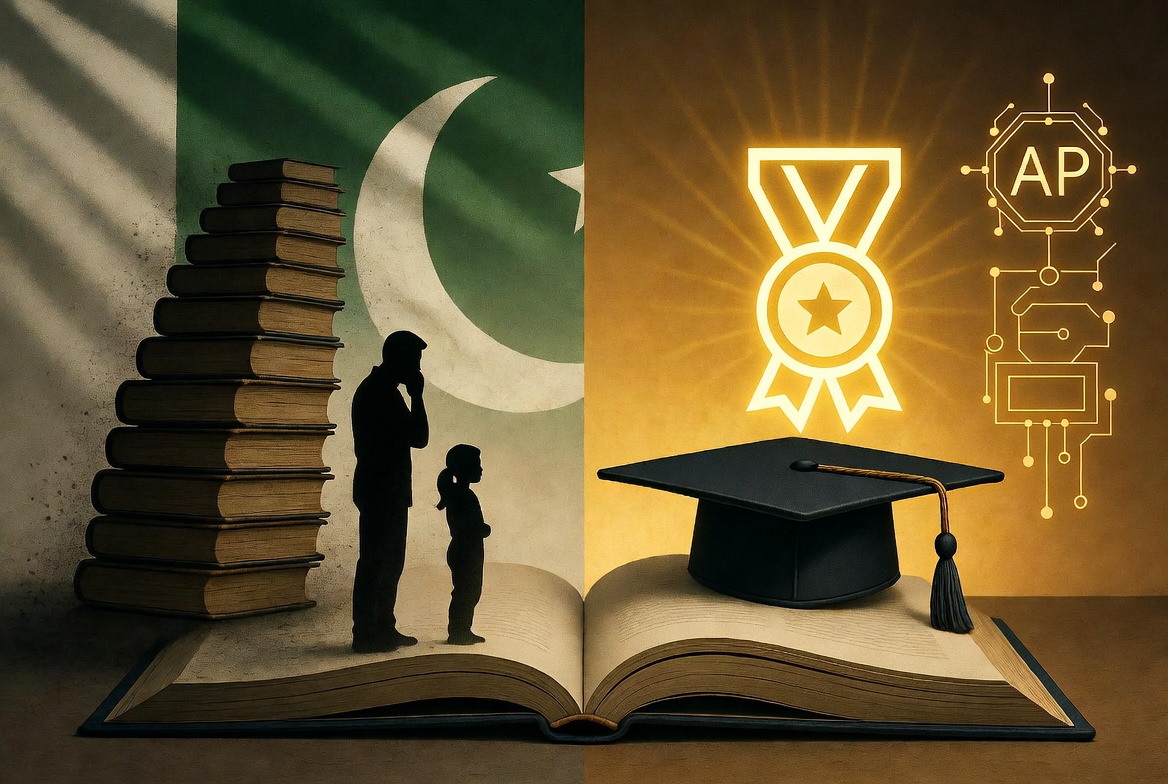
Before we talk about progress, we have to acknowledge the scale of the problem, because it is too large to gloss over. According to the latest household survey data, nearly 20 million children in Pakistan are still not in school. Read that number slowly. Twenty million children. That is not a developing-country statistic from twenty years ago. That is the reality in 2026, right now, in a country with nuclear capabilities and a space programme and a growing IT export industry.
Nearly three out of every ten children in Pakistan are receiving no formal education at all. Punjab, despite being the most developed province, still has an out-of-school rate of around 21% — and experts say progress there has essentially stalled. Balochistan continues to have the highest exclusion rate in the country. Girls are disproportionately affected, with poverty, cultural barriers, distance to schools, and lack of female teachers all working together to keep them out of classrooms.
Pakistan's overall literacy rate currently sits at around 60.6%, with a stark gender gap: 68% for men versus 52.8% for women. That female literacy figure is not just a social problem. It is an economic one. Planning Minister Ahsan Iqbal has said directly that Pakistan cannot achieve sustainable economic growth with low literacy levels. He is right. No country in history has built a strong economy on the back of an uneducated population.
The other number that should bother everyone — policymakers, parents, and taxpayers alike — is how little Pakistan actually spends on education. According to the Economic Survey of Pakistan 2024-25, the combined federal and provincial education expenditure amounted to just 0.8% of GDP. That is not a typo. Pakistan, a country of 240 million people, spent less than one percent of its GDP on education in the last fiscal year. For context, the global recommendation from UNESCO is at least 4 to 6 percent of GDP for a functioning education system. These are uncomfortable numbers. But pretending they do not exist helps no one.
What the Government Is Actually Doing — And What It Means for You
The good news is that 2026 has brought some genuinely useful initiatives — particularly for students at the higher education level and for young Pakistanis looking to build careers in the digital economy.
The HEC US-Pakistan Knowledge Corridor Scholarship
This is one of the most significant opportunities available to Pakistani students right now and it is not getting nearly enough attention. The Higher Education Commission recently opened applications for fully funded PhD scholarships under the US-Pakistan Knowledge Corridor Project. These scholarships allow Pakistani scholars to pursue doctoral studies at top 300 QS World-Ranked universities in the United States, which includes some of the best research institutions on earth.
Here is what the package looks like: students securing admission at top 50 QS-ranked universities receive complete financial coverage — tuition, monthly stipend, and health insurance. Those admitted to institutions ranked between 51 and 100 receive up to $12,000 per year in tuition support, along with stipend and health insurance. The scholarship covers disciplines ranging from engineering and computer science to agriculture, health sciences, and social sciences.
The programme is part of Pakistan's broader goal to send 10,000 scholars to the United States over the long term, building a pipeline of world-class researchers who are expected to return and contribute to Pakistan's development. The return-service bond is mandatory — scholars must serve in Pakistan after completing their degrees. The application deadline for the most recent cycle was April 30, 2026. If you missed it, do not be discouraged. Applications open in cycles and the next round will come. Begin preparing now: secure your admission to a QS-ranked US university, check eligibility on the official HEC portal at hec.gov.pk, and get your documents in order well in advance.
The School Meals Programme Expansion
In a quieter but meaningful move, the Ministry of Federal Education has expanded its school meals programme to additional schools in rural Islamabad. This might not sound dramatic, but nutrition and education are directly connected. Children who come to school hungry cannot learn. Schools that offer meals see better attendance, better concentration, and lower dropout rates. It is a small expansion — but it is the right kind of thinking.
Punjab Partners with Google for Free IT Courses
In April 2026, the Punjab Government announced a partnership with Google to offer free IT courses to students and young professionals. Details on the full scope of the programme are still being rolled out, but the direction is encouraging. Pakistan's youth is deeply motivated to learn technology skills. The barrier is access — to quality training, to devices, and to reliable internet. Government-backed digital training programmes, particularly when partnered with global companies, can meaningfully lower that barrier.
The Opportunity That AI Is Creating for Pakistan's Students
There is a new conversation happening in Pakistan's education circles that would have sounded futuristic just a couple of years ago, and it is now unavoidably real: artificial intelligence. The government's National AI Advancement Initiative is planning to roll out 20,000 AI training programmes nationwide, targeting fresh graduates, teachers, and working professionals. These six to twelve-month programmes will offer certifications in machine learning, deep learning, and AI ethics, with separate literacy tracks for civil servants and corporate leaders.
For students and young graduates, this matters enormously. The global job market is shifting faster than university curricula can keep up with. A student who graduates today with a degree in computer science but no practical knowledge of AI tools is already at a disadvantage compared to international peers. The AI training programmes — if designed and delivered well — can help bridge that gap.
But here is the honest caveat that experts are raising, and it deserves space: whether these programmes will be genuinely high-quality and accessible to students outside major cities remains to be seen. Announcements of 20,000 training programmes are impressive. Whether those programmes translate into real skills and real jobs is a question of follow-through, quality control, and execution — areas where Pakistan's public institutions have a mixed track record at best.
What Parents Should Know Right Now
If you are a parent navigating Pakistan's education system in 2026, here are the most practical things to keep in mind. For children at school level, the single most important thing you can do — regardless of whether your child is in a government or private school — is to stay engaged with what they are learning. Curriculum quality varies enormously across provinces and institutions. Supplementing classroom learning with digital resources, even something as accessible as YouTube tutorials and free online courses, can make a significant difference.
For students approaching intermediate and university level, start researching scholarships much earlier than you think you need to. The HEC scholarship portal, the PEEF (Punjab Educational Endowment Fund), and international programmes like the Turkish government's Türkiye Bursları scholarships all have application windows that close before most students begin preparing. Missing a deadline by a week because you did not know soon enough is a genuinely painful and avoidable experience.
For students considering the AI and tech space, the time to start building skills is right now — not after graduation, not after the government finishes setting up its training programmes. Platforms like Coursera, edX, and Google's own free learning resources offer legitimate, recognized certifications that employers actually value. Do not wait for someone else to hand you an opportunity.
The Bigger Picture: What Pakistan's Education System Needs
Spending 0.8% of GDP on education while 20 million children are out of school is not a policy position — it is a contradiction. The scholarships, the AI training programmes, the Google partnership, the school meals expansion — all of these are meaningful, but they are also Band-Aids on a wound that needs surgery.
Pakistan needs increased and sustained education spending at every level, from early childhood all the way through university. It needs teacher training that is taken seriously and actually implemented. It needs school infrastructure — buildings, desks, toilets, electricity, and internet — that makes showing up to class worth the effort. It needs a curriculum that prepares students for the economy of 2030, not 1990. And above all, it needs the political will to treat education not as a vote-winning slogan, but as the single most important long-term investment a country can make.
The students sitting in Pakistan's classrooms today will be running this country's hospitals, businesses, schools, and institutions in twenty years. What they learn — and whether they get to learn anything at all — is the most consequential decision Pakistan makes every single year. The opportunities are real. The challenges are enormous. The stakes could not be higher.