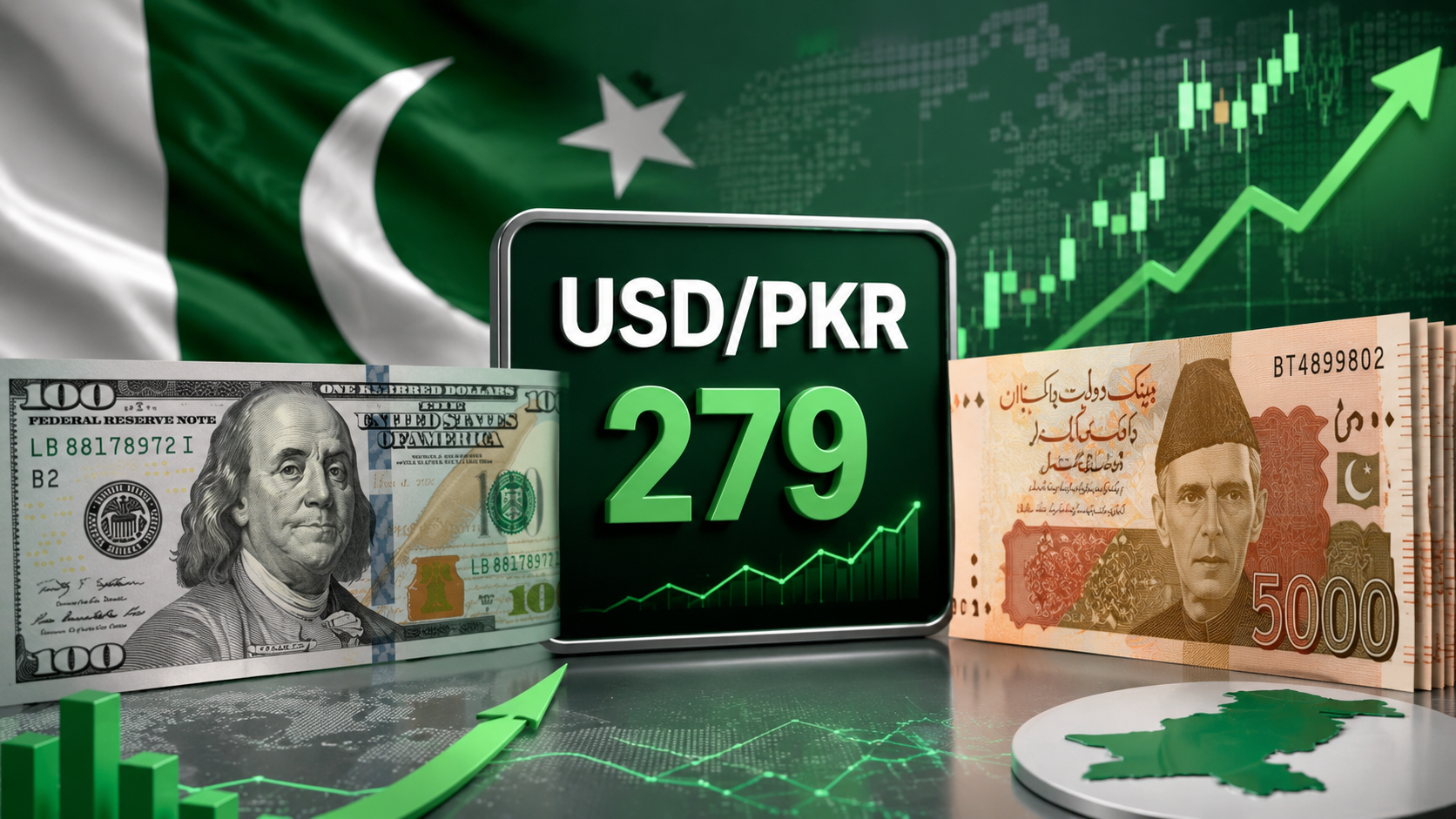
Today's Dollar Rate in Pakistan — May 14, 2026
This morning, something quietly remarkable is happening at currency exchange windows across Pakistan. The dollar is sitting at Rs 279. Stable. Calm. Almost eerily uneventful for a currency pair that has given Pakistani families some of the most anxious moments of the past decade. Three years ago, in September 2023, the dollar hit Rs 308. Families planning children's education abroad panicked. Freelancers watched their rupee earnings shrink in real value. Importers scrambled. Businesses hedged desperately against further falls.
Today — in the middle of a regional war, with oil prices elevated, inflation at 10.9%, and Pakistan carrying external debt obligations — the dollar rate in Pakistan is Rs 279. Lower than it was at the 2023 peak. Holding steady for weeks. This is not an accident. And understanding why it is happening — and whether it will last — is genuinely important for every Pakistani family that earns, spends, saves, or sends money across borders.
Here are today's confirmed rates across all markets:
| Market | Buying Rate | Selling Rate |
|---|---|---|
| Interbank | Rs 279.05 | Rs 279.05 |
| Open Market | Rs 278.90 | Rs 279.85 |
| SBP Reference Rate | Rs 279.65 | — |
As of May 14, 2026, the official rate for the US Dollar is Rs 279.05 in the interbank market. The Pakistani Rupee is holding its own this Thursday. According to fresh data from the Forex Association of Pakistan, the open market dollar rate shows the US Dollar sitting at Rs 278.9 buying and Rs 279.85 selling. Travelers and investors are seeing a very tight spread right now, which basically means the market has plenty of cash and demand is staying under control across Karachi, Lahore, and Islamabad.
Today's Full Currency Rate Table — All Major Currencies
For anyone sending or receiving money from abroad — whether you are receiving remittances from Saudi Arabia, the UAE, or the UK, or paying for international services — here are today's complete rates:
Euro (EUR) is trading at Rs 326.60 for buying and Rs 330.70 for selling, while the UK Pound Sterling (GBP) is at Rs 376.85 and Rs 380.44 respectively. UAE Dirham (AED) is available at Rs 75.85 buying and Rs 76.65 selling, and the Saudi Riyal (SAR) is at Rs 74.35 buying and Rs 75.05 selling. Other notable rates include the Australian Dollar (AUD) at Rs 199.95/207.35, Canadian Dollar (CAD) at Rs 202.35/208.35, and Swiss Franc (CHF) at Rs 355.92/360.65. Japanese Yen (JPY) remains at Rs 1.76/1.86, the Kuwaiti Dinar (KWD) at Rs 880.42, the Omani Riyal (OMR) at Rs 722.50/737.59, and the Qatari Riyal (QAR) at Rs 74.75/76.75.
For Pakistanis receiving remittances from Saudi Arabia and the UAE — where millions of Pakistani workers are based — today's rates translate as: SAR 1,000 (1,000 Saudi Riyals) = approximately Rs 74,350–75,050 at today's rate. AED 1,000 (1,000 UAE Dirhams) = approximately Rs 75,850–76,650 at today's rate. These rates are meaningfully better than they were at the 2023 peak, when the rupee's collapse made every remittance worth significantly less in real terms for families receiving it.
Why Is the Rupee So Stable Right Now?
This is the question that deserves a proper explanation — because understanding it helps you make better financial decisions. Pakistan's rupee stability in May 2026 is the product of four specific factors working together. None of them was guaranteed. All of them could change.
Factor 1 — The IMF Programme Is On Track
The single most important anchor for the rupee right now is Pakistan's compliance with its IMF programme. The IMF approved $1.32 billion in fresh funding just last week — the third major tranche — pushing State Bank of Pakistan reserves above $17 billion. Over the past year, the average exchange rate was 281.43 Pakistani Rupees per US Dollar. The high point for USD/PKR was Rs 285.29 on July 21, 2025. The low point was Rs 278.40 on April 3, 2026 — showing a clear trend of rupee strengthening rather than weakening over the past twelve months. When reserves are high, the State Bank can intervene in the currency market to prevent sharp depreciation. With $17 billion in reserves — compared to barely $4 billion during the 2023 crisis — the SBP has genuine firepower to defend the rupee against speculative pressure.
Factor 2 — Remittances Are Strong
Pakistan receives over $38 billion in annual remittances — money sent home by Pakistanis working in Saudi Arabia, the UAE, the UK, the US, and dozens of other countries. This constant inflow of foreign exchange is one of the most powerful stabilising forces for the rupee. The State Bank's strict monitoring of unregulated trading has contributed to current stability. If remittance inflows from overseas Pakistanis decrease, the dollar rate in Pakistan increases. Right now, remittances remain strong — and the Hajj and Umrah season currently underway is pushing Saudi Riyal and Dirham supply into the market as returning pilgrims exchange foreign currency.
Factor 3 — Reduced Import Pressure
Pakistan's import bill has been tightly managed under the IMF programme. The previous government's strategy of controlling imports — controversial and painful for businesses — successfully reduced the pressure on foreign exchange reserves that had contributed to the 2023 collapse. Managed imports are preventing that pressure of buying demand on the dollar that usually sinks the Rupee. Even with global shifts, the supply of Saudi Riyal and UAE Dirham is meeting the needs of travelers and pilgrims right now.
Factor 4 — Reduced Rupee Speculation
After the crackdown on unauthorised money exchange and currency speculation in 2023–2024, the gap between interbank and open market rates has narrowed dramatically. The tight spread of Rs 278.90 to Rs 279.85 that you see today — a difference of less than Rs 1 — would have been unimaginable in 2022, when the open market was trading Rs 5–10 above the interbank rate.
The Risk That Is Being Ignored
Here is the honest part that most currency articles leave out. The current rupee stability is real — but it is sitting on top of real underlying vulnerabilities that have not gone away. The oil import bill is enormous. Pakistan's fuel import costs have jumped from $300 million to over $800 million per month due to the Hormuz crisis. This sustained drain on foreign exchange is being covered by IMF inflows and remittances right now. If either of those two pillars weakens, the arithmetic gets difficult very quickly. The current account deficit is under pressure. Every month that oil stays above $100 per barrel adds to Pakistan's foreign exchange outflows. The IMF programme covers a portion of this — it does not cover all of it indefinitely.
The rupee is not "strong" in a fundamental sense. Over the past 10 years, the US Dollar has appreciated 166% against the Pakistani Rupee. Consequently, the US Dollar has gained significant purchasing power compared to the Pakistani Rupee over the last decade. Today's stability is welcome — but it is stability at a rate that is still 166% weaker than a decade ago. The 2026 budget will matter enormously. The upcoming federal budget, expected in June, will determine whether Pakistan's fiscal path tightens further or eases. A budget that deviates significantly from IMF targets could trigger renewed currency pressure quickly.
What This Means for Different Groups of Pakistanis
For Freelancers and Remote Workers
Today's rate of Rs 279 means every $100 you earn from Upwork, Fiverr, or any international client equals Rs 27,900. Compare this to two years ago when the same $100 was worth around Rs 28,500–30,000 during the brief period of elevated rates — but the economic chaos made banking it difficult. The current stability suggests the PKR has hit a sweet spot, making it a safe time to handle currency conversions. For freelancers withdrawing through Payoneer or Wise to local bank accounts, this predictability is genuinely valuable for financial planning. The practical advice: avoid holding large dollar balances indefinitely if you need rupees for expenses. The current stable rate makes conversion sensible. Holding dollars on the hope of a significant further rupee depreciation is speculation, not planning.
For Families Receiving Remittances
The stable rate is good news for the millions of Pakistani families dependent on money sent from abroad. Your monthly transfer from Saudi Arabia, the UAE, or the UK is converting at predictable rates that allow proper household budgeting. The practical advice: use bank-to-bank transfers rather than informal channels (hundi/hawala) — the premium for informal channels has largely disappeared now that the official market is functioning properly. You are also protected against fraud and non-delivery when you use formal channels.
For Anyone Planning to Pay in Foreign Currency
Students applying for international programmes, businesses ordering imported goods, families planning trips abroad — all of you benefit from the current stability. The dollar forecast for May 2026 shows a range of Rs 275–283, with an average of Rs 279. June forecast shows a similar range of Rs 275–284 with an average of Rs 280. This suggests relative stability through at least the next 6–8 weeks — though geopolitical developments around the Iran ceasefire remain the primary wildcard. If you need to make a significant foreign currency payment in the next 30–60 days, doing it now at current stable rates — rather than waiting and hoping for the rupee to strengthen further — is the more prudent approach for most ordinary Pakistanis.
Dollar Rate History: How Far Pakistan Has Come
To appreciate today's stability, a quick look at where the rupee has been is genuinely useful:
| Period | USD to PKR Rate | Key Event |
|---|---|---|
| May 2016 | Rs 104 | Stable pre-CPEC era |
| August 2018 | Rs 124 | Devaluation cycle begins |
| June 2019 | Rs 157 | IMF programme entered |
| July 2022 | Rs 211 | Flood crisis, political chaos |
| September 2023 | Rs 308 | All-time high — peak crisis |
| January 2024 | Rs 280 | IMF stabilisation begins |
| May 2025 | Rs 285 | India-Pakistan tensions |
| April 2026 | Rs 278 | Post-IMF tranche low |
| May 14, 2026 | Rs 279 | Current rate — stable |
The high point for USD/PKR was Rs 285.29 on July 21, 2025. The low point was Rs 278.40 on April 3, 2026. The direction — from Rs 308 in 2023 to Rs 279 today — is a genuine, measurable improvement in Pakistan's economic position that deserves acknowledgement.
The Forecast: What Analysts Expect for the Rest of 2026
The USD to PKR forecast for the remainder of 2026 shows relative stability through year end. The September 2026 forecast projects an average of Rs 278 with a high of Rs 282 and low of Rs 274. By December 2026, the average is projected at Rs 276, suggesting a slight further strengthening of the rupee if economic conditions hold. This is a forecast, not a guarantee. The assumptions behind it include a gradual resolution of the Iran crisis and continued IMF programme compliance. Both of those assumptions face real risks.
The scenarios that could push the dollar higher — back toward Rs 285–290 — include a ceasefire collapse that drives oil prices higher, an IMF programme review that uncovers missed targets, or a significant reduction in remittance flows. The scenarios that could push the dollar lower — toward Rs 270–275 — include a genuine Iran peace deal that reduces oil prices significantly, continued strong remittance inflows, and successful June budget passage in line with IMF targets. The most likely scenario is continued stability in the Rs 275–285 range through 2026 — which, for families and businesses making plans, is a useful baseline.
What to Actually Do With This Information
Let us end practically. If you need to convert currency in the next 30 days: Do it at current rates. The stability window is real and the rates are reasonable. If you are a freelancer: Set your monthly budget in rupees at Rs 278–280 per dollar. Build in a buffer for minor fluctuations. Do not structure your finances around the assumption of a significant rupee depreciation — the fundamentals currently do not support it. If you are receiving remittances: Use official channels. The premium for informal methods has disappeared. You get better rates, better protection, and your family gets it faster. If you are planning a foreign trip or payment: Budget at Rs 280–285 to be conservative. You may end up paying slightly less — which is a pleasant surprise rather than a budget crisis. If you are watching this as an investment signal: The rupee's stability reflects Pakistan's improved macroeconomic fundamentals. It also reflects genuine risks that have not gone away. Stability today is not guaranteed tomorrow. Plan accordingly — neither panicking nor becoming complacent.
Disclaimer: Exchange rate information in this article is for educational and informational purposes only and does not constitute financial or investment advice. Exchange rates fluctuate constantly. Always verify current rates with a licensed exchange company or your bank before transacting. Consult a qualified financial advisor for personalised financial decisions.