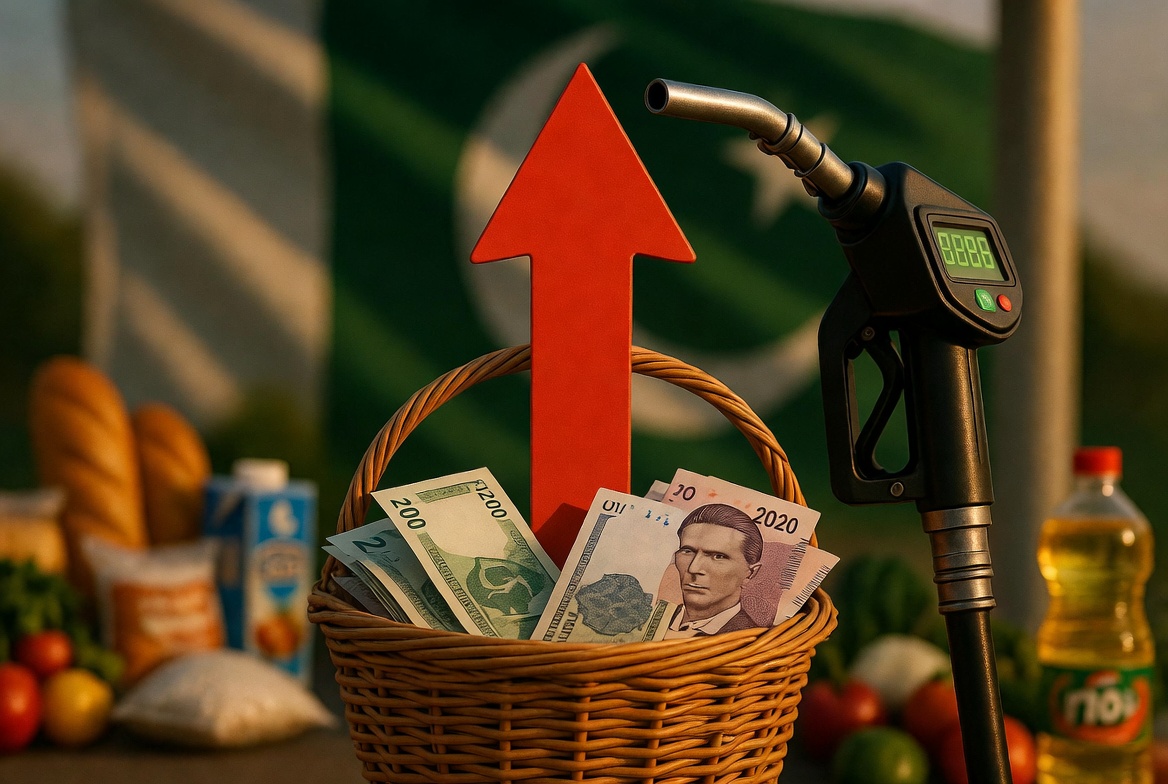
Inflation Is Back in Double Digits — Here's the Reality
If you've been to a grocery store or filled up your motorcycle with petrol recently, you already know something is off. Prices are climbing — fast. That feeling in your gut when you look at the receipt? That's inflation doing what it does best: quietly eating away at your buying power while life keeps moving forward. Let's talk about what is really going on with Pakistan's economy right now, why your monthly budget feels tighter than ever, and what the numbers actually mean for you and your family.
Pakistan's headline inflation jumped to 10.9% in April 2026, a sharp rise from 7.3% recorded in March. That might sound like a government statistic that has nothing to do with your daily life — but it absolutely does. Think about it this way. If you were spending Rs. 20,000 a month on groceries and household expenses last year around the same time, you are now effectively spending more than Rs. 22,000 for the same items. And that gap is only growing.
What made April particularly painful was the breadth of the price hikes. It wasn't just one category that went up. Housing and utilities surged by 16.8%, transport costs jumped by nearly 30%, and food prices — the one thing that hits every household directly — rose by 7.6%. These are not small numbers.
The weekly inflation data, released by the Pakistan Bureau of Statistics for the week ending May 7, 2026, showed another 0.79% increase in the Sensitive Price Index (SPI). On a year-on-year basis, that weekly SPI figure sits at 15.16%. The main culprits? Petrol, diesel, electricity, chicken, fresh milk, meat, mutton, and flour. Basically, everything that ends up on your plate or gets you to work in the morning.
Why Are Fuel Prices the Biggest Problem Right Now?
At the heart of this inflation story is fuel — and the reason fuel is so expensive right now goes beyond Pakistan's borders. The ongoing conflict in the Middle East has sent global oil prices soaring. Pakistan, which depends heavily on imported energy, is feeling that shock more than most countries. The country's fuel import bill reportedly surged from around $300 million to $800 million, putting enormous pressure on foreign exchange reserves and the current account.
Here is where it gets complicated for the government. They are caught between two difficult choices. If they pass the full cost of global oil prices onto Pakistani consumers, public anger will be immediate and intense. If they subsidise fuel to cushion the blow, the fiscal deficit balloons and the IMF program — which Pakistan cannot afford to lose — comes under threat. Diesel alone drives a huge chunk of the country's economy. Trucks that carry goods across the country, tractors that plant and harvest crops, generators that keep factories running — they all run on diesel. When diesel prices go up, the cost of nearly everything else follows.
The IMF Factor and Pakistan's Economic Balancing Act
The International Monetary Fund recently approved a $1.2 billion tranche for Pakistan, a sign that the reform program is still on track. But with that support comes continued pressure to maintain fiscal discipline — meaning the government cannot simply spend its way out of this inflation problem.
The IMF has revised its projections for Pakistan. GDP growth for FY27 has been cut to 3.5%, while inflation expectations for that same year have been raised to 8.4%. In simpler terms: slower growth, higher prices — not exactly an encouraging combination for families already stretched thin.
That said, the State Bank of Pakistan's own half-year report for FY26 paints a slightly more balanced picture. The report highlights genuine improvements in Pakistan's macroeconomic stability during the first half of the year — inflation eased in those months, foreign exchange reserves strengthened, and financial inflows improved. The problem is that the second half of the year has brought fresh pressures, largely driven by global events outside Pakistan's control.
The Asian Development Bank (ADB), in its own recent assessment, projects that Pakistan's economy will continue to grow, but warns that downside risks are significant — particularly if the Middle East conflict drags on and continues to disrupt energy and remittance flows.
What About the Common Person's Pocket?
Statistics and projections are one thing. But let's speak plainly about what this means for the average person in Lahore, Faisalabad, Karachi, or any other city. Petrol prices affect everything. When the cost of running a delivery van goes up, shopkeepers raise prices. When electricity bills increase, manufacturers pass those costs to consumers. When flour becomes more expensive, every naan and roti on your table costs more. This is called a cost-push inflation spiral, and once it starts, it takes a long time to stop.
For the lowest income groups — families earning below Rs. 17,732 per month — even a 0.69% weekly increase in the SPI is devastating. These households spend the largest proportion of their income on food and basic utilities. There is no financial buffer. Every price hike is felt immediately and completely.
Middle-income families are also struggling in ways that are less visible. School fees, rent, petrol for the car, medical expenses — these don't come down just because inflation is inconvenient. Many households are quietly burning through savings or cutting back on non-essential spending just to maintain their standard of living.
Is There Any Good News?
It would be unfair to paint the entire picture in dark colours. There are genuine positives worth acknowledging. Pakistan's forex reserves have improved compared to the crisis-level lows seen a couple of years ago. The IMF programme has provided stability and international credibility. The agricultural sector, despite some pressure, has not collapsed. And remittances from overseas Pakistanis — though under risk from Middle East tensions — continue to provide a meaningful economic lifeline.
The State Bank of Pakistan is expected to ease monetary policy cautiously as inflation stabilises, which could eventually bring down borrowing costs for businesses and improve economic activity. But this will take time, and any misstep in reform implementation could reverse the progress made.
Looking Ahead: What to Watch
Over the coming weeks and months, several things are worth keeping an eye on. First, the direction of global oil prices — if the Middle East situation stabilises, fuel prices could ease and bring relief across the board. Second, the government's upcoming budget decisions will reveal how it plans to balance fiscal discipline with the very real economic pain being felt by millions of Pakistanis. Third, the State Bank's monetary policy stance — whether it cuts interest rates and by how much — will shape business investment and borrowing costs going forward.
Pakistan's economic story in 2026 is not one of collapse, but it is certainly one of strain. The foundations are there. The reforms are moving, however slowly. But for the millions of families trying to make ends meet amid rising prices, those macro-level improvements feel distant. The real question is not just whether Pakistan's economy will grow — it is whether that growth will reach the people who need it most, before the weight of inflation becomes too heavy to carry.