Introduction: The Classroom Without Walls Has Finally Arrived
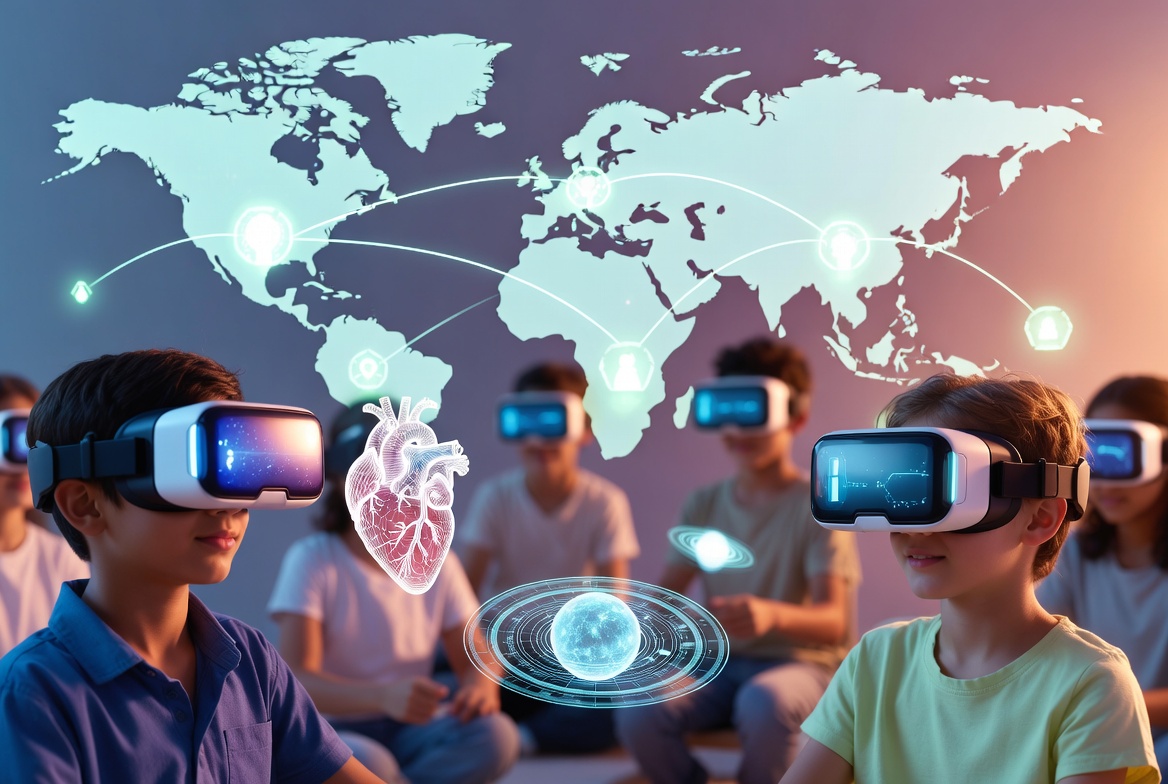
Maria sits in her apartment in Manila, puts on a lightweight headset, and suddenly she's standing inside a human heart. Not looking at a diagram. Not watching a video. Standing inside it, watching blood cells rush past her as her professor—teaching from London—points out the mitral valve. Three thousand miles away, Carlos in São Paulo stands beside her, asking questions in real-time. This isn't science fiction. This is what VR classrooms and spatial learning look like in 2026.
For decades, remote education meant staring at a flat screen, fighting Zoom fatigue, and pretending a grid of thumbnail faces created genuine connection. Students reported feeling isolated. Teachers struggled to gauge understanding through muted microphones. Dropout rates for online courses hovered between 40% and 60%—not because the content was poor, but because the experience was fundamentally broken. The global remote education market desperately needed transformation.
That transformation has arrived. And it's not what most people expected.
Table of Contents
- What Are VR Classrooms Actually Like in 2026?
- The Science Behind Spatial Learning: Why Your Brain Prefers 3D
- Real Schools Already Winning With VR Education
- The Hardware Revolution: What You Actually Need (And What It Costs)
- Implementation Roadmap: How Schools Can Adopt VR Without Breaking
- The Global Student Advantage: Crossing Borders Without Leaving Home
- Challenges Nobody Talks About (And How to Solve Them)
- Frequently Asked Questions
- Conclusion: The Classroom Without Borders
What Are VR Classrooms Actually Like in 2026?
Let's be specific. When people hear "VR education," they often picture clunky headsets and cartoonish avatars from 2017. The reality in 2026 is unrecognizably better.
Modern educational VR platforms combine three elements that create genuine presence—the psychological sensation of "being there" rather than "looking at there." First, photorealistic environments rendered in real-time by headsets like the Apple Vision Pro, Meta Quest 4, and Pico 5. Second, spatial audio that places voices precisely where they should originate. When the student to your virtual left speaks, their voice comes from your left. Third, hand and eye tracking that captures natural gestures and gaze direction.
The combination transforms abstract concepts into embodied experiences. Medical students practice surgical techniques on virtual cadavers that provide haptic feedback. Architecture students walk through their designs before a single brick is laid. Language learners order coffee in simulated Parisian cafes where virtual baristas respond to pronunciation and grammar.
One platform leading this transformation is Engage XR, which now hosts over 1,800 educational institutions globally. Their latest data shows students in VR classrooms demonstrate 27% higher information retention compared to traditional video-based remote learning. The difference isn't marginal—it's transformational.
The Science Behind Spatial Learning: Why Your Brain Prefers 3D
There's a reason you remember the layout of your childhood home but struggle to recall slides from last week's PowerPoint presentation. Human brains evolved to navigate and remember three-dimensional spaces. This isn't opinion—it's neuroscience.
Spatial learning leverages the brain's innate mapping systems. When you learn information associated with a specific location in a virtual environment, you're encoding that knowledge using the same neural mechanisms that help you remember where you parked your car. The hippocampus—your brain's memory center—activates more strongly during spatial learning than during passive screen viewing.
Research from Stanford's Virtual Human Interaction Lab demonstrates that VR learning experiences generate 3.75 times more emotional connection to content than traditional video. Emotional connection correlates directly with memory formation. You remember what you feel.
Consider the implications for different subjects:
- History: Instead of reading about ancient Rome, students walk through a reconstruction of the Forum during Caesar's time. They hear the crowd, see the architecture, and understand scale in ways no textbook can convey.
- Biology: Students shrink to cellular size and travel through the human body, observing processes like mitosis or immune response from inside the action.
- Chemistry: Molecular structures become tangible objects students can manipulate, bond, and break apart—building intuitive understanding before mathematical formalization.
- Literature: Students step into the settings of novels, experiencing the spatial and atmospheric context that shaped characters' decisions.
The research consensus is clear: spatial learning doesn't just make education more engaging. It makes it more effective.
Real Schools Already Winning With VR Education
Case studies matter more than promises. Here's what's actually working in 2026.
Case Study 1: Morehouse College's VR Campus
Morehouse College in Atlanta pioneered what they call the "Metaversity"—a complete digital twin of their physical campus where students attend classes, meet with professors during office hours, and even participate in virtual extracurricular activities. After three years of operation, their data tells a compelling story.
Students in VR-enhanced courses showed a 10.7% improvement in final grades compared to traditional online sections of the same courses. Attendance increased from 75% to 92%. Perhaps most significantly, course evaluation scores for "feeling connected to classmates" rose from 3.2 to 4.6 on a five-point scale.
Dr. Muhsinah Morris, who leads the program, emphasizes that VR doesn't replace in-person education—it enhances remote learning to approach residential quality. "Students who can't physically attend Morehouse," she explains, "can now experience something far closer to being here than any previous technology allowed."
Case Study 2: Pakistan's Virtual University Expansion
Virtual University of Pakistan deployed VR classrooms to reach students in remote areas where physical campus attendance remains impossible for many—particularly women facing mobility restrictions. Their pilot program equipped 500 students with headsets and created virtual laboratories for science courses that previously required physical presence.
The results exceeded expectations. Female student enrollment in STEM courses increased 34%. Laboratory practical exam scores matched in-person cohorts within two percentage points. The university is now scaling to 5,000 students with funding from international development partners who see VR as a solution to gender gaps in STEM education.
Case Study 3: Global Medical Training Collaborative
A consortium of teaching hospitals across six countries now uses VR for surgical training collaboration. Residents in Nigeria, Brazil, India, and the UK train together in shared virtual operating theaters, learning techniques from specialists who could never physically visit every location.
The program has documented 23% faster skill acquisition compared to traditional observation-based training. More importantly, it's democratizing access to specialized surgical education that was previously concentrated in a handful of wealthy institutions.
The Hardware Revolution: What You Actually Need (And What It Costs)
Let's address the elephant in the virtual room: cost. Many educators assume VR requires expensive equipment beyond institutional budgets. The 2026 reality is more nuanced.
Entry-Level: Mobile VR ($0-100 per student)
Students use smartphones they already own with inexpensive headset adapters. The experience lacks hand tracking and high-end graphics but still delivers immersive 360-degree content. Platforms like Google Expeditions Pro and Nearpod VR operate in this tier. Suitable for occasional VR experiences rather than full courses.
Mid-Range: Standalone Headsets ($300-500 per student)
The Meta Quest 4 and Pico 5 dominate this category. These devices require no external computer or sensors—everything is built in. Hand tracking, spatial audio, and sufficient processing power for educational applications. Most institutions deploying VR at scale operate in this tier.
Premium: Mixed Reality Headsets ($1,500-3,500 per student)
Apple Vision Pro, Varjo XR-4, and enterprise-focused devices offer photorealistic passthrough, precise eye tracking, and professional applications. Medical schools and advanced engineering programs justify these investments through shared device programs—students check out headsets like library books rather than owning them individually.
The Hidden Cost Nobody Budgets For
Hardware is visible. Content development is invisible until it's too late. Schools consistently underestimate the investment required to create or license quality VR educational content. Off-the-shelf experiences rarely align perfectly with curriculum requirements. Custom development costs range from $50,000 for simple modules to $500,000+ for comprehensive course coverage.
The solution emerging in 2026 involves consortia—groups of institutions sharing development costs and content libraries. The Global VR Education Alliance now includes over 400 member institutions pooling resources to create standards-aligned experiences across major subjects.
Implementation Roadmap: How Schools Can Adopt VR Without Breaking
Based on analysis of successful VR deployments across 50+ institutions, here's the pragmatic path to adoption that minimizes risk while maximizing impact.
Phase 1: Pilot With Enthusiasts (3-6 months)
Identify 2-3 faculty members already interested in immersive technology. Equip them and their students with 10-15 headsets. Run a single course module in VR. Measure engagement, comprehension, and satisfaction against traditional delivery. This phase answers the question: "Does VR meaningfully improve outcomes in our specific context?"
Phase 2: Targeted Scaling (6-12 months)
Based on pilot results, expand to courses where spatial understanding provides clear advantage—anatomy, architecture, engineering, art history. Develop or license content specifically for these use cases. Train additional faculty through peer mentoring rather than centralized workshops (which consistently underperform).
Phase 3: Infrastructure Building (12-18 months)
Establish dedicated VR lab spaces with charging stations, hygiene supplies, and technical support. Implement device management software that allows remote updates and usage tracking. Create content development capacity—either internal team or preferred vendor relationships.
Phase 4: Strategic Integration (18-24 months)
Move VR from special projects to standard infrastructure. Integrate with learning management systems. Develop assessment methodologies that capture spatial learning outcomes. Contribute to shared content libraries to reduce ongoing costs.
The institutions succeeding with VR share one characteristic: they treat implementation as change management, not technology procurement. Faculty buy-in determines outcomes more than hardware specifications.
The Global Student Advantage: Crossing Borders Without Leaving Home
For international students, VR classrooms solve three persistent problems that traditional remote education couldn't address.
Problem 1: The Social Isolation Gap
International remote students historically reported the highest isolation rates and lowest completion percentages. Time zone differences meant live sessions happened at 3 AM. Discussion forums felt like shouting into voids. VR's persistent environments allow asynchronous social presence—students visit virtual campuses at convenient times and encounter classmates organically, rebuilding the casual interactions that form genuine community.
Problem 2: The Experiential Deficit
Reading about laboratory techniques or watching surgical videos cannot replace hands-on experience. International students unable to travel for practical components faced significant learning gaps. VR laboratories and simulation environments now provide 80-90% of the practical experience at a fraction of travel costs.
Problem 3: The Cultural Immersion Disconnect
Language learning without cultural context produces technically proficient speakers who miss nuance. VR environments recreate cultural settings—markets, workplaces, social gatherings—where students practice not just vocabulary but appropriate behavior, gesture, and social timing. Studies show VR-trained language learners demonstrate 40% higher cultural competency scores than traditional online learners.
Challenges Nobody Talks About (And How to Solve Them)
VR education isn't magic. Significant challenges remain, and honest discussion of limitations builds credibility with skeptical stakeholders.
Motion Sickness: Approximately 15-20% of users experience discomfort in VR, particularly during movement-intensive experiences. Solutions include teleportation-based navigation, shorter session duration (20-30 minutes maximum), and gradual exposure protocols that reduce sensitivity over time. Hardware improvements in 2026 have reduced but not eliminated this issue.
Accessibility Gaps: Students with visual impairments, mobility limitations, or certain neurological conditions may find VR inaccessible or uncomfortable. Leading platforms now include accessibility features—audio descriptions, seated modes, simplified interfaces—but gaps remain. Institutions must maintain alternative pathways for affected students.
Faculty Resistance: Many professors, particularly those later in their careers, view VR as a gimmick rather than legitimate pedagogy. Mandating participation backfires. Successful institutions identify enthusiastic early adopters, provide them with resources and recognition, and let their success stories drive organic adoption among peers.
Equity Concerns: If VR becomes essential for education, students without access to hardware face new forms of disadvantage. Institutional device lending programs and mobile VR options that work with existing smartphones partially address this. However, true equity requires treating VR access as infrastructure—like library computers or campus WiFi—rather than individual responsibility.
Frequently Asked Questions
Q: Will VR replace physical classrooms entirely?
A: No credible expert predicts total replacement. VR excels at specific educational experiences—spatial understanding, dangerous simulations, impossible perspectives. Physical classrooms remain superior for certain types of discussion, hands-on material manipulation, and social bonding. The future is blended, not binary.
Q: How much does it actually cost per student per year?
A: Amortizing hardware over three years, adding software licensing, and including content development, institutions report $180-350 per student annually for moderate VR integration. This compares favorably to physical laboratory equipment costs but exceeds traditional online course budgets. Grant funding and consortium participation significantly reduce effective costs.
Q: What subjects benefit most from VR education?
A: Anatomy, architecture, engineering, chemistry, art history, astronomy, and any subject where spatial relationships or impossible perspectives enhance understanding. Subjects primarily involving textual analysis—literature, philosophy, history (excluding immersive reconstructions)—benefit less proportionally.
Q: How do we assess learning in VR environments?
A: Assessment is evolving beyond multiple-choice tests. VR platforms now capture behavioral data—where students look, what they manipulate, how long they spend on specific elements. Combined with traditional assessments, this creates richer understanding of student comprehension. Some institutions are developing performance-based assessments where students demonstrate skills within VR rather than describing them on paper.
Q: What about students who can't use VR due to medical conditions?
A: Institutions must maintain equivalent alternative pathways. This typically involves desktop versions of VR experiences (reduced immersion but same core content) and additional written materials. Accessibility requirements under laws like the Americans with Disabilities Act and similar global frameworks apply to educational VR just as they apply to physical classrooms.
Conclusion: The Classroom Without Borders
VR classrooms and spatial learning represent something more significant than another educational technology trend. They address fundamental limitations of remote education that have persisted for decades—the absence of genuine presence, the difficulty of conveying spatial concepts, the isolation of distance learners.
The evidence from 2026 is clear: when implemented thoughtfully, with faculty buy-in and adequate support, VR enhances learning outcomes, increases engagement, and creates educational opportunities that transcend geography. A student in rural Pakistan can now dissect the same virtual cadaver as a student at Johns Hopkins. A language learner in Brazil can practice conversation in simulated Parisian cafes alongside classmates from six continents.
This doesn't replace the value of physical presence—the friendships formed in dormitories, the mentorship that happens in office hours, the transformative experience of living in a new culture. But for millions of students who cannot access those experiences, VR offers something unprecedented: a genuine approximation of being there.
The classroom without walls isn't coming. It's already here. The only question is whether your institution will help shape it—or scramble to catch up.
The future of global education is spatial. Are you ready to step inside?