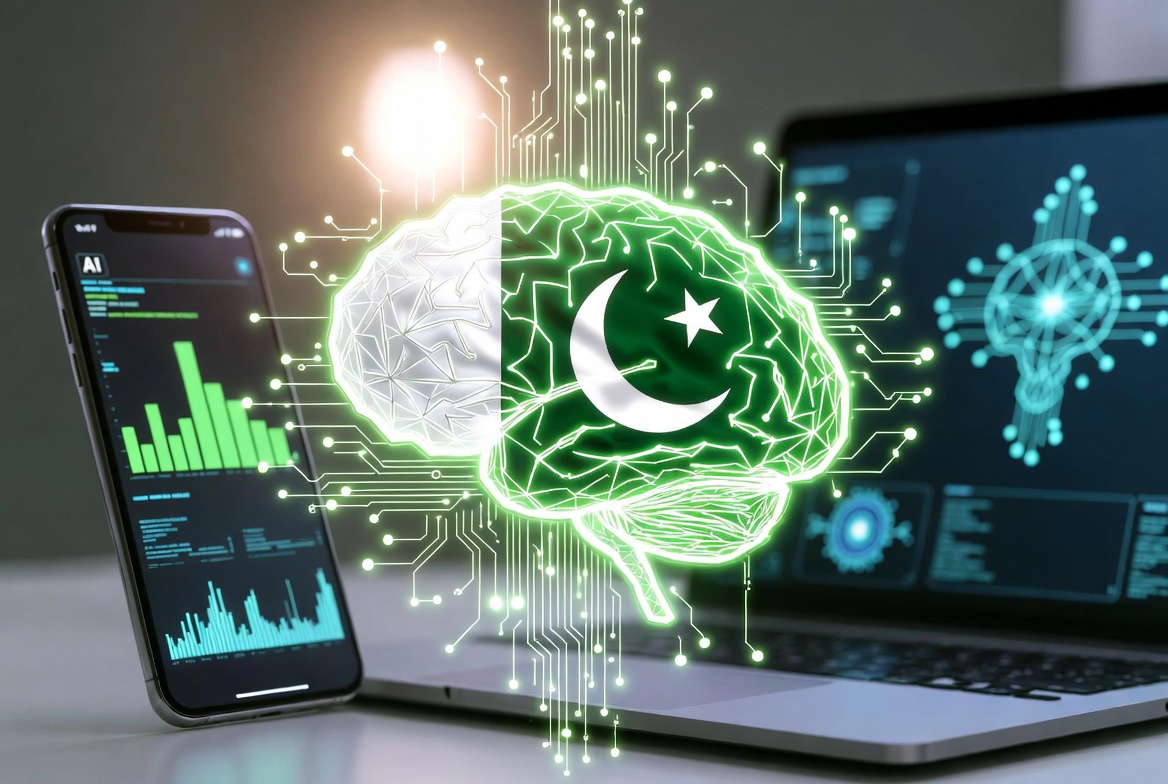
Pakistan Is Moving Faster Than Most People Realise
Something significant happened in Islamabad this February. Prime Minister Shehbaz Sharif stood at the opening ceremony of Indus AI Week 2026 and made an announcement that would have sounded like science fiction just five years ago. The government of Pakistan is committed to investing $1 billion in artificial intelligence by 2030 to build a fully functional AI ecosystem in the country.
One billion dollars. In artificial intelligence. In Pakistan. That is not a press release buried on a government website. It is a national declaration that the country has chosen its technological future — and it wants ordinary Pakistanis to be part of it.
Artificial intelligence in Pakistan is no longer a subject discussed only in university computer science departments or startup meetups in Karachi. It is in government policy, in school curricula, in the apps millions of Pakistanis already use every day — and increasingly, in the job market that determines whether the next generation prospers or struggles. Here is the honest, complete picture of where Pakistan stands with AI in 2026, what the opportunities are, and what the very real challenges still need to be addressed.
The statistics coming out of Pakistan in 2026 are surprising — and they deserve to be better known. A staggering 86% of professionals in Pakistan report using AI tools for their work tasks — significantly higher than many developed nations. From students using ChatGPT to prepare assignments to marketers generating social media content to doctors using AI-assisted diagnostic tools, artificial intelligence has become the default co-pilot for a remarkable proportion of Pakistan's working population.
Pakistan ranks fourth globally, with 76% of the population familiar with ChatGPT, according to Stanford University's AI Index Report. Fourth in the world. Ahead of most European nations. Ahead of countries with far more advanced digital infrastructure. This tells you something important about Pakistan's relationship with technology. The country has always been a fast adopter at the consumer level — mobile penetration, WhatsApp usage, social media engagement all happened faster in Pakistan than formal infrastructure investments would have predicted. AI is following the same pattern. The question is whether the government, the education system, and the private sector can build the formal infrastructure to match the grassroots enthusiasm that is already there.
What the Government Is Actually Doing
For once, the government's plans match the scale of the ambition — at least on paper. Federal Minister for IT and Telecom Shaza Fatima Khawaja has unveiled a national AI strategy targeting the training of one million individuals in artificial intelligence to ensure the workforce remains competitive. The current software export target of $3.8 billion is being scaled toward a long-term milestone of $15 billion.
Training one million people in AI skills is an enormous undertaking. To put it in perspective, that is roughly the entire current population of Islamabad going through AI training — every man, woman, and teenager in the capital city. The government launched the AI Seekho 2026 program in partnership with Google for Developers, Telenor Pakistan, and leading IT company Innovista. The program is designed to introduce hands-on "vibe coding" — which refers to the practice of prompting AI tools to generate code rather than writing it manually — using tools like Google AI Studio.
PM Shehbaz also announced that an AI curriculum would be introduced not only in all federally-controlled schools but across all schools in Azad Jammu and Kashmir and Gilgit-Baltistan, with plans to extend implementation to remote parts of Balochistan. The government will also provide 1,000 fully-funded PhD scholarships in AI to students across the country. These are not small gestures. An AI curriculum in schools from Karachi to Gilgit would mean an entire generation of Pakistani children grows up understanding artificial intelligence as a basic literacy — the same way previous generations learned to read or use a computer.
Whether the implementation matches the announcement is a separate question. Pakistan has a history of ambitious policy frameworks that struggle at the execution stage. But the direction is clear, the funding is committed, and the political will — at least for now — appears genuine.
What AI Actually Looks Like in Pakistan Today
The $1 billion announcement and the million-person training targets are future goals. What is artificial intelligence doing in Pakistan right now, on the ground, in real industries? More than most people realise.
In agriculture, which employs over 40% of Pakistan's workforce, AI is being used to analyse soil health, predict weather patterns more accurately, and detect crop diseases before they spread. A farmer in Sindh can receive an SMS alert telling him the optimal time to water his fields based on data from satellites and local sensors, conserving water and increasing yield. For a country where agriculture is the backbone of the economy and water scarcity is a growing crisis, this is not a luxury technology — it is a survival tool.
In the IT sector, the adoption is striking. Major Pakistani IT export firms report that up to 30% of their solutions now incorporate AI, largely driven by global demand. Pakistani software houses building products for international clients are integrating machine learning, natural language processing, and AI automation into their offerings because clients in the US, UK, and UAE are demanding it.
In telecoms, Zong has integrated AI models into its internal operations. Zong 4G integrated DeepSeek AI's open-source models to streamline operations and improve internal efficiencies through its AI-powered system, Zong Aeye.
In government services, AI-powered scanning technology at ports has been deployed to combat smuggling and tax evasion — with measurable results on revenue recovery that the Prime Minister himself cited publicly. The technology is not waiting for Pakistan to be ready. It is already here, already working, and already producing outcomes across sectors that touch the daily lives of millions of people.
The Opportunity for Pakistani Students and Workers
If you are a student, a fresh graduate, or someone in the middle of a career in Pakistan, the AI revolution is the single most important economic development you need to pay attention to. Pakistan's share of AI's economic impact is estimated to be between $10 billion and $20 billion by 2030. That value has to be created by somebody. The people who build the skills now — before the market is saturated, before AI skills become as common as basic computer literacy — are the ones who will capture a meaningful portion of that opportunity.
The skills that are in highest demand right now and will remain in demand through the decade:
- Prompt engineering — the ability to communicate with AI tools effectively to produce high-quality outputs. This is already a paid skill on international freelancing platforms and the barrier to entry is remarkably low.
- AI-assisted content creation — combining human editorial judgment with AI tools to produce content, graphics, videos, and marketing materials at scale.
- Data analysis — AI tools have made basic data analysis accessible to non-programmers, but human judgment about what the data means and what to do with it remains irreplaceable.
- AI integration for businesses — helping small and medium Pakistani businesses understand and implement AI tools in their operations. This is a consultancy opportunity that barely anyone in Pakistan is currently filling.
- Python and machine learning — for those willing to invest 6–12 months in serious technical learning, these skills command some of the highest freelancing rates on any international platform.
The free AI Seekho program, DigiSkills courses on digital tools, and internationally available resources from Coursera and Google are all accessible right now. The only thing between most Pakistani students and these skills is a decision to start.
The Honest Challenges That Cannot Be Ignored
Pakistan's AI ambitions are real. So are the obstacles standing between ambition and outcome.
Infrastructure gaps remain severe. Pakistan's investment in research and development remains limited, especially compared to technologically advanced economies. Many universities are constrained by insufficient research funding, inadequate laboratory resources, and a lack of industry collaboration. Building a million AI-skilled workers requires training facilities, trainers, and digital access that do not uniformly exist yet — particularly outside major cities.
Job displacement is a real risk. Approximately 17% of jobs in Pakistan are at high risk of automation. Sectors like manufacturing, customer service, and agriculture — traditionally reliant on manual labour — are undergoing notable changes. While these technological strides boost efficiency and productivity, they also present challenges in the form of potential job displacement. This is the difficult conversation that AI enthusiasm tends to skip. Yes, AI creates new jobs. It also eliminates existing ones — often faster than the new ones are created, and not always in the same locations or requiring the same people. A customer service worker in Lahore whose job is replaced by a chatbot does not automatically become a prompt engineer. That transition requires training, time, and support that the current system is not yet equipped to provide at scale.
Security risks are growing. Only 52% of Pakistani AI users are trained in safe AI use. Digital scams cost Pakistan an estimated $9 billion annually, highlighting the urgent need for AI-driven security measures. As AI tools become more accessible, so do the malicious applications — deepfake scams, AI-generated phishing attacks, and automated fraud schemes that are increasingly difficult for ordinary people to detect.
What This Means for Pakistan's Future
The honest assessment of artificial intelligence in Pakistan in 2026 is one of genuine potential intersecting with genuine risk. Pakistan is no longer a passive consumer of technology. The vision is clear: from being consumers of AI to becoming creators — from the farmer's SMS alert to the student's AI tutor to the doctor's diagnostic assistant. The infrastructure to realise that vision is being built, imperfectly and unevenly, but with more urgency than any previous technology moment in the country's history.
The economic stakes are enormous. Digital transformation could generate PKR 9.7 trillion for Pakistan by 2030. That is not government optimism — it is a figure from independent economic analysis. The path to that number runs directly through how effectively Pakistan educates its workforce, builds its digital infrastructure, and ensures that the benefits of AI reach beyond the educated elite in major cities.
For individual Pakistanis reading this right now, the window to build meaningful AI skills before the market catches up is still open — but it will not stay open indefinitely. The countries and the individuals who moved early on previous technology waves captured the majority of the value. The ones who waited for certainty found themselves in a crowded, commoditised market. AI in Pakistan is not a future story. It is a present one — and you are already in it, whether you have chosen to be or not. The question is what you do with that knowledge.