The Decision That Changes Everything
The day your matric result arrives is one of those moments that feels enormous — and then immediately confusing. Because the moment the celebration fades, a question arrives that nobody fully prepares you for. Now what? Your parents have opinions. Your relatives have opinions. Your friends are all choosing different paths. Every school and institute has a poster outside promising you a "bright future." And somewhere underneath all the noise, you are trying to figure out what you actually want — and what actually makes sense in the world as it exists in 2026.
This article is the guide I wish every Pakistani student had sitting in front of them the week after matric results. No hype. No "all fields are equal" diplomatic vagueness. Just the honest, complete picture of every option you have — what each path leads to, how long it takes, what it costs, and what the real employment market looks like at the end of it.
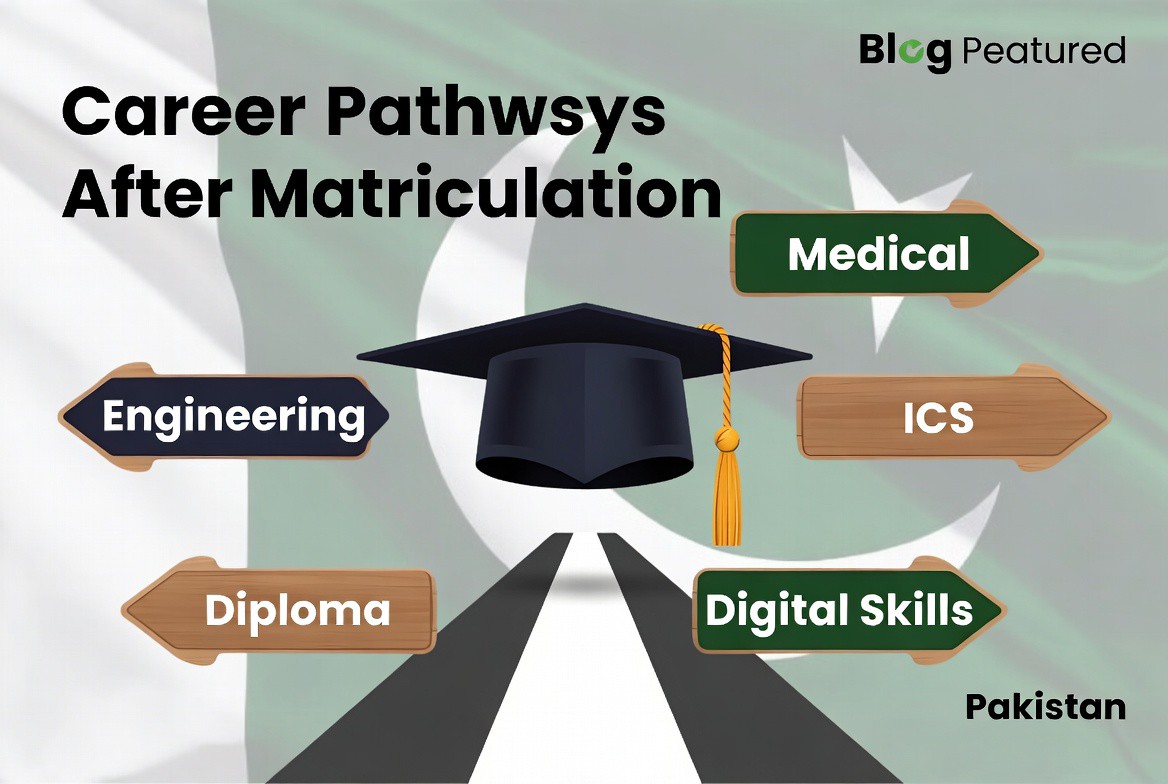
Before you look at any specific option, understand this: the choice you make after matric does not lock you into a single career forever. Pakistan's education system offers more flexibility than most students realise. From traditional routes like FSc Pre-Medical and FSc Pre-Engineering, which pave the way for careers in medicine and engineering, to modern choices like ICS and FA IT that cater to tech enthusiasts, each option opens doors to specific futures. The key is understanding which door leads where — and choosing based on your interests and goals, not just what someone else thinks has "scope."
One more thing before we begin: the world your parents studied in no longer fully exists. The careers that were guaranteed to produce a stable middle-class life in Pakistan fifteen years ago are under serious pressure today. And some of the paths that barely existed a decade ago are producing some of the highest incomes in the country right now. Keep that in mind as you read.
Option 1: FSc Pre-Medical — Still the Most Competitive Path
Let's start with the most popular choice — because it is also the most misunderstood one. FSc Pre-Medical includes Biology, Chemistry, and Physics. It is the gateway to medicine, dentistry, pharmacy, nursing, and the broader healthcare sector. It is also one of the most demanding two years of study in Pakistan's education system.
The best field after FSc Pre-Medical depends on what you like and your future plans. If you want to be a doctor, MBBS is the best choice. If you are interested in teeth and oral health, BDS is great. For helping patients in hospitals, Nursing is a good option. If you like science and research, you can study Biotechnology, Microbiology, or Biochemistry.
The honest reality about medicine in 2026: MBBS remains one of Pakistan's most respected degrees and leads to genuine long-term financial security. But it requires a minimum of 6 years to become a practicing doctor — 5 years of MBBS plus 1 year house job. You need excellent FSc marks AND a strong MDCAT score. And the first several years of salary as a young doctor are modest. If medicine is your genuine calling and you are prepared for that commitment — pursue it with everything you have. If you chose Pre-Medical because your parents wanted a doctor in the family and you are not sure it is what you want — this is the right moment to have that honest conversation.
Non-MBBS options for Pre-Medical graduates that deserve more attention: Pharmacy (Pharm-D): 5-year degree, strong job market in hospitals and pharmaceutical companies, growing export sector. Salary range Rs 50,000–90,000 for hospital pharmacists mid-career. DPT (Physical Therapy): Rising demand with increasing sports injuries, post-surgery rehabilitation, and awareness of physiotherapy. Good scope both domestically and abroad. Biotechnology and Microbiology: Research-oriented fields with growing industry demand as Pakistan's pharmaceutical and food science sectors expand. Allied Health Sciences: Medical Lab Technology, Radiology, and Emergency Care diplomas have strong practical demand and shorter study periods than MBBS.
Option 2: FSc Pre-Engineering — For Problem Solvers
FSc Pre-Engineering includes Mathematics, Chemistry, and Physics. It is the pathway to engineering degrees and is also the entry point for Computer Science — which is where some of the most exciting career opportunities in Pakistan exist right now. In 2026, technology dominates almost every industry. For many students searching for the best degree after FSc Pakistan, BS Computer Science stands out. We've seen students blindly choose MBBS because relatives said so, others pick Engineering because "scope hai." Very few sit down and actually compare degree options properly.
Engineering branches with the strongest employment outlook in Pakistan in 2026: Software Engineering and Computer Science: Consistently the highest-demand field in Pakistan's IT export sector. A software developer with three years of experience routinely earns Rs 150,000–300,000 per month from local companies, significantly more from international remote clients. Electrical Engineering: Strong demand from Pakistan's power sector, solar energy industry, and manufacturing. The country's massive energy transition is creating real jobs. Civil Engineering: Always in demand given Pakistan's ongoing infrastructure development. CPEC and urban expansion projects continue to absorb civil engineers across the country. Mechanical Engineering: Core industrial demand remains stable. Automotive, manufacturing, and energy sectors all recruit regularly.
One critical point: an engineering degree is four years minimum. Entry tests — ECAT, NTS, or university-specific — are mandatory for government universities. Start preparing for these during FSc year 2, not the week before the exam.
Option 3: ICS — The Smart Middle Path
ICS — Intermediate in Computer Sciences — is dramatically underrated by Pakistani families who still see it as a "lesser" option than FSc. ICS integrates Computer Science, Mathematics, and Physics. It is best for students interested in computing and technology. The curriculum emphasises programming, system analysis, and software development. The scope extends to software engineering, IT management, and computer science degrees. ICS students can apply for BS Computer Science, Software Engineering, IT, and data science programmes at universities. They can also transition into commerce and business administration routes. And critically — the two years of ICS give you genuine foundational programming skills that are immediately monetisable. An ICS student who uses their two years well — building a portfolio, learning web development or app development on the side, exploring freelancing — can be earning real money before their degree is even finished.
Option 4: ICom and FA — Underappreciated Career Paths
ICom (Intermediate in Commerce) and FA (Faculty of Arts) serve a much larger segment of the Pakistani population than their reputation suggests. ICom opens doors to CA (Chartered Accountancy) — one of the highest-paying professional qualifications available in Pakistan. Computer Science and Chartered Accountancy currently show the highest income potential among degree options available to Pakistani students. A qualified CA in Pakistan earns from Rs 200,000 to Rs 500,000+ per month at the senior level. The path is demanding — the CA qualification takes 3–5 years of examinations — but the financial reward at the end is substantial.
ICom also leads to BBA, MBA, and ACCA — all of which have strong demand in Pakistan's banking, corporate, and entrepreneurial sectors. FA — particularly with subjects like English, Psychology, Economics, and Sociology — leads to journalism, law, teaching, civil services, and social sciences. The HEC CSS examination, which is Pakistan's most prestigious civil service pathway, is highly accessible from an FA background.
Option 5: Diploma and Technical Courses — The Fastest Path to Income
This option receives the least respect in Pakistani families and produces some of the most financially independent young people in the country. If you want to get a job quickly, get admission in DAE or diplomas. If you want to earn online, learn IT and freelancing skills. The best strategy is to combine education plus skills, because the future in Pakistan is moving toward digital and technical careers.
DAE — Diploma of Associate Engineering — is a 3-year programme offered by polytechnic institutes across Pakistan. DAE graduates in electrical, civil, and mechanical specialisations enter the workforce at 19-20 years old with practical skills that fresh university graduates often lack. Technical diplomas in specific fields that are producing strong income in 2026: IT and Web Development Diplomas: 6-month to 1-year focused programmes that teach real skills. A student who completes a proper web development diploma and builds a portfolio can start freelancing on Fiverr or Upwork before the year is out. Graphic Design: Short courses in Canva, Photoshop, and Illustrator — combined with practical work — produce freelancers earning Rs 30,000–80,000 per month within their first year. Healthcare Diplomas: Medical Lab Technology graduates have strong Gulf demand for laboratory roles. Nursing and midwifery programs are globally portable — UK, USA, Canada, Germany, and Saudi Arabia all actively recruit. These paths lead to international migration opportunities that few university degrees can match at the same career stage.
Option 6: The Digital Economy Path — Skills Over Degrees
This option did not exist for your parents' generation. It is one of the most significant opportunities available to Pakistani students in 2026. Pakistan has over 2.37 million active freelancers. The country ranks among the top five freelancing nations globally. And the skills that produce this income do not require an FSc, a university degree, or any board exam result. What they require is learning, practice, and persistence.
The skills with the clearest path from zero to income for a Pakistani student right now: Content writing in English: If your English is strong, this is the fastest path to first freelance income. Rs 15,000–25,000 per month is achievable within three months of serious practice. Rs 60,000+ within a year if you specialise. Web development: 6–12 months of focused learning produces developers who command Rs 100,000–300,000 per month from international clients. Free resources on YouTube and DigiSkills are genuinely sufficient to start. AI tools and automation: The newest and most under-served niche in Pakistan. Students who learn how to use AI tools professionally — prompt engineering, AI content creation, workflow automation — are entering a market with almost no local competition and strong international demand. Digital marketing and SEO: Every business in the world needs online visibility. Pakistani digital marketers are in demand from UK, US, and UAE clients. DigiSkills offers a free course that covers the fundamentals.
The important thing to understand about this path: you can pursue it alongside FSc, ICS, or any degree programme. These skills do not require you to choose between education and income. They run in parallel.
The Career Decision Framework: Four Questions to Answer Honestly
Before you make a final decision about what to do after matric, answer these four questions. Write the answers down.
1. What subject did you genuinely enjoy most in school? Not what you were told to like. Not the subject that impresses relatives. The one that made time pass quickly when you were studying it. That enthusiasm is a data point worth taking seriously.
2. How long are you willing to study before earning? Medicine is 6+ years. Engineering is 4+ years. A technical diploma is 1–2 years. Freelancing skills can produce income in 3–6 months. There is no right answer — but be honest with yourself and your family about financial realities.
3. Do you want to work in Pakistan or abroad? Certain qualifications — nursing, medical lab technology, chartered accountancy — have significantly stronger international pathways than others. If working abroad is a genuine goal, factor this into your decision from the beginning.
4. What can your family realistically support financially? A private medical college in Pakistan can cost Rs 2.5–5 million for the complete degree. A government university engineering degree costs a fraction of that. A DigiSkills course costs nothing. Financial reality is not a limitation of ambition — it is a variable in a smart plan.
The Paths That Are Growing and the Paths That Are Shrinking
This section is the most important one in the article for anyone thinking about the job market that will exist in 5–10 years, not just today. Growing strongly: Technology careers (software, AI, cybersecurity, data science), healthcare (especially with international migration potential), digital skills and freelancing, entrepreneurship and e-commerce, renewable energy engineering. Stable with competition: Medicine, civil engineering, CA and finance, teaching and academia, law. Under pressure: Traditional clerical and administrative roles, manufacturing jobs being replaced by automation, fields with significant graduate supply but limited job creation in the domestic market.
The rise in demand for technical courses after matric and FSc is happening because of unemployment, rising competition, and global demand for skilled workers. As a result, skill-based education is no longer optional — it has become necessary for career success. Pakistan's digital economy — freelancing, IT exports, remote work — is one of the few sectors where the country is genuinely growing its global market share. Students who build digital skills alongside any academic qualification position themselves for both the domestic and international markets.
The One Piece of Advice That Matters Most
Whatever path you choose — FSc Pre-Medical, ICS, a diploma, or jumping directly into digital skills — there is one thing that separates the students who succeed from those who spend years regretting their choice. Choose based on what you are genuinely interested in. Not what your cousins chose. Not what carries the most prestige at family gatherings. Not what seemed safe when you were fifteen. Interest produces effort. Effort produces skill. Skill produces income and satisfaction. And satisfaction produces a career you can sustain for thirty years without burning out.
The worst career decision you can make is a prestigious one that you hate — because hating your field is invisible at admission time and completely obvious ten years later. Pakistan's economy in 2026 is creating opportunities in more directions than any previous generation had available. The students who win are the ones who pick a direction, commit to it completely, and keep building skills even when the path gets difficult. That student can be you — starting from today.