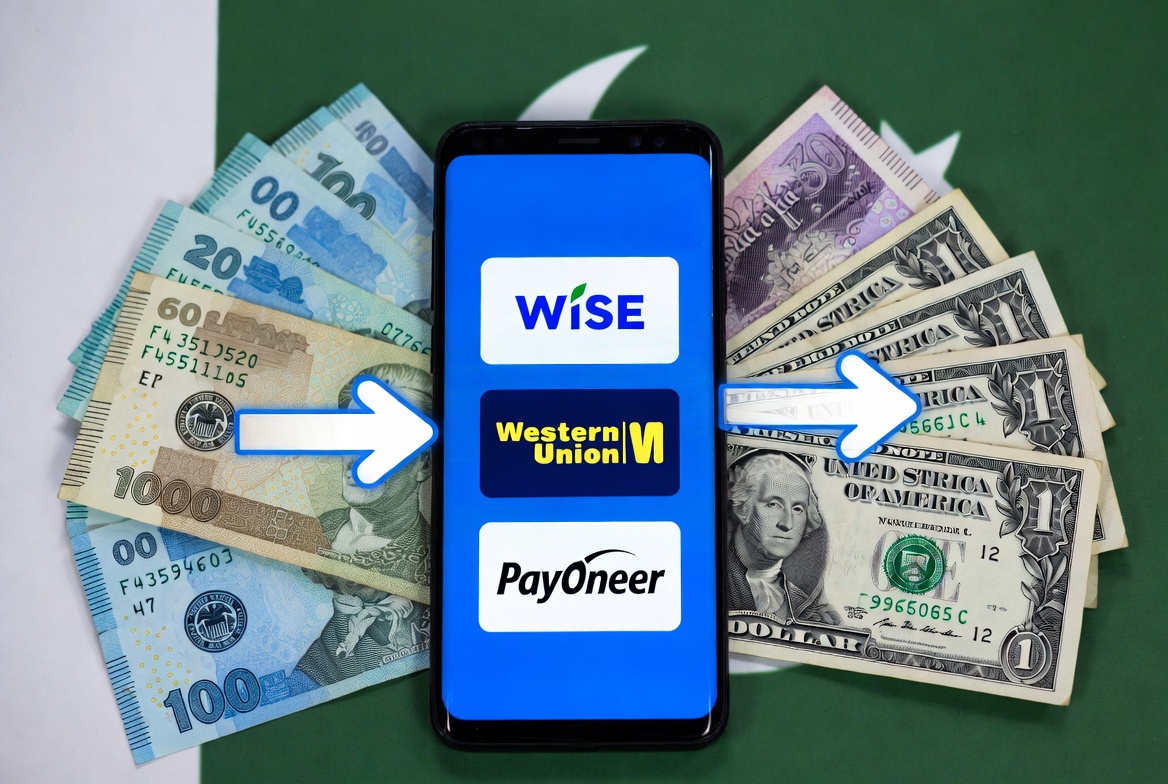
The Hidden Fee That Nobody Tells You About
There is a moment that every Pakistani student studying abroad — and every family supporting one — dreads. The university fee payment deadline is approaching. You need to send Rs 500,000 to a university account in the UK or Canada. You go to your bank, explain the situation, and spend the next hour filling out forms, waiting in a queue, and discovering that the exchange rate you thought you were getting is not the exchange rate you are actually getting. Three days later, you discover the amount that arrived at the university was Rs 15,000 less than what you sent.
Nobody explained that the bank takes a margin on the exchange rate in addition to the transfer fee. Nobody mentioned that the receiving bank sometimes deducts its own charges too. And nobody told you that a simple free account on a different platform would have sent the same amount for a fraction of the cost in half the time. This is the situation facing hundreds of thousands of Pakistanis in 2026 — students paying tuition abroad, families supporting relatives in other countries, professionals paying for international certifications, and businesses settling invoices with foreign suppliers. This guide gives you everything you need to make the right choice — which method to use, what it actually costs, how long it takes, and how to avoid the hidden fees that eat your money before it arrives.
Before comparing any specific service, you need to understand the most important concept in international money transfers. The number that most people check before sending money is the transfer fee. Bank charges Rs 1,500. Western Union charges zero. Wise charges Rs 500. Payoneer seems free. These numbers are almost meaningless. The real cost of any international transfer is not the transfer fee — it is the exchange rate markup. Every transfer service, from your high street bank to Western Union to Payoneer, converts your rupees to the destination currency using an exchange rate. That rate is almost always worse than the mid-market rate — the real exchange rate that banks use when trading with each other and that you see when you search "USD to PKR" on Google.
The exchange rate you see on Google — called the mid-market rate — is what banks use when trading with each other. Most transfer services will give you a less favourable rate and keep the difference as profit. Exchange rate markups often cost more than the service fees themselves. Here is what that means practically. Sending $1,000 to a US university account through a Pakistani bank that charges a 3% exchange rate margin costs you $30 in markup — in addition to the stated transfer fee. On a $5,000 tuition payment, that same 3% margin costs you $150 that never appears as a fee but quietly disappears into the transfer. On a $1,000 transfer, the difference between using a Pakistani bank and using Wise is approximately $30 to $50 per transaction. Over a year of monthly transfers, that is $360 to $600 in unnecessary losses. Always compare the total amount that arrives at the destination — not the transfer fee — when evaluating any service. For today's exchange rates, see our Dollar Rate in Pakistan Today guide.
Method 1 — Pakistani Bank SWIFT Transfer
The most familiar option. Your existing bank account in Pakistan can send money internationally through the SWIFT network — the global messaging system that banks use to communicate transfers between each other. How it works: You visit your branch or initiate through online banking, provide the recipient's bank name, SWIFT code, account number, and IBAN (for European banks), fill in the purpose of remittance, and authorise the transfer. Pakistani bank international transfers carry a typical fee of PKR 1,000 to PKR 2,500 per SWIFT transfer, plus an exchange rate margin. Transfer speed is typically 3 to 5 business days internationally. Reliability is high — transfers are regulated, traceable, and familiar to receiving banks worldwide.
Best for: Large transfers of $5,000 and above where the flat fee is a small percentage of the total amount. Property transactions abroad, large tuition payments to universities that only accept bank wires, and business-to-business payments requiring a formal bank paper trail. Worst for: Regular monthly transfers and smaller amounts where the flat fee and exchange rate margin together make it significantly more expensive than alternatives. The State Bank regulations to know: Pakistan's State Bank limits the amount that can be remitted abroad per year without additional documentation. For students studying abroad, fee payments directly to universities are permitted above the standard limit with documentation. Consult your bank for current limits. For students paying foreign university tuition, most banks now have a dedicated process for educational remittances with supporting documentation — your admission letter and fee invoice. This route is smoother than general foreign remittances and usually processed faster. For more on banking in Pakistan, see our guide on How to Make Your Bank Account Work for You in Pakistan 2026.
Method 2 — Western Union
Western Union has been moving money internationally for over 150 years. Its massive global agent network is its defining advantage — particularly for cash pickup situations. How it works from Pakistan: To send money from an agent location in Pakistan, you must be present in-person and provide your original and valid government-issued photo ID — CNIC, NICOP, or Passport. The maximum principal send amount is $3,000 US dollars or local equivalent per person per day. Only personal transfers are allowed — commercial or trade-related transfers are not permitted.
Cost reality: Western Union advertises zero transfer fees on many routes. But as explained above, the real cost is embedded in the exchange rate. Although Western Union does not charge a transfer fee on many routes, the hidden exchange rate fee makes it more expensive. Using Wise to send the same amount, recipients can get over Rs 3,000 more on a typical transfer. Speed: Cash pickup is often available within minutes. Bank account deposits typically take 1 to 3 business days depending on the destination. Best for: Sending money to a recipient who cannot receive bank transfers — someone without a bank account, in a rural area, or in a country where Western Union's cash pickup network is the most practical option. For emergency cash transfers where speed is the absolute priority, Western Union's minutes-to-pickup capability is genuinely valuable. Worst for: Regular large transfers where the exchange rate markup accumulates significantly over multiple transactions.
Method 3 — Wise (Formerly TransferWise)
Wise has changed international money transfers more fundamentally than any other service in the past decade — and for Pakistani users doing regular international transfers, it is often the most cost-effective option. The core difference from every other service: Wise uses the real mid-market exchange rate — the same rate you see on Google — and charges a small, transparent, upfront fee. No hidden exchange rate markup. What you see is what your recipient gets. On a $1,000 transfer, the difference between using a Pakistani bank and using Wise is approximately $30 to $50 per transaction. Over a year of monthly transfers, that is $360 to $600 in unnecessary losses — real money that stays in your pocket with Wise versus disappearing quietly through bank rate margins.
How it works: Wise is entirely digital. Create an account at wise.com, complete identity verification with your CNIC or passport, link your Pakistani bank account or debit card, and initiate a transfer. The platform shows you exactly what the recipient will receive before you confirm — no surprises. For Pakistanis abroad sending money home: Wise is available for sending from the US, UK, EU, Canada, and Australia to Pakistan. It delivers directly to Pakistani bank accounts — JazzCash and Easypaisa are also supported for some corridors. It offers the best rate for regular remittances on most major corridors. Speed: Over 13 million people have used Wise to send transfers around the globe. Transfers can arrive in seconds on popular transfer routes, with Wise being completely online and low-cost.
Limitations from Pakistan: Wise's full outgoing transfer capability — sending money abroad from a Pakistani bank account — has had varying availability depending on corridor and regulatory conditions. Check wise.com/pk for the current status of sending from Pakistan specifically, as this evolves with SBP regulations. For Pakistanis receiving money from abroad into a Pakistani bank account, Wise works reliably on major corridors. Best for: Regular transfers on major corridors — UK to Pakistan, US to Pakistan, Canada to Pakistan. Students receiving money from family abroad. Freelancers receiving client payments where Wise is an option. Anyone making repeated monthly transfers where the rate savings accumulate significantly.
Method 4 — Payoneer
Payoneer occupies a specific niche in Pakistan's international money movement — and for freelancers specifically, it is the single most important financial tool. Unlike Wise or Western Union, Payoneer is not primarily a money transfer service. It is a global payment platform that gives you virtual bank accounts in the US, UK, EU, Japan, and other countries — allowing international clients to pay you as if you had a local bank account in their country. For Pakistani freelancers working on Upwork, Fiverr, or directly with international clients, Payoneer is the default receiving mechanism — not because it offers the best exchange rates, but because it is the most widely accepted payment method by international freelancing platforms in Pakistan. For more on freelancing income, see our Freelancing in Pakistan 2026 Guide.
Fees: Payoneer charges 2% when receiving payments from other Payoneer accounts. Withdrawing to a Pakistani bank account incurs a fee that varies by bank and withdrawal method — typically $3 to $5 per withdrawal plus an exchange rate margin. For receiving Upwork payments specifically, fees follow Upwork's published rate schedule. Speed: Payoneer balance is usually available quickly after receiving a payment. Bank withdrawal to Pakistan takes 2 to 5 business days depending on your bank. Best for: Freelancers receiving international client payments. Upwork and Fiverr withdrawals. Anyone whose international clients pay through Payoneer specifically. Not ideal for one-off large transfers or for sending money outward from Pakistan.
Method 5 — Roshan Digital Account
This is the most underused option on this list — and for overseas Pakistanis specifically, it may be the most important one. The Roshan Digital Account is a specific government initiative allowing overseas Pakistanis to hold USD, GBP, EUR, or PKR accounts with Pakistani banks remotely. For Pakistanis abroad sending money home to Pakistan, the Roshan Digital Account is subject to preferential treatment under Foreign Exchange Regulations — consult your bank for current terms. The Roshan Digital Account allows overseas Pakistanis to open and manage Pakistani bank accounts entirely from abroad — without visiting a branch in Pakistan. It offers competitive profit rates on foreign currency deposits, which is a meaningful benefit when holding USD or GBP savings.
More importantly for the purpose of this article: Roshan Digital Accounts can be used to make investments within Pakistan — Naya Pakistan Certificates, stock market investments through PSX, and real estate — all from abroad, with no requirement to convert foreign currency to rupees until you choose to. For PSX investing, see our How to Invest in Pakistan Stock Exchange Guide. If you are an overseas Pakistani sending regular remittances home, or planning to invest in Pakistan from abroad, the Roshan Digital Account through your preferred Pakistani bank — HBL, MCB, Meezan, UBL all offer it — is worth exploring seriously.
State Bank Regulations: What You Are Actually Allowed to Send
This section is critically important and routinely misunderstood. Pakistan has foreign exchange regulations that govern how much money can be sent abroad and for what purposes. These rules exist to protect the country's foreign exchange reserves — and they apply to you. The personal remittance allowance: Pakistani residents can send a capped amount abroad per year through official banking channels without extensive documentation. This limit changes periodically based on the country's foreign exchange position — consult your bank for the current figure. Student fee payments: This is the most commonly needed exception. Pakistani students accepted to foreign universities can remit tuition fees above the standard limit with supporting documentation — specifically, your admission letter from the university and the official fee invoice. Your bank processes this through a dedicated educational remittance route.
Medical treatment abroad: Documented medical treatment abroad qualifies for a separate remittance allowance. Your doctor's referral letter and medical institution's invoice are required. Business and commercial transfers: These require their own documentation framework through the SBP. Consult your bank's trade finance department for business-to-business international payments — the process is different from personal remittances. The critical rule: All legal international transfers must go through official banking channels or licensed money transfer operators. Hundi and hawala — informal money transfer networks — are illegal under Pakistan's foreign exchange regulations. Using them exposes you to legal risk and provides zero recourse if the money does not arrive. For more on crypto alternatives, see our Crypto Legal in Pakistan 2026 Guide. For saving strategies, read Ways to Save Money When Income Is Low in Pakistan.
Which Method Should You Use? The Decision Framework
Here is a clear decision guide based on your specific situation. For a student paying university tuition abroad (large one-time or semester payment): Use a bank SWIFT transfer with supporting educational documentation. The flat fee is acceptable on large amounts, the paper trail is important for university accounting, and the regulatory framework specifically accommodates student fee payments. For regular monthly support payments to a family member abroad (Rs 10,000 to Rs 100,000 range): Compare Wise versus your bank on each specific corridor. Calculate the total amount arriving — not the stated fee — and use whichever delivers more to your recipient. On most major corridors, Wise wins this comparison on exchange rate.
For emergency cash to someone who cannot receive bank transfers: Western Union for cash pickup. It is faster than any bank-to-bank option for immediate cash access. For freelancing income from international clients: Payoneer is the standard for Upwork and Fiverr. Wise is an excellent alternative for direct client payments from countries where it operates. Binance P2P remains widely used for crypto-to-PKR conversion. For overseas Pakistanis sending regular remittances to Pakistan: Wise or Remitly for the best rates on the UK-Pakistan, US-Pakistan, and Canada-Pakistan corridors. Western Union for cash pickup to recipients without bank accounts. Roshan Digital Account for larger amounts where investment in Pakistan is also intended. For job search strategies, see How to Get Your First Job in Pakistan After Graduation. For gold rates, see Gold Rate in Pakistan Today. For petrol prices, check Petrol Price in Pakistan Today.
The Practical Checklist Before Every International Transfer
Regardless of which method you use, run through this checklist before sending any significant amount abroad. 1. Calculate the total arrival amount, not the transfer fee. Input your transfer on each platform you are considering and note what the recipient receives. Use this number — not the stated fee — for comparison. 2. Verify the recipient's account details twice. For bank transfers, you need the SWIFT code identifying the bank globally and the IBAN or account number. One wrong digit means a failed or misdirected transfer that is extremely difficult to reverse. Get these details directly from your recipient — do not guess or abbreviate. 3. Confirm the purpose of remittance is accurately stated. On Pakistani bank transfer forms, the purpose code matters for SBP reporting. "Education" for tuition fees. "Family maintenance" for supporting a relative. Misclassifying the purpose creates compliance complications later. 4. Keep all transfer documentation. Receipt, confirmation email, tracking number — all of it. If a transfer is delayed, lost, or disputed, this documentation is your evidence. Most international transfer issues are resolved faster when the sender has complete records. 5. Know what to do if the transfer does not arrive. Every legitimate service — bank, Western Union, Wise — has a tracing procedure for delayed transfers. The SWIFT trace for bank transfers usually resolves within 3 to 5 business days. Western Union provides a Money Transfer Control Number (MTCN) that the recipient uses to track and collect. Wise shows transfer status in real-time on your account dashboard.
The Bottom Line: Stop Overpaying for International Transfers
Pakistan's foreign exchange situation has improved dramatically — the rupee is stable, reserves are at multi-year highs, and the regulatory framework for international transfers is clearer than it has been in years. This is the right environment to review how you are sending money abroad and make sure you are not overpaying unnecessarily. If you are using a Pakistani bank for every international transfer, regardless of amount or purpose, you are almost certainly overpaying on the exchange rate margin for smaller regular transfers. Switching to Wise for those smaller monthly transfers while keeping large one-time payments through your bank is a practical split strategy that many experienced Pakistani users already use. The money you save on transfer costs stays with your family, funds your education, or supports the purpose you sent it for in the first place. It does not need to disappear silently into exchange rate margins. Do the comparison before your next transfer. The five minutes it takes is worth every rupee.
Disclaimer: Transfer fees, exchange rates, and regulatory limits change regularly. Always verify current rates and limits directly with each service before initiating any international transfer. This article is for educational and informational purposes only and does not constitute financial advice.