Executive Summary
On June 13, 2026, Prime Minister Shehbaz Sharif announced that Pakistan is preparing for the electronic signing of a peace deal between the United States and Iran — a deal being formally called the Islamabad Pact. If it holds, it will end a war that began on February 28, 2026, reopen the Strait of Hormuz to global shipping, and cement Pakistan's remarkable transformation from a diplomatically isolated nation to one of the world's most consequential peace brokers.
This is the complete story of how it happened — and what it means for Pakistan and the world.
Table of Contents
- Why This Moment Is Historic
- How the 2026 Iran War Began
- Pakistan Before the Crisis: A Nation Rebuilding Its Standing
- The Backchannel Begins: How Pakistan Entered the Picture
- Field Marshal Asim Munir: The Man at the Centre
- The Islamabad Talks: 21 Hours That Changed Everything
- From Failed Talks to Breakthrough: The Road from April to June
- What Is the Islamabad Pact? What We Know So Far
- What Pakistan Gains from This Deal
- What This Means for Ordinary Pakistanis
- Risks and What Could Still Go Wrong
- The Bigger Picture: Pakistan's New Place in the World
- Timeline of Events
- FAQ Section (15 Questions)
Key Takeaways
- Pakistan is finalizing the Islamabad Pact — a US-Iran peace deal named after the city where Pakistan hosted critical negotiations
- The deal follows months of backchannel diplomacy led personally by Field Marshal Asim Munir, Pakistan's army chief
- The agreement is expected to include an immediate ceasefire, the reopening of the Strait of Hormuz, Iranian commitments on its nuclear program, and sanctions relief for Tehran
- Pakistan's mediation role is built on a rare combination: good relations with both the US and Iran, a nuclear deterrent, and geographic strategic weight
- The deal represents Pakistan's single greatest diplomatic achievement since the 1970s
- For ordinary Pakistanis, the deal could reduce petrol prices, increase remittances, stabilize trade, and attract foreign investment
Quick Answer: What Is the Islamabad Pact?
The Islamabad Pact (also called the Islamabad Accord) is a peace agreement between the United States and Iran brokered by Pakistan, expected to be signed electronically on or around June 13–14, 2026. It would end the 2026 Iran war, reopen the Strait of Hormuz to international shipping, and establish a framework for further negotiations on Iran's nuclear program and sanctions relief. The deal is named after Islamabad, Pakistan, which hosted the critical in-person talks in April 2026 and served as the primary communications channel between Washington and Tehran throughout the negotiations.
Why This Moment Is Historic
History rarely announces itself clearly. But what is happening this week in Islamabad is, by any honest measure, extraordinary.
A nation that was diplomatically strained just over a year ago — in the aftermath of a brief but intense military confrontation with India in May 2025 — is now finalizing a peace deal between the world's most powerful military and one of its most sanctioned nations. A peace deal that, if it holds, will reshape energy markets, Middle Eastern geopolitics, and the global oil supply chain.
Pakistan brokered this. Not the United Nations. Not Switzerland. Not Qatar. Pakistan.
"We are confident that this historic peace deal will form a strong foundation for lasting peace," Prime Minister Shehbaz Sharif wrote on June 13, 2026. US President Donald Trump shared the post on Truth Social within the hour.
That exchange — two leaders of vastly different global statures sharing a moment of diplomatic credit — tells you everything about how much Pakistan's international position has shifted.
How the 2026 Iran War Began
To understand Pakistan's role, you need to understand what Pakistan stepped into.
On February 28, 2026, the United States and Israel launched coordinated airstrikes on Iranian nuclear and military infrastructure. The strikes followed months of escalating tensions over Iran's nuclear program, Iranian support for regional proxies, and a series of incidents in the Strait of Hormuz. Iran retaliated, and within days the region was in open conflict.
Iran's most powerful immediate response was the closure of the Strait of Hormuz — the narrow waterway through which roughly 20% of the world's traded oil flows. The economic shock was immediate and global. Oil prices spiked. Shipping insurance rates exploded. Gulf economies dependent on oil exports faced severe disruption.
For Pakistan, a country that imports significant quantities of oil through Gulf trade routes and whose millions of diaspora workers in the Gulf send back tens of billions of dollars in remittances annually, the war was not a distant event. It was a direct economic threat arriving at the worst possible time.
Pakistan Before the Crisis: A Nation Rebuilding Its Standing
Pakistan's entry into this diplomatic drama was not accidental. It was built on a year of deliberate repositioning.
After the May 2025 military confrontation with India — which ended with a ceasefire and both sides stepping back from the brink — Pakistan's establishment, led by Field Marshal Asim Munir, made a conscious strategic choice. Rather than remain on the defensive, Pakistan would lean into relationships it had quietly been cultivating for months.
Pakistan-US ties, which had been severely strained during the PTI government era, had been methodically rebuilt. Field Marshal Munir had visited the United States in June 2025, meeting senior military and intelligence officials. He was warmly received — the US CENTCOM commander publicly described Pakistan as a "phenomenal partner" in counterterrorism operations. Pakistan had handed over a high-value ISIS-K operative to the United States, a demonstration of intelligence-sharing at the highest level.
Simultaneously, Pakistan maintained its longstanding ties with Iran. The two countries share a long border, deep historical and cultural connections, and a web of economic arrangements. Iranian President Masoud Pezeshkian had visited Islamabad in August 2025, signing 12 cooperation agreements spanning trade, agriculture, technology, and infrastructure.
Pakistan was, in other words, one of the very few countries in the world that both Washington and Tehran trusted enough to speak frankly to. When the war began, that rare position became suddenly, urgently valuable.
The Backchannel Begins: How Pakistan Entered the Picture
The public story of Pakistan's mediation begins in early March 2026, but the backchannel started earlier.
Pakistani officials have said their public peace effort followed weeks of quiet diplomacy, though they have provided few details about its precise origins. What emerged in media reports is a picture of Pakistan quietly ferrying messages between Washington and Tehran — 15 US proposals were at one point being "deliberated upon by Iran" after Pakistan relayed them, Deputy PM Ishaq Dar confirmed.
The US delayed several planned strikes on Iranian infrastructure during this period, describing talks as "productive but preliminary." Iran, for its part, publicly denied negotiations were occurring while privately engaging through Pakistan. The Strait of Hormuz remained closed — Iran's most powerful bargaining chip.
Pakistan's position was delicate. It had to maintain credibility with both sides simultaneously. Iran needed assurance that Pakistan was not simply an American tool. Washington needed assurance that Islamabad was genuinely neutral and would not tilt toward Tehran at a critical moment. Managing both perceptions, while making actual diplomatic progress, required the kind of careful, persistent diplomacy that rarely makes headlines.
It also required personal relationships. And that is where Field Marshal Asim Munir became indispensable.
Field Marshal Asim Munir: The Man at the Centre
If there is one individual most responsible for Pakistan's mediation success, most analysts point to Field Marshal Asim Munir, Pakistan's army chief, who was elevated to the rank of Field Marshal in May 2025 — only the second man in Pakistan's history to hold that rank.
Munir had cultivated relationships with both US and Iranian leadership over years in various intelligence and military roles. He met with US Vice President JD Vance when Vance led the American delegation to the Islamabad Talks in April 2026. He personally travelled to Tehran in May 2026 for three rounds of talks with Iranian leadership in a single week — an extraordinary tempo of personal diplomacy for any military commander.
The White House's own assessment of Munir's role is notable. A White House spokesperson stated directly that "Prime Minister Shehbaz Sharif and Field Marshal Asim Munir have been helpful mediators, and the United States is grateful for Pakistan's efforts to bring an end to the conflict."
On the night before a critical breakthrough, Reuters reported that Munir had been in contact "all night long" with US Vice President Vance, Special Envoy Steve Witkoff, and Iranian Foreign Minister Abbas Araghchi simultaneously. That image — one Pakistani general holding open a three-way communication line between two adversarial powers through a night of intensive diplomacy — captures what Pakistan actually contributed to this process.
The Islamabad Talks: 21 Hours That Changed Everything (And Also Failed)
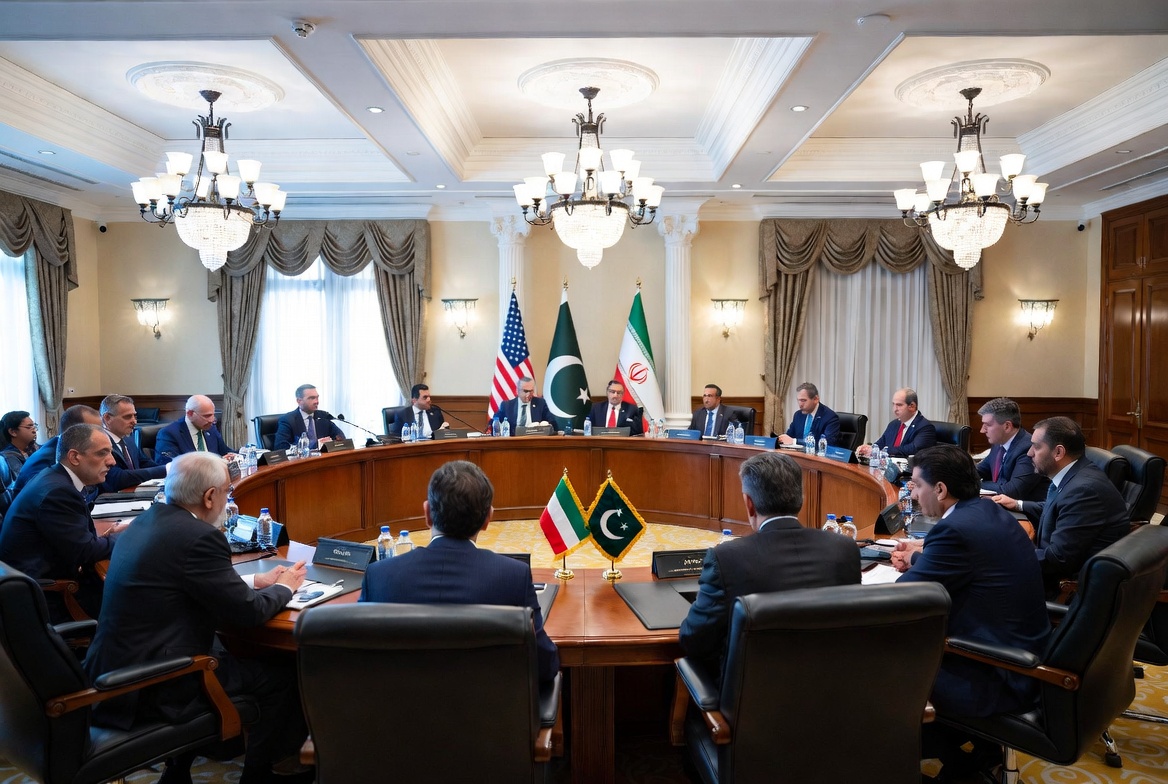
The most dramatic public episode of the mediation came on April 11–12, 2026, when Pakistan hosted in-person talks at the Islamabad Serena Hotel.
The American delegation, numbering 300 members and led by Vice President JD Vance, flew to Islamabad. The Iranian delegation arrived separately. For 21 hours, negotiators worked through three rounds of talks — the first indirect (Pakistan shuttling between rooms), the second and third direct face-to-face.
The teams made progress on most of the 10-point ceasefire framework. But two issues blocked agreement: the Strait of Hormuz, and Iran's nuclear program. Iran would not reopen the Strait without guarantees that went beyond what Washington was prepared to offer in a first phase. The nuclear question was even more complex.
The talks ended with no signed agreement, no memorandum of understanding, and public statements that carefully avoided the word "failure."
That framing was deliberate. Pakistan — and both delegations — understood that walking away entirely would collapse the entire framework. The absence of a signed deal was disappointing. But the fact that an American Vice President and senior Iranian officials had sat across from each other, in Islamabad, for direct talks, was itself a breakthrough that could not be unseen.
The second round of talks was always going to happen. And Pakistan was always going to host it.
From Failed Talks to Breakthrough: The Road from April to June
The seven weeks between the failed Islamabad Talks and today's announcement were not quiet.
Iran allowed 20 Pakistani-flagged vessels to transit the Strait of Hormuz — what Pakistan's Foreign Office spokesperson called "a harbinger of peace" and a signal that Tehran was not closing the door. Trump threatened to bomb Iran "back to the Stone Ages" at one point if it did not accept terms, prompting Iran to issue retaliatory warnings. Pakistan's Foreign Office acknowledged "obstacles" but stated publicly it would continue facilitating.
Behind the scenes, Field Marshal Munir made multiple trips to Tehran. Secretary of State Marco Rubio acknowledged "slight progress" in May — diplomatic language for real movement. The contours of a two-phase deal took shape: an immediate ceasefire and Strait reopening, followed by 15–20 days to finalize a broader settlement covering the nuclear question and sanctions relief.
That framework — Pakistan as the sole communication channel, all elements agreed through an MOU finalized electronically — is exactly what is now being signed.
Defence Minister Khawaja Asif confirmed on June 13 that the deal would be formally presented as the "Islamabad Pact." PM Shehbaz said signing was expected within 24 hours. Trump amplified the announcement within the hour.
What Is the Islamabad Pact? What We Know So Far
Based on multiple confirmed sources, the Islamabad Pact is expected to include:
Phase 1 (Immediate upon signing):
- A ceasefire between US/Israeli forces and Iran
- Reopening of the Strait of Hormuz to international shipping
- Release of some frozen Iranian assets as a confidence-building measure
- A regional framework for Strait governance going forward
Phase 2 (To be negotiated within 15–20 days):
- Iranian commitments on the nuclear program — not pursuing nuclear weapons in exchange for broader sanctions relief
- A broader regional security framework addressing proxy relationships
- Full normalization of Iranian access to international banking
Pakistan's role going forward:
- Named as the guarantor of the process
- Islamabad likely to host Phase 2 in-person negotiations
- The deal is being finalized electronically through Pakistan as the communication channel
It is important to note: as of the time of publication, the deal has not yet been formally signed. The announcement by PM Shehbaz refers to preparation for signing. Final terms could still shift. History is full of deals that seemed certain until they were not. But the momentum, the political will on all three sides, and the personal investment of the key individuals involved all point toward completion.
What Pakistan Gains from This Deal
Pakistan's motivations for expending enormous diplomatic capital on this mediation are not mysterious. They are substantial and concrete.
Global prestige and diplomatic leverage. A nation that brokers a deal between the United States and Iran earns a level of international credibility that cannot be purchased. Pakistan's case for a non-permanent seat on the UN Security Council becomes significantly stronger.
Economic benefits from a stabilized region. Pakistan's Gulf diaspora — estimated at over 5 million workers — sends home remittances that are a lifeline to Pakistan's foreign exchange reserves. Peace stabilizes these flows.
Energy prices. The reopening of the Strait of Hormuz will ease the global oil supply shock, providing economic relief for Pakistani consumers.
US relationship upgrade. Pakistan's mediation transforms its relationship with Washington from a transactional counter-terrorism partnership to something closer to a strategic alliance.
Regional influence. A Pakistan that successfully mediates between great powers shifts Islamabad's bargaining position in every bilateral relationship simultaneously.
What This Means for Ordinary Pakistanis
Beyond the geopolitical language, what does this actually mean for a Pakistani family in Karachi, Lahore, or Quetta?
Petrol prices: The Strait of Hormuz closure contributed to the global oil price spike of 2026. Its reopening will reverse at least part of that, benefiting transport, food distribution, and household budgets.
Remittances: Pakistanis working in Gulf countries faced uncertainty during the conflict. A stable, peaceful Gulf means Pakistani workers can earn, send money home, and plan with confidence.
Business confidence: International investors tend to avoid regions with active nearby wars. Pakistan's role as a peace broker sends a signal to foreign capital that Islamabad is a stable, serious partner.
National pride: There is something harder to quantify but unmistakably real about what this moment means for Pakistanis who have spent years watching their country described as a problem to be managed rather than a partner to be valued.
Risks and What Could Still Go Wrong
No honest analysis of this moment can ignore the risks. Several are real.
The deal could still collapse. Phase 2 negotiations — covering Iran's nuclear program and the full sanctions architecture — are genuinely complex. The history of US-Iran diplomacy is littered with agreements that fell apart during implementation.
Domestic politics in Iran. Hardliners in Tehran have consistently opposed any accommodation with Washington. A signed deal can face internal Iranian resistance that makes implementation difficult.
US political volatility. The Trump administration's track record on deal-making includes withdrawing from agreements its predecessor signed. Future US political leadership could revisit the Islamabad Pact.
Expectations management for Pakistan. Pakistan's diplomatic success creates an expectation of continued performance. Failing in a future mediation could damage the credibility that made this deal possible.
The Bigger Picture: Pakistan's New Place in the World
A Reuters analysis published in early April 2026 captured Pakistan's transformation in a single sentence: "A diplomatic outcast a year ago, Pakistan has become a trusted regional partner and a mediator between the U.S. and Iran to end the war in the Middle East."
That transformation is real, and it is not purely the product of circumstance. It is the result of deliberate choices — to rebuild ties with Washington, to maintain the Iran relationship, to position Pakistan as a neutral channel rather than a partisan actor.
The question Pakistan now faces is whether this transformation is consolidated into something durable, or whether it proves to be a moment rather than a movement.
The Islamabad Pact, if it is signed and if it holds, is the most important diplomatic success in Pakistan's modern history. What Pakistan does with that success will determine whether it becomes a turning point or a footnote.
Timeline of Events: Pakistan's Road to the Islamabad Pact
| Date | Event | May 2025 | India-Pakistan military confrontation ends in ceasefire. Pakistan begins diplomatic reset. | May 21, 2025 | Field Marshal Asim Munir promoted to Field Marshal — only second in Pakistan's history. | June 2025 | Field Marshal Munir visits the United States; described as "phenomenal partner" by CENTCOM chief. | July 2025 | Pakistan-US trade deal concluded in Washington. | August 2025 | Iranian President Pezeshkian visits Islamabad. Pakistan and Iran sign 12 cooperation agreements. | February 28, 2026 | US and Israel launch airstrikes on Iran. 2026 Iran War begins. | Early March 2026 | Iran closes Strait of Hormuz. Pakistan begins backchannel diplomacy. | April 11–12, 2026 | Islamabad Talks at Serena Hotel. 21 hours of talks. No agreement reached. | May 22, 2026 | Field Marshal Munir flies to Tehran for third round of talks in one week. | May–June 2026 | Iran allows 20 Pakistani-flagged vessels through the Strait — "harbinger of peace." | June 13, 2026 | PM Shehbaz announces Pakistan preparing for electronic signing of US-Iran deal. Deal to be named "Islamabad Pact." |
|---|
Conclusion
History will record that in the spring of 2026, when two nuclear-capable powers were locked in open war and the global economy was rattled by a blockaded strait, it was a third country — Pakistan — that found the path through.
Not through military power. Not through economic leverage. Through relationships, patience, geography, and the rare quality of being trusted by both sides of a conflict simultaneously.
The Islamabad Pact carries Pakistan's name. Whether that name becomes synonymous with a durable peace or a collapsed agreement depends on what comes next. But no one — not Pakistan's critics, not its occasional allies, not the analysts who wrote it off after the India confrontation of 2025 — can take away what has already happened.
Pakistan brought America and Iran to the table. And they signed.
Frequently Asked Questions (FAQ)
1. What is the Islamabad Pact?
The Islamabad Pact is a peace agreement between the United States and Iran brokered by Pakistan, expected to end the 2026 Iran war, reopen the Strait of Hormuz, and establish a framework for resolving the Iran nuclear question and sanctions.
2. When is the Islamabad Pact being signed?
PM Shehbaz Sharif announced on June 13, 2026 that Pakistan is preparing for the electronic signing of the deal, expected within 24 hours.
3. Why did Pakistan become the mediator between the US and Iran?
Pakistan was chosen because it has maintained functional relationships with both the United States and Iran — rare in today's polarized geopolitical landscape. Both parties trusted Pakistan enough to speak candidly through it.
4. What role did Field Marshal Asim Munir play?
Field Marshal Munir was the primary architect of Pakistan's mediation effort, making multiple personal trips to Tehran and maintaining direct contact with US Vice President JD Vance and Special Envoy Steve Witkoff.
5. What are the main terms of the Islamabad Pact?
The expected framework includes: an immediate ceasefire, reopening of the Strait of Hormuz, release of some frozen Iranian assets, followed by negotiations on Iran's nuclear commitments and broader sanctions relief.
6. What were the Islamabad Talks in April 2026?
In-person negotiations held at the Islamabad Serena Hotel on April 11–12, 2026, where a 300-member US delegation led by VP JD Vance met Iranian negotiators for 21 hours across three rounds.
7. How does this affect petrol prices in Pakistan?
The reopening of the Strait of Hormuz is expected to ease global oil price pressures, benefiting fuel costs in Pakistan, though the timeline and scale depend on broader market conditions.
8. What does the Islamabad Pact mean for Pakistani workers in the Gulf?
Regional peace and stable energy markets protect the livelihoods of approximately 5 million Pakistani workers in Gulf states and the remittance flows their families depend on.
9. Why is this called the Islamabad Pact specifically?
The deal is named after Islamabad because Pakistan was the host city for the critical in-person negotiations and served as the sole communication channel through which the entire agreement was negotiated.
10. Could the deal still collapse before signing?
As of June 13, 2026, the deal has been announced but not yet formally signed. However, the level of public commitment from all parties makes a last-minute collapse less likely than at earlier stages.
11. How did Pakistan's relationship with the US change in 2025-26?
Following the May 2025 India-Pakistan conflict, Pakistan rebuilt ties through Field Marshal Munir's US visit, counter-terrorism cooperation, and the July 2025 Pakistan-US trade deal.
12. What does this mean for Pakistan's relationship with Iran going forward?
Successfully brokering Iran's agreement makes Pakistan's relationship with Tehran significantly warmer, with deep goodwill if the deal holds.
13. Will the Islamabad Pact affect Pakistan's relationship with India?
Pakistan's elevated international standing changes the broader context of the bilateral relationship, though the deal does not directly affect India-Pakistan ties.
14. What happens in Phase 2 of the Islamabad Pact?
Phase 2 will cover Iran's nuclear program commitments, full sanctions relief, release of frozen Iranian assets, and a broader regional security framework.
15. What is the historical significance of the Islamabad Pact for Pakistan?
This is widely regarded as Pakistan's most significant diplomatic achievement in the modern era — a fundamental reframing from regional problem to global peacemaker.
This article is based on publicly available information from Reuters, Al Jazeera, The Express Tribune, Fox News, AP, Axios, Dawn, and Gulf News as of June 13, 2026. The Islamabad Pact had not been formally signed at the time of publication. Pakistan Blogs will update this article as events develop.
Published on PakistanBlogs.online | Category: News | Author: Mohsan Abbas