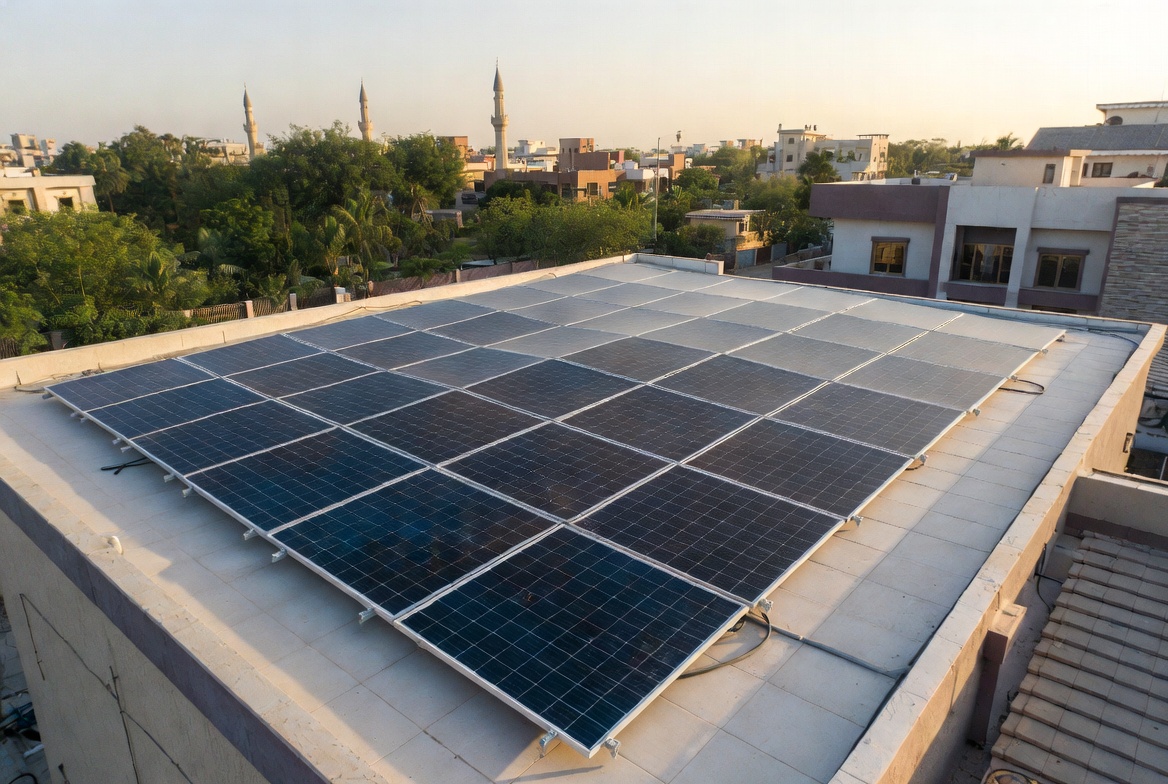
Executive Summary
Solar energy has shifted from luxury to necessity for millions of Pakistani households. With electricity tariffs exceeding Rs70/unit in many slabs, persistent load shedding, and the 2026-27 federal budget extending tax relief on solar imports, going solar in Pakistan has never made more financial sense — or been more confusing. This guide cuts through the noise, giving you real market prices, honest ROI calculations, a guide to net metering, trusted brand comparisons, and a clear framework to decide whether solar is right for your home.
Introduction: Why Solar Is No Longer Optional for Pakistani Homes
Electricity bills that once sat at Rs3,000–5,000 per month now routinely hit Rs20,000–40,000 for middle-class households. Load shedding in many cities still reaches 8–12 hours a day during summer. Diesel generator fuel costs Rs400+ per litre. And the dollar keeps pushing up energy import costs across the board.
Against this backdrop, solar panels have gone from a niche investment to a mainstream survival strategy for Pakistani families. In 2024, Pakistan added more than 17 gigawatts of solar capacity — much of it residential — making it one of the fastest solar adoption stories in Asia. In 2025 and 2026, that momentum has only accelerated.
But the solar market in Pakistan is also a minefield. Countless low-quality panels are being dumped from China. Fly-by-night installers are quoting wildly different prices. And the technicalities of net metering, hybrid vs. on-grid systems, and battery storage leave most buyers thoroughly confused.
This guide is here to change that.
By the end of this article, you will know exactly what a solar system costs in Pakistan in 2026, how long it takes to pay back, which brands to trust, how net metering works, and whether to go on-grid, off-grid, or hybrid — for your specific situation.
Table of Contents
- Why Solar Makes Financial Sense in Pakistan Right Now
- Types of Solar Systems in Pakistan
- How Much Does Solar Cost in Pakistan in 2026?
- Solar Panel Brands Available in Pakistan
- How to Size Your Solar System
- Net Metering in Pakistan: A Complete Guide
- Solar ROI: When Will You Actually Break Even?
- Solar Financing Options in Pakistan
- How to Choose a Solar Installer
- Government Policy and Subsidies 2026
- Common Solar Mistakes Pakistanis Make
- Future of Solar in Pakistan
- Action Plan: How to Go Solar Step by Step
- FAQ Section
Key Takeaways
- A 5kW hybrid solar system in Pakistan costs Rs700,000–1,000,000 installed in 2026
- Average payback period for a well-chosen system is 3–5 years
- Net metering lets you sell excess power back to WAPDA at ~Rs22/unit
- Longi, Jinko, and Canadian Solar are the most reliable panel brands available in Pakistan
- The 2026-27 budget maintains zero customs duty on solar panels and inverters
- Hybrid solar is the best choice for most urban Pakistani households
- Poor-quality panels and untrained installers are the two biggest risks to avoid
Quick Answer: What Does Solar Cost in Pakistan in 2026?
A basic 3kW on-grid system starts around Rs350,000–450,000 installed. A 5kW hybrid system with battery backup typically runs Rs800,000–1,100,000. A 10kW system for larger homes or small businesses ranges from Rs1,400,000–2,000,000+. Prices vary by panel brand, inverter quality, battery type, and installer.
Why Solar Makes Financial Sense in Pakistan Right Now
There are five forces working simultaneously to make solar one of the best financial decisions a Pakistani household can make in 2026.
1. Electricity Tariffs Are at Historic Highs
NEPRA has approved multiple tariff increases over the past three years. Residential consumers in the 301+ unit monthly slab now pay upwards of Rs55–75 per unit when fuel adjustments are included. A household consuming 600 units per month can face bills exceeding Rs35,000 — that is Rs420,000 per year just in electricity.
2. Load Shedding Persists Despite Promises
Urban areas in Punjab and Sindh still experience 6–10 hours of daily load shedding in peak summer months. This forces households to run petrol or gas generators, adding Rs8,000–15,000 per month in fuel costs. A solar-plus-battery system eliminates most of this cost entirely.
3. Solar Panel Prices Have Dropped Dramatically
Global solar panel prices have fallen roughly 80% over the past decade, and 2024–2025 saw another significant correction driven by Chinese manufacturing overcapacity. In Pakistan, quality Tier-1 panels now sell for Rs12,000–18,000 per panel (370–400W), down from Rs25,000+ just a few years ago.
4. Government Policy Supports Solar Adoption
The federal government has maintained zero customs duty and sales tax exemptions on solar panels, inverters, and related equipment. The 2026-27 budget, presented by Finance Minister Aurangzeb on June 12, continues this policy, making solar imports cheaper than ever. The Alternative Energy Development Board (AEDB) is also actively promoting distributed solar.
5. Net Metering Makes It a Revenue Source
With a proper net metering connection, your solar system does not just cut your bill — it allows you to sell surplus electricity back to WAPDA at a predetermined rate. This turns your rooftop into a partial income generator.
Types of Solar Systems in Pakistan
Understanding the three main system types is the first and most critical decision you will make.
On-Grid Solar (Grid-Tied)
How it works: Your panels connect directly to WAPDA's grid. During the day, solar powers your home. Surplus power flows to the grid (net metering). At night or on cloudy days, you draw from the grid as normal.
Pros: Lowest upfront cost. Simple setup. Eligible for net metering.
Cons: Does not work during load shedding unless you have a special inverter. No backup power.
Best for: Households with minimal load shedding, or offices/businesses that operate only during daylight.
Typical cost for 5kW: Rs500,000–700,000 installed
Off-Grid Solar
How it works: Completely independent of WAPDA. Your panels charge a battery bank that powers your home 24/7. No grid connection.
Pros: Full energy independence. Works during load shedding and grid outages.
Cons: High battery cost. Need to size batteries carefully. Cannot sell surplus power. Larger upfront investment.
Best for: Rural areas without reliable grid access, or households that want total independence.
Typical cost for 5kW: Rs900,000–1,400,000 installed (depending on battery capacity)
Hybrid Solar (Most Popular in Pakistan)
How it works: Combines on-grid and off-grid. Panels charge batteries first, then export to the grid. During load shedding, batteries power the home. During the day, solar reduces grid consumption.
Pros: Best of both worlds. Load shedding protection plus net metering eligibility. Scalable.
Cons: Higher upfront cost than pure on-grid. Battery adds maintenance.
Best for: Urban households with significant load shedding and high bills. This is the right choice for the vast majority of Pakistani homes in 2026.
Typical cost for 5kW: Rs800,000–1,100,000 installed
How Much Does Solar Cost in Pakistan in 2026?
Let's get specific. These are real market prices as of mid-2026, based on Tier-1 brands with professional installation.
| System Size | Type | Typical Use | Estimated Cost (Installed) | 3kW | On-Grid | 1–2 ACs + basics | Rs350,000–480,000 | 5kW | On-Grid | 2–3 ACs + appliances | Rs550,000–700,000 | 5kW | Hybrid (with 5kWh battery) | 2–3 ACs + backup | Rs800,000–1,100,000 | 10kW | Hybrid | Large home or business | Rs1,400,000–2,000,000 | 3kW | Off-Grid | Rural/basic use | Rs600,000–850,000 |
|---|
What is included in installation cost?
A proper installation quote should include: solar panels, inverter, mounting structure, DC and AC cabling, protection devices (breakers/fuses), battery bank (for hybrid/off-grid), net metering application assistance, and commissioning. If a quote seems unusually cheap, something is missing — usually the inverter quality or battery.
What drives cost variation?
- Panel brand (Tier-1 vs. Tier-3 Chinese knockoffs): Rs6,000–18,000 per panel
- Inverter brand (Huawei, SMA, Growatt vs. local): Rs60,000–250,000
- Battery type (lithium vs. lead-acid): Lithium costs 2–3x more but lasts 3–4x longer
- Installer reputation and warranty support
Solar Panel Brands Available in Pakistan
Not all panels are equal. Pakistan's market has been flooded with low-cost, low-quality panels that degrade quickly in the intense Pakistani sun. Here is an honest breakdown.
Tier-1 Brands (Recommended)
Longi Solar (China) — The single most popular panel in Pakistan by volume. Excellent efficiency (20–22%), reliable warranties, and widely available. Price: Rs14,000–18,000 per panel (370–400W).
Jinko Solar (China) — Consistent quality, well-established warranty support. The Tiger Neo series offers excellent performance in high-temperature conditions — ideal for Pakistan's climate. Price: Rs13,000–17,000 per panel.
Canadian Solar (Canada/China) — Premium brand with strong long-term reliability data. Higher price point but excellent degradation warranty. Price: Rs15,000–20,000 per panel.
JA Solar (China) — Strong value-for-money option that has performed well in Pakistani installations. Price: Rs12,000–16,000 per panel.
Inverters Worth Considering
- Huawei SUN2000 Series — Best smart monitoring, excellent efficiency, widely used in Pakistan
- Growatt — Good value, solid warranty support, popular with Pakistani installers
- SMA (Germany) — Premium European quality, higher cost, excellent for large systems
- Must/Solis — Budget-friendly, decent for smaller residential setups
Battery Choices
Lithium Iron Phosphate (LiFePO4): Rs80,000–130,000 per 5kWh. Lasts 4,000–6,000 cycles (~10–15 years). Strongly recommended.
Lead-Acid/AGM: Rs30,000–50,000 per 5kWh equivalent. Lasts 500–800 cycles (~2–3 years). Only suitable for very tight budgets.
The math is clear: despite the higher upfront cost, lithium batteries are dramatically cheaper over a 10-year period.
How to Size Your Solar System
This is where most Pakistanis get misquoted or self-deceived. System sizing is a calculation, not a guess.
Step 1: Calculate Your Daily Energy Consumption
Pull out your last 3 electricity bills. Find the units consumed per month. Divide by 30 to get daily units.
Example: 600 units/month ÷ 30 = 20 units (kWh) per day
Step 2: Determine Your Solar Window
Pakistan has excellent sun exposure. Most regions average 5–6 peak sun hours per day.
Example: 20 kWh ÷ 5.5 hours = ~3.6 kW system needed at minimum
Step 3: Add a Safety Margin
Add 20–25% for system losses, cloudy days, and future load growth.
Example: 3.6 kW × 1.25 = 4.5kW system — so a 5kW system is appropriate
Step 4: Account for Load Shedding Hours
If you want full backup during load shedding, calculate how many kWh you consume during outage hours and size your batteries accordingly.
Example: 6 hours × 2kW average load = 12kWh battery bank needed
Net Metering in Pakistan: A Complete Guide
Net metering is the policy that allows you to feed surplus solar power back into WAPDA's grid and receive a credit on your electricity bill. It is one of the most important concepts for understanding solar ROI in Pakistan.
Who Manages Net Metering?
NEPRA regulates the net metering framework. Actual connections are managed by your local distribution company (LESCO, HESCO, IESCO, MEPCO, PESCO, etc.).
How Does Net Metering Work?
A bi-directional meter replaces your standard WAPDA meter. During the day, if your solar system generates more electricity than you consume, the surplus flows into the grid. Your meter tracks this export. At the end of the billing cycle, units exported are offset against units imported.
The current buyback rate is approximately Rs22–24 per unit exported, which is lower than the rate you pay when importing (Rs55–75/unit). This is why self-consumption is always more valuable than export — the goal is to maximize what you use directly and minimize what you send to the grid.
Net Metering Application Process
- Contact your distribution company (DISCO) and request a net metering connection
- Submit application with system details, inverter specs, and installer certification
- DISCO inspects the installation (typically 30–90 days)
- Bi-directional meter is installed
- Net metering begins
Important: Only grid-tied and hybrid systems are eligible for net metering. Off-grid systems are not connected to WAPDA and therefore cannot participate.
Solar ROI: When Will You Actually Break Even?
Let's run a real-world calculation for a typical Pakistani household.
Scenario: Middle-class family in Lahore
- Monthly bill before solar: Rs28,000 (approximately 500 units at high slab rates)
- System chosen: 6kW hybrid solar with 10kWh lithium battery
- Total installed cost: Rs1,050,000
- Annual bill saving: Rs28,000 × 12 = Rs336,000
- Net metering credit (estimated): Rs40,000/year
- Total annual benefit: Rs376,000
- Simple payback period: ~2.8 years
This assumes electricity tariffs do not increase further — which historically they always do, meaning the actual payback can be even shorter as bills rise.
After break-even: A quality solar system has a rated lifespan of 25 years. After the payback period, you are essentially generating free electricity for 20+ years, with only minimal maintenance costs.
Solar Financing Options in Pakistan
Not everyone can pay Rs800,000–1,000,000 upfront. Here are the real financing options available in 2026.
Bank Loans (Green Financing)
Meezan Bank offers Shariah-compliant solar financing with terms up to 5 years. Monthly installments on a Rs800,000 system typically fall around Rs18,000–22,000 — often less than the electricity bill you are replacing.
Bank Alfalah has a renewable energy financing product with competitive rates.
National Bank of Pakistan (NBP) has offered subsidized solar loans under the government's green energy push.
Installer Payment Plans
Several larger solar companies offer in-house installment plans. Be cautious: always get the total cost, implied interest rate, and penalty clauses in writing before signing.
The Key Financial Insight
Even with financing at 18–22% annual rates, many households find that monthly installments are lower than their pre-solar electricity bill. You are effectively converting an expense into an asset.
How to Choose a Solar Installer
This is where most buyers get burned. Pakistan's solar boom has attracted thousands of installers with wildly varying skill levels and ethics.
What Good Installers Provide
- Site assessment before quoting (roof angle, shading analysis)
- Detailed written proposal with panel specs, inverter model, battery specs
- References from recent installations
- Post-installation monitoring support
- Written warranty on workmanship (minimum 2 years)
- Assistance with net metering application
Red Flags to Watch
- Refusing to provide written specifications upfront
- Offering "special discount" that expires today
- Not mentioning panel brand or inverter model in the quote
- Very low quote with no explanation of panel quality
- No physical office or verifiable local presence
Government Policy and Budget 2026 Impact
The federal government's stance on solar energy has been broadly supportive, and the 2026-27 budget continues several critical incentives.
- Zero customs duty on solar panels: All photovoltaic panels remain import duty-free
- Sales tax exemption: Solar panels, inverters, and batteries continue to be exempt from GST
- AEDB targets: Pakistan is targeting 60% renewable energy share in the power mix by 2030
- Net metering policy: NEPRA has maintained its net metering regulations with minor updates
Common Solar Mistakes Pakistanis Make
- Buying undersized systems to save money — Size correctly from the start
- Choosing lead-acid batteries for the cost saving — Invest in lithium
- Going with the cheapest quote — Tier-3 panels degrade rapidly
- Skipping net metering application — Apply immediately after commissioning
- Not monitoring system performance — Track daily generation
- Ignoring roof condition — Assess integrity before installation
- Not getting multiple quotes — Always get three detailed, itemized quotes
Action Plan: How to Go Solar in 7 Steps
- Pull your last 3 electricity bills. Calculate average monthly units and cost.
- Determine your system type. Hybrid for urban load shedding, on-grid for minimal outage areas.
- Calculate system size. Monthly units ÷ 30 ÷ 5.5 × 1.25 = system kW required.
- Get 3 detailed, itemized quotes. Specify Tier-1 panels and named inverter brand.
- Verify the installer. Ask for references, visit a completed installation.
- Review financing. Compare upfront payment vs. bank loan installments.
- Apply for net metering immediately after commissioning.
Conclusion
Solar panels in Pakistan in 2026 represent one of the most financially sound investments a middle-class household can make. With electricity tariffs at historic highs, government policy supportive of imports, panel prices at historic lows, and payback periods of 3–5 years for well-chosen systems, the numbers have never made more sense.
The key is making an informed decision: choose the right system type for your situation, invest in Tier-1 panels and quality inverters, prioritize lithium batteries, get multiple quotes, and apply for net metering without delay.
Going solar is no longer a luxury. For millions of Pakistani families, it is the financially responsible thing to do.
FAQ
Q1. Are solar panels worth it in Pakistan in 2026?
Yes, for most urban and suburban households. With electricity bills at historic highs and system payback periods of 3–5 years, solar offers strong returns. After break-even, you generate essentially free electricity for 20+ years.
Q2. What is the price of a 5kW solar system in Pakistan in 2026?
A 5kW on-grid system costs approximately Rs550,000–700,000 installed. A 5kW hybrid system with a lithium battery backup runs Rs800,000–1,100,000, depending on panel brand, inverter quality, and battery capacity.
Q3. What is net metering and how does it work in Pakistan?
Net metering allows you to send surplus solar power to WAPDA's grid and receive credits on your electricity bill. The current buyback rate is approximately Rs22–24 per unit exported. Only on-grid and hybrid systems are eligible.
Q4. Which solar panel brand is best in Pakistan?
Longi Solar, Jinko Solar, Canadian Solar, and JA Solar are the most reliable Tier-1 brands available in Pakistan in 2026. Avoid unbranded or Tier-3 panels regardless of how cheap they appear.
Q5. How long do solar panels last in Pakistan?
Quality Tier-1 panels are warranted for 25–30 years of operation with a maximum degradation of 0.5–0.7% per year. In Pakistan's climate, real-world performance typically shows 15–25% degradation over 25 years for good panels.
Q6. Can I run an AC on solar in Pakistan?
Yes. A 1.5-ton inverter AC consumes approximately 1.2–1.5kW per hour. A 5kW solar system can comfortably run 2–3 inverter ACs during peak sunlight hours. For overnight operation, a battery bank is necessary.
Q7. What is the difference between on-grid, off-grid, and hybrid solar?
On-grid connects to WAPDA but does not work during load shedding. Off-grid is fully independent but cannot use net metering. Hybrid combines both — batteries for backup during load shedding and grid connection for net metering.
Q8. How many solar panels do I need for a 5 marla house?
A typical 5 marla house consuming 300–500 units per month would need a 4–6kW system, which typically requires 10–15 panels of 400W each. The exact number depends on your roof area and energy consumption.
Q9. Does solar work during load shedding?
An on-grid system alone does not work during load shedding. A hybrid or off-grid system with batteries will continue to power your home during outages.
Q10. What is the payback period for solar in Pakistan?
For a well-sized hybrid system, the average payback period is 3–5 years depending on your electricity consumption, tariff slab, and system cost.
Q11. Can I get solar financing in Pakistan?
Yes. Meezan Bank, Bank Alfalah, and NBP offer solar financing products. Many installers also offer in-house installment plans.
Q12. Is there a government subsidy for solar in Pakistan in 2026?
The government maintains zero customs duty and sales tax exemptions on solar equipment. Direct cash subsidies for residential solar are limited but some provincial schemes exist.
Q13. How do I apply for net metering in Pakistan?
Contact your local distribution company (LESCO, HESCO, IESCO, etc.) after your solar system is commissioned. The process typically takes 30–90 days for meter replacement and activation.
Q14. What maintenance does a solar system require?
Solar panels should be cleaned every 4–8 weeks to remove dust. Inverters require ventilation. Lithium batteries need no regular maintenance. Annual professional inspection is advisable.
Q15. Are solar panels safe during Pakistan's monsoon season?
Yes. Quality panels and installations are fully weatherproofed and designed for rain, wind, and hail. Ensure your installer uses proper weatherproof junction boxes and cable management.
Final Reader Takeaway
You now have everything you need to make an intelligent solar decision. The numbers are clear: solar works in Pakistan, the technology is proven, the government supports it, and the financial returns are excellent. Your next step is to pull your electricity bills, calculate your system size using the framework in this guide, and request three itemized quotes from reputable installers in your city. Do not overthink it — every month you wait is another month of paying Rs20,000–40,000 in electricity bills that solar would eliminate.
Published on PakistanBlogs.online | Category: Technology | Author: Mohsan Abbas