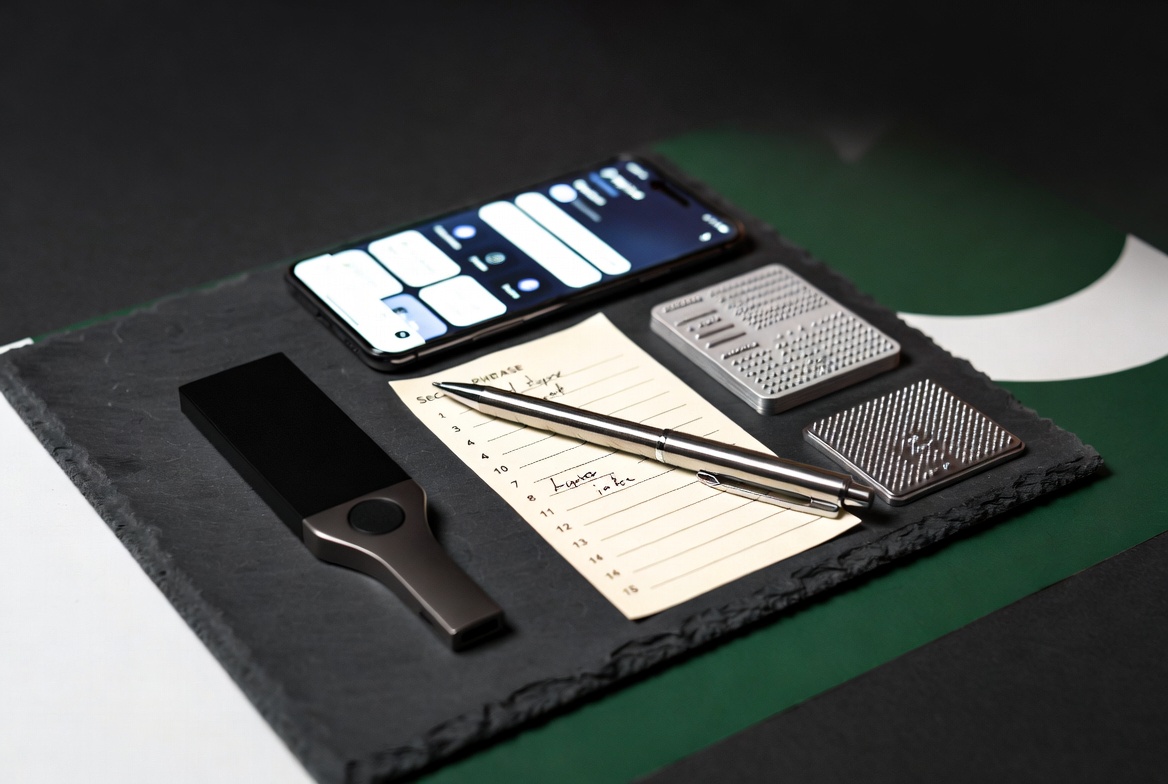
Executive Summary
Pakistan has 15–20 million cryptocurrency users, yet the vast majority store their assets on exchanges — the single most dangerous place to keep crypto. A Binance or exchange account is not a wallet. Crypto scammers stole $17 billion globally in 2025, and Pakistani users are disproportionately targeted due to low security awareness and rapid market growth. This guide covers every type of crypto wallet available, how each one works, which is right for your situation, how to protect your seed phrase, and how to recognize and avoid the scams that are draining Pakistani crypto holders right now.
Introduction
There is a phrase that every serious crypto user knows and every beginner ignores until it's too late: "Not your keys, not your coins."
It sounds like a slogan. It is actually a description of how crypto ownership works at the technical level — and understanding it is the single most important piece of financial education for any Pakistani holding cryptocurrency in 2026.
When your Bitcoin or USDT sits on Binance, you don't own it in any direct technical sense. Binance owns those coins. You own a balance in their database — an IOU. If Binance gets hacked, freezes Pakistani accounts due to regulatory pressure, goes offline, or experiences any operational failure, your funds are at risk. You have no recourse. You have no private key. You cannot move those assets without Binance's permission and infrastructure.
A crypto wallet changes that. A proper wallet gives you direct, irreversible control of your assets through private keys that only you hold. No company, no government, and no technical failure can touch funds held in a correctly configured self-custody wallet.
This guide explains every category of crypto wallet in plain terms, recommends specific options for Pakistani users at different experience levels, walks through exactly how to secure your seed phrase, and maps every active scam currently targeting Pakistani crypto holders — with practical steps to avoid each one.
Table of Contents
- What Is a Crypto Wallet? (And What It Actually Isn't)
- The Two Fundamental Wallet Types: Custodial vs. Non-Custodial
- Hot Wallets: Types, Pros, and Cons
- Cold Wallets: Hardware Wallet Explained
- Best Crypto Wallets for Pakistani Users in 2026
- The Seed Phrase: What It Is, Why It Is Everything
- How to Store Your Seed Phrase Safely in Pakistan
- The 10 Crypto Scams Targeting Pakistani Users Right Now
- How to Avoid Each Scam: Specific Countermeasures
- Hardware Wallet Buying Guide for Pakistan: Where to Buy Safely
- Setting Up Your First Non-Custodial Wallet: Step-by-Step
- Wallet Security Checklist: Do This Today
- Common Mistakes Pakistani Crypto Holders Make
- What to Do If You Think You've Been Scammed
- Conclusion
- FAQ
Key Takeaways
- A Binance or exchange account is NOT a crypto wallet — it is a custodial account where the exchange controls your private keys
- Hardware wallets (Ledger, Trezor) are the safest storage for any amount of crypto you plan to hold long-term
- Your seed phrase (12 or 24 words) is the master key to your entire wallet — losing it means permanently losing all funds
- Never store your seed phrase digitally — not in WhatsApp, not in photos, not in Google Drive, not in email
- Crypto scammers stole $17 billion globally in 2025; Pakistani users are specifically targeted by P2P scams, fake recovery services, and AI-powered impersonation
- Trust Wallet and MetaMask are the best free hot wallets for Pakistani beginners
- Never buy a hardware wallet from a marketplace like Daraz or a local shop — only from official manufacturer websites
Quick Answer: Which Crypto Wallet Should I Use in Pakistan?
| Situation | Recommended Wallet | Just starting, small amounts (under $200) | Trust Wallet (mobile, free) | Active DeFi/Web3 user | MetaMask (browser/mobile) | Holding $500+ long-term | Ledger Nano X or Trezor Safe 5 | Holding large amounts ($2,000+) | Ledger Stax or Trezor Safe 7 | Maximum security, advanced user | Air-gapped wallet (Keystone 3 Pro) | Keeping some on exchange for trading | Binance (custodial, for active trading only) |
|---|
Why This Matters: The Real Risk of Exchange Storage
Most Pakistani crypto users follow the same pattern: they buy Bitcoin or USDT on Binance, leave it in their Binance account, and consider it stored. This is the most common and most dangerous crypto habit in Pakistan.
Here is the specific risk landscape for Pakistani exchange users in 2026:
Regulatory freezes. Pakistan's regulatory environment for crypto remains in transition. PVARA (Pakistan Virtual Assets Regulatory Authority) is establishing its framework. There is a genuine risk that exchange accounts could face withdrawal restrictions during regulatory events. Funds held on exchanges are subject to platform-level decisions that users cannot override.
Exchange hacks. Even large exchanges experience security incidents. Users with exchange-held funds during a hack may receive partial or no compensation. The legal recourse for Pakistani users against foreign exchanges is effectively zero.
Account freezes. Exchanges freeze accounts for KYC issues, suspicious activity flags, or compliance reasons. Pakistani users have reported unexplained Binance account restrictions that locked access to funds for weeks.
The solution is simple. Move the crypto you don't intend to trade in the next few days into a wallet you control. This takes 15 minutes to set up and eliminates all of the above risks.
What Is a Crypto Wallet?
A crypto wallet does not store cryptocurrency. This is the most common misconception.
Cryptocurrency exists on the blockchain — a global, distributed ledger. Your Bitcoin is not "in" your wallet any more than a website is "in" your browser. The blockchain records that a certain address holds a certain amount. Your wallet stores the private key — a cryptographic credential that proves ownership of that address and authorizes transactions from it.
Lose your private key with no backup, and your crypto is inaccessible forever. Nobody can recover it. The blockchain doesn't care who you are — only who has the key.
This is why wallet security is not optional. It is the foundation of crypto ownership.
The Two Fundamental Wallet Types
Custodial Wallets
A custodial wallet is any system where a third party — typically an exchange — holds your private keys on your behalf. When you use Binance, your private keys are held by Binance. You access your balance through their interface, but you do not directly control the underlying assets.
Advantages: Easy to use, no seed phrase to manage, easy recovery if you forget your password, instant trading.
Disadvantages: You don't actually own your crypto. The platform controls access. Hacks, regulatory actions, or platform failures directly threaten your funds.
In Pakistan: Binance with PVARA NOC is the most used custodial platform. Suitable only for funds you are actively trading in the short term.
Non-Custodial Wallets
A non-custodial (or self-custody) wallet gives you direct control of your private keys. You — and only you — hold the credential that authorizes transactions. No company, bank, or government can freeze or seize your funds.
Advantages: True ownership. No third-party risk. Works regardless of what happens to any exchange or platform.
Disadvantages: You are fully responsible for your private key backup. Losing your seed phrase means permanent loss of funds with no recovery possible.
Recommendation for Pakistani users: Any amount you plan to hold for more than a few days should be in a non-custodial wallet.
Hot Wallets: Connected, Convenient, and Risky for Large Amounts
A hot wallet is any non-custodial wallet that maintains an internet connection. They are software applications — installed on your phone or browser — that store your private keys on an internet-connected device.
Hot wallets are excellent for small amounts of crypto you interact with regularly. They are not appropriate for storing large holdings.
Trust Wallet
The most widely used mobile hot wallet globally. Owned by Binance but fully non-custodial — Binance does not have access to your private keys.
Best for: Pakistani beginners moving off exchanges for the first time. Supports BTC, ETH, BNB, USDT, and 10 million+ other assets. Available on Android and iOS.
Setup: Download from Google Play Store or Apple App Store. Never from any other source. Create a new wallet. Write down your 12-word seed phrase on paper immediately. Store it securely offline.
MetaMask
The dominant Web3 and DeFi wallet. Essential for anyone interacting with Ethereum-based decentralized applications, DeFi protocols, or NFTs.
Best for: Pakistani users who want to use DeFi platforms, swap tokens, or interact with Web3 applications. Available as a browser extension (Chrome, Firefox, Edge) and mobile app.
Important: MetaMask is Ethereum-focused. It does not natively support Bitcoin. For a multi-chain mobile wallet, Trust Wallet is more practical for Pakistani beginners.
Comparison: Trust Wallet vs MetaMask
| Feature | Trust Wallet | MetaMask | Bitcoin support | Yes | No (native) | Mobile app | Yes | Yes | Browser extension | No | Yes | DeFi/DApp support | Good | Excellent | Beginner-friendly | Very | Moderate | Multi-chain | Yes | Primarily EVM | Best use case | Holding + basic DeFi | Advanced DeFi/Web3 |
|---|
Cold Wallets: Hardware Wallets Explained
A hardware wallet (also called a cold wallet or cold storage) is a physical device — roughly the size of a USB drive — that stores your private keys offline. The keys never leave the device and never touch an internet-connected system.
To authorize a transaction, you physically connect the device, verify the transaction details on its screen, and approve it by pressing a button. Even if your computer is infected with malware, the malware cannot access your keys — they live in an isolated, hardware-secured chip.
This is why security experts consistently recommend hardware wallets for any significant crypto holding.
How Hardware Wallets Work
- Your private keys are generated and stored inside the device's secure chip
- When you want to send crypto, the transaction is sent to the device for signing
- You verify the recipient address and amount on the device screen (not your computer screen)
- You physically approve the transaction on the device
- The signed transaction is broadcast to the blockchain
- Your private keys never leave the hardware device
Best Hardware Wallets for Pakistani Users 2026
Ledger Nano X — Best Overall
Price: Approximately $149 USD (PKR 41,000–43,000 at current rates)
The most widely used hardware wallet globally. Stores private keys in a CC EAL5+ certified secure element chip. Supports over 5,500 cryptocurrencies and connects via Bluetooth or USB-C to the Ledger Live app on mobile or desktop.
Best for: Pakistani crypto holders with $500 or more in assets who want a balance of security, usability, and broad asset support.
Trezor Safe 5 — Best for Open-Source Transparency
Price: Approximately $169 USD (PKR 46,000–49,000)
Trezor is fully open-source — every line of firmware code is publicly auditable. The Safe 5 features a color touchscreen and robust support for major cryptocurrencies.
Best for: Security-conscious Pakistani users who prefer open-source hardware and software.
Ledger Nano S Plus — Best Budget Hardware Option
Price: Approximately $79 USD (PKR 22,000–24,000)
The entry-level Ledger. No Bluetooth, USB-C only, smaller screen, but the same secure element chip as the Nano X.
Best for: Pakistani users who want hardware wallet security without the full Nano X price.
Hardware vs. Hot Wallet: When to Use Which
| Amount | Holding Period | Recommended Storage | Under $100 | Any | Hot wallet (Trust Wallet) | $100–$500 | Under 1 week | Hot wallet acceptable | $100–$500 | Over 1 week | Consider hardware wallet | $500–$2,000 | Any | Hardware wallet strongly recommended | Over $2,000 | Any | Hardware wallet essential |
|---|
The Seed Phrase: The Most Important 12–24 Words You Will Ever Write
Your seed phrase (also called recovery phrase, backup phrase, or mnemonic) is a sequence of 12 or 24 words generated when you create a non-custodial wallet. It is not a password. It is the mathematical root from which all your wallet's private keys are derived.
This means:
- Anyone who has your seed phrase has full access to every coin in your wallet — instantly, from anywhere in the world
- If you lose your seed phrase and lose access to your wallet, your funds are permanently gone. No company, no support team, no government agency can recover them
- It doesn't matter how much crypto you have — the seed phrase is all that matters
The BIP39 Standard
All major modern wallets use the BIP39 standard. Your 12-word phrase provides 128 bits of security; your 24-word phrase provides 256 bits. Both use the same standardized wordlist of 2,048 words. This means a 24-word seed from Trust Wallet can recover your funds in MetaMask, Ledger Live, or any other BIP39-compatible wallet — the words themselves are the key, not any specific application.
How to Store Your Seed Phrase Safely in Pakistan
This is where most Pakistani crypto users fail. They write the seed phrase on a piece of paper, photograph it on their phone, and save the photo to WhatsApp or Google Photos. This is approximately as secure as posting the keys to your house on Facebook.
The Right Way: Physical, Offline, Multiple Copies
Step 1: Write the seed phrase by hand on paper. Use a pen, not a pencil. Write clearly. Number each word.
Step 2: Verify the backup. Close your wallet app, then use the seed phrase to restore your wallet from scratch on a different device or by selecting "restore wallet" on the same device. Confirm your funds are accessible before trusting the backup.
Step 3: Store the paper in a secure physical location — not in your wallet, not in your phone case, not in a desk drawer. Options: a home safe, a locked filing cabinet, a trusted family member's home.
Step 4: Consider a second copy stored in a different physical location. If a fire, flood, or theft destroys one copy, you still have access.
Advanced: Metal Backup
Paper is vulnerable to fire, water, and physical wear. Metal seed phrase storage devices (available internationally, approximately $30–80 USD) allow you to stamp or engrave your seed words into stainless steel. These survive house fires, floods, and decades of storage.
What Never to Do
- Never photograph your seed phrase
- Never type it into any website, form, or chat — including "official support" chats
- Never save it in your notes app, WhatsApp, Telegram, email drafts, or cloud storage
- Never share it with any person for any reason
- Never store the seed phrase in the same location as the hardware device
The 10 Crypto Scams Targeting Pakistani Users Right Now
Crypto scammers stole $17 billion from users worldwide in 2025, according to Chainalysis's 2026 Crypto Crime Report. Pakistani users are disproportionately targeted. Here are the specific attack vectors active in Pakistan right now.
Scam 1: Fake Recovery Services
How it works: A Pakistani crypto user loses wallet access or gets scammed. They search online for "crypto wallet recovery Pakistan." They find a website or WhatsApp number offering wallet recovery services. The "recovery service" asks for their seed phrase to "access" the wallet for recovery. They hand over the seed phrase. Everything is immediately drained.
The reality: No legitimate service can recover crypto without your seed phrase. Any service that asks for your seed phrase is stealing it. There is no such thing as external wallet recovery.
Protection: Never contact any recovery service. Never share your seed phrase with anyone for any reason.
Scam 2: Fake Seed Phrase / "Free Money" Trap
How it works: A scammer posts a seed phrase online in a forum, YouTube comment, or WhatsApp group — pretending they found money and can't figure out how to withdraw it. Curious users import the wallet. To move the funds, they send a bit of TRX or ETH for gas fees. The attacker, who already controls the wallet, instantly steals everything.
Protection: Never import any seed phrase you didn't personally generate. Anyone sharing a seed phrase is running a trap.
Scam 3: Pre-Loaded Hardware Wallet Scam
How it works: A Pakistani user buys a hardware wallet from a local shop, Daraz listing, or WhatsApp reseller. The device arrives with a pre-printed seed phrase card in the box. If your hardware wallet includes a pre-filled seed phrase, stop immediately. Legitimate devices generate a new seed phrase directly on the device screen during setup.
Protection: Only buy hardware wallets directly from official manufacturer websites (ledger.com, trezor.io). Never from any marketplace, reseller, or physical shop.
Scam 4: Google / Search Ad Phishing
How it works: Scammers bid on Google/Bing keywords for "MetaMask," "Coinbase," or "Ledger Live." You click the top ad, land on a pixel-perfect clone of the real site, enter your seed phrase, and your wallet is emptied.
Protection: Bookmark official wallet sites. Never click search ads. Official sites: metamask.io, trustwallet.com, ledger.com, trezor.io.
Scam 5: WhatsApp / Telegram Crypto Group Scams
How it works: Pakistani users are added to WhatsApp or Telegram groups promising "crypto signals," "guaranteed profits," or "investment schemes." Admin accounts build trust over days, then direct members to fake investment platforms or ask for seed phrases.
Protection: No legitimate investment operates through WhatsApp or Telegram groups. There are no guaranteed crypto profits.
Scam 6: P2P Trading Scams on Binance
How it works: On Binance P2P, a buyer sends a payment screenshot rather than actual payment, then pressures the seller to release crypto before bank confirmation.
Protection: Never release crypto until the payment has fully cleared and appeared in your bank account. Enable Binance's two-step P2P verification.
Scam 7: Fake Customer Support Impersonation
How it works: A Pakistani user posts a complaint about Binance, Trust Wallet, or MetaMask online. Fake "support" accounts respond with a WhatsApp number. The "support agent" requests the seed phrase or remote device access.
Protection: Legitimate wallet providers do not contact users through social media comments or WhatsApp. Your seed phrase is never needed by actual wallet support.
Scam 8: Clipboard Hijacking Malware
How it works: Malware silently watches your clipboard. When you copy a crypto wallet address, the malware swaps it with the scammer's address. You paste and send funds directly to the scammer.
Protection: Always verify the full wallet address on-screen after pasting before confirming any transaction. Remove suspicious browser extensions.
Scam 9: AI-Powered Impersonation Scams
How it works: In 2026, AI voice cloning and deepfake video enable scammers to impersonate known Pakistani crypto influencers or even friends and family to request crypto transfers or seed phrases.
Protection: Treat any unsolicited contact requesting crypto funds or wallet information as a scam regardless of how convincing it appears.
Scam 10: Rug Pull Projects and Fake ICOs
How it works: Pakistani crypto communities are regularly targeted by fake "Pakistani crypto projects," fake DeFi platforms promising high yields, and token presales that disappear after collecting funds.
Protection: Never invest in unaudited DeFi protocols. Verify smart contract audits from reputable security firms.
Hardware Wallet Buying Guide for Pakistan: Where to Buy Safely
Pakistani users face a specific challenge: official Ledger and Trezor stores do not ship directly to Pakistan in all cases, and local resellers carry genuine tamper and counterfeit risk.
The Safest Purchasing Path
Option 1 — Direct from manufacturer website: Visit ledger.com or trezor.io directly. International shipping to Pakistan is available, though customs and shipping costs add approximately $20–30. This is the safest method.
Option 2 — Through a trusted overseas contact: Have a trusted family member or friend in the UK, UAE, or USA purchase from the official store and bring it to Pakistan.
Option 3 — Verified international retailers: Amazon UK, Amazon US, or B&H Photo sell authentic units. Only purchase if the seller is "Fulfilled by Amazon" or the official brand store.
What to Absolutely Avoid
- Daraz listings for hardware wallets
- WhatsApp/Telegram resellers
- Local computer shops claiming to stock Ledger or Trezor
- Any device that comes with a pre-written seed phrase
Setting Up Your First Non-Custodial Wallet: Step-by-Step
This walkthrough uses Trust Wallet, the recommended starting point for Pakistani beginners.
Step 1: Download the Official App
Open Google Play Store or Apple App Store. Search "Trust Wallet." The official app is published by "Trust Wallet." Install it. Do not download from any other source.
Step 2: Create a New Wallet
Open Trust Wallet. Select "Create a New Wallet." Read the security warnings — they matter.
Step 3: Write Down Your Seed Phrase
Trust Wallet will display 12 words. Get a pen and paper before this screen. Write every word down in exact order, numbered 1–12. Do not screenshot. Do not type them anywhere.
Step 4: Verify Your Backup
Trust Wallet will ask you to verify the seed phrase by selecting words in order. This is a test — not a formality. If you fail it, your backup is wrong and you need to start again.
Step 5: Set a Strong PIN
Create a strong PIN for app access. This protects against someone with physical access to your phone.
Step 6: Move Your First Small Amount
Before moving any significant funds, move a small test amount (the equivalent of PKR 500–1,000). Verify it arrives correctly.
Wallet Security Checklist: Do This Today
- [ ] Your exchange balance: only what you plan to trade this week
- [ ] Seed phrase written on paper — not photographed, not typed, not in any app
- [ ] Seed phrase stored in a secure physical location away from your device
- [ ] A test recovery performed — you verified you can restore access from the seed phrase
- [ ] Hardware wallet purchased (if holding more than $500)
- [ ] Hardware wallet purchased directly from official manufacturer only
- [ ] All exchange accounts have 2FA enabled (authenticator app, not SMS)
- [ ] No suspicious browser extensions installed
- [ ] Official wallet apps downloaded from official stores only
- [ ] Nobody — family, friend, or support agent — has ever seen your seed phrase
Common Mistakes Pakistani Crypto Holders Make
- Leaving large amounts on Binance indefinitely
- Storing the seed phrase and hardware device together
- Using the same email and password for crypto exchanges as other accounts
- Buying hardware wallets from unofficial sources
- Installing wallet apps from links in WhatsApp messages
- Trusting urgency — scams create artificial urgency
What to Do If You Think You've Been Scammed
Act immediately. Speed matters.
If you shared your seed phrase:
- Create a completely new wallet on a different device immediately
- Transfer all remaining funds from the compromised wallet to the new wallet as fast as possible
- Abandon the compromised wallet address permanently
If you sent crypto to a scammer:
- Report the recipient address to the platform where you hold crypto
- Report to PVARA (Pakistan Virtual Assets Regulatory Authority) — pvara.gov.pk
- File a complaint with FIA Cybercrime Wing — fia.gov.pk/cybercrime
- Report the wallet address on Chainabuse (chainabuse.com)
- Accept the reality: blockchain transactions are irreversible
Conclusion
Pakistan's crypto community is growing fast. The security knowledge is not keeping up. The gap between those two curves is where the scammers operate.
The protection available to Pakistani crypto holders is entirely within reach. A Trust Wallet account takes 10 minutes to set up. A Ledger Nano X costs less than Rs 40,000 — a fraction of the crypto it can protect. A seed phrase written on paper and stored in a safe place costs nothing.
What it requires is understanding: the seed phrase is everything, exchange accounts are not ownership, and no legitimate service will ever ask for your recovery words.
Start with one step. If your crypto is sitting on Binance right now, download Trust Wallet today and move a portion off the exchange. That single action meaningfully reduces your risk.
FAQ
Q1: What is the safest way to store cryptocurrency in Pakistan?
The safest method is a hardware wallet (cold storage) such as Ledger Nano X or Trezor Safe 5. For amounts under $200, a non-custodial hot wallet like Trust Wallet is a significant improvement over exchange storage.
Q2: Is keeping crypto on Binance safe in Pakistan?
Binance now holds a PVARA NOC in Pakistan, which provides some regulatory standing. However, any exchange is a custodial service. For active trading, exchange use is acceptable. For long-term holding, moving to a self-custody wallet is strongly recommended.
Q3: What is a seed phrase and why is it important?
A seed phrase is a sequence of 12 or 24 words generated when you create a non-custodial wallet. It is the master key to your entire wallet. Anyone who has your seed phrase has complete control of your wallet and all assets in it.
Q4: Which crypto wallet is best for Pakistani beginners?
Trust Wallet is the recommended starting point for Pakistani beginners. It is free, non-custodial, supports Bitcoin, USDT, ETH, BNB, and millions of other assets, and works on Android and iOS.
Q5: Can I buy a Ledger wallet in Pakistan?
Ledger ships internationally to Pakistan through its official website (ledger.com). The safest options are ordering directly from ledger.com or having a trusted contact abroad purchase from the official store. Never purchase from Daraz, WhatsApp resellers, or local shops.
Q6: What happens if I lose my hardware wallet?
Losing the physical hardware device does not mean losing your crypto. Your funds are on the blockchain, secured by your private keys. Use your seed phrase to restore your wallet on a new hardware device or compatible software wallet.
Q7: Is MetaMask safe to use in Pakistan?
MetaMask is a legitimate, widely-used non-custodial wallet. Safety depends on behavior: only installing from metamask.io, never entering your seed phrase anywhere, and carefully reviewing every transaction before approval.
Q8: What are the most common crypto scams in Pakistan in 2026?
The most prevalent scams are: fake recovery services, pre-loaded hardware wallets from unofficial sellers, P2P trading fraud, WhatsApp investment groups, fake customer support, Google ad phishing sites, and clipboard hijacking malware.
Q9: Can the FIA or PVARA help recover stolen crypto?
Reporting to FIA Cybercrime Wing and PVARA is the correct course of action, but actual recovery of stolen funds is rare. Blockchain transactions are technically irreversible. The priority after theft is protecting remaining assets.
Q10: What is the difference between a hot wallet and a cold wallet?
A hot wallet is connected to the internet — mobile apps like Trust Wallet are hot wallets. A cold wallet (hardware wallet) stores private keys on a physical device that is never connected to the internet during normal operation. Cold wallets are significantly harder to hack remotely.
Final Reader Takeaway
Pakistan has millions of crypto users and a rapidly growing market. The security infrastructure — the knowledge, habits, and tools — hasn't kept pace with that growth. Most Pakistani crypto losses are not from sophisticated hacking. They are from predictable, preventable failures: seed phrases stored in WhatsApp, hardware wallets bought from unofficial sources, recovery service scams.
The defense isn't complicated. It's consistent. Understand what a seed phrase is. Store it on paper, offline, in a secure place. Move significant holdings off exchanges into self-custody. Buy hardware wallets from official sources only. Trust no one who asks for your recovery words.
That combination protects against the overwhelming majority of attacks active in Pakistan's crypto environment right now.
Published on PakistanBlogs.online | Category: Cryptocurrency